Every creator brand hits the same fork in the road: keep packing orders yourself (or with a small in-house team), or hand fulfilment to a third-party logistics (3PL) partner. Search "3pl fulfilment" and you'll find plenty of definitions, but not much that actually helps you decide which model suits your brand at your current stage.
This article isn't a listicle of pros and cons. It's a working decision framework — covering the four variables that actually change the answer (cost structure, control, SKU complexity, and returns) and a scale condition tree you can use to self-assess where you sit right now. If you're still getting oriented on the basics, our [practical guide to what 3PL fulfilment covers] walks through the mechanics in more depth before you dive into the comparison below. This piece builds on the broader framework in Ecommerce Fulfilment in Australia for Creator Brands, so it's worth reading alongside that hub if you haven't already.
Cost Structure: Fixed vs Variable, and Where Pass-Through Costs Hide
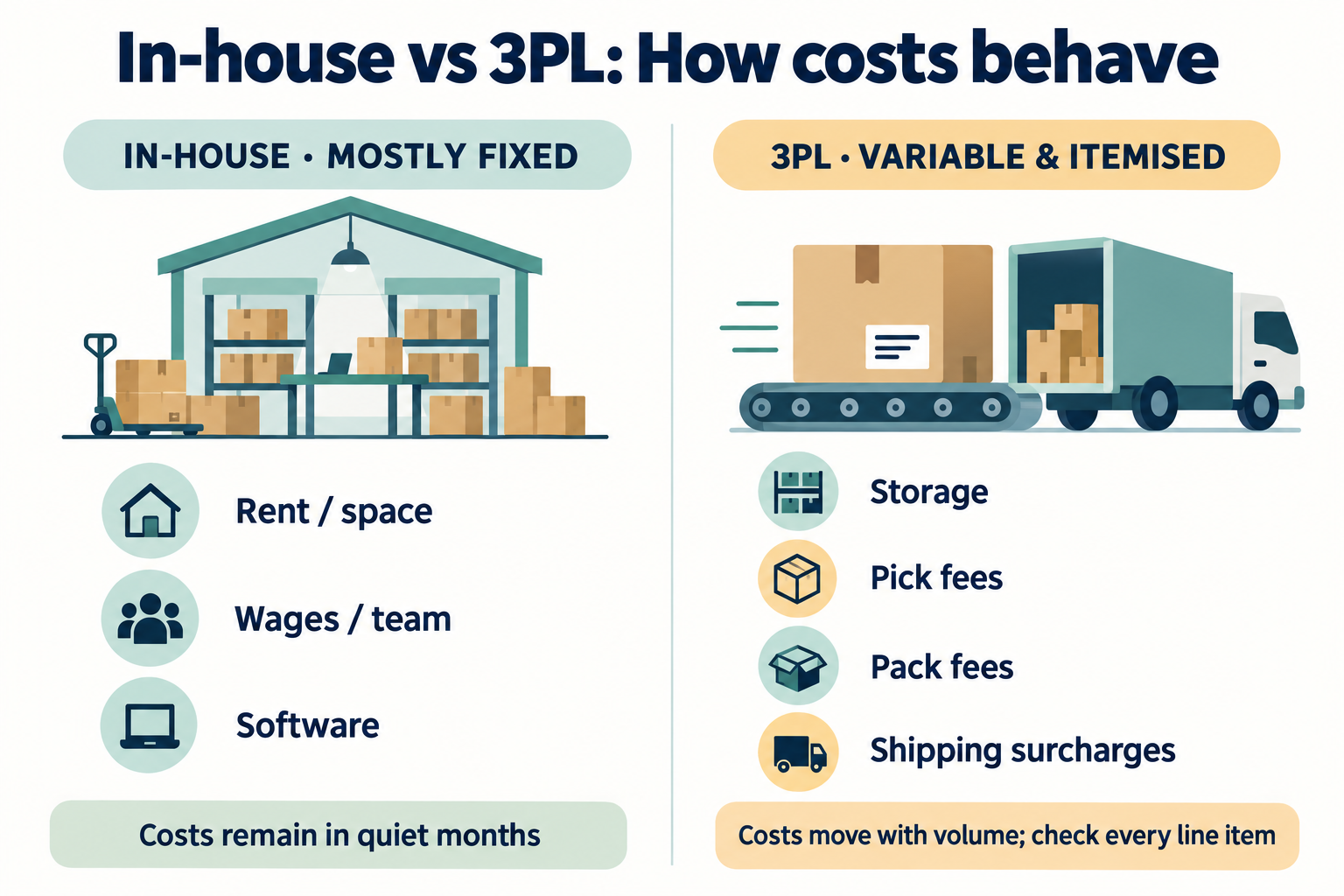
The single biggest structural difference between in-house and 3PL fulfilment is how the cost behaves as volume changes.
In-house fulfilment carries largely fixed costs: rent (or a share of it), packing stations, software licences, insurance, and — critically — people. A part-time or full-time team member who packs 50 orders a week costs roughly the same as one packing 200, up to the point where you need to hire again. That means in-house fulfilment can look cheap per order at low volume and expensive per order in the troughs between sales spikes, because the fixed costs don't flex down.
3PL fulfilment is built around variable, pass-through pricing: you typically pay per unit stored, per order picked and packed, and per shipment, plus pass-through carrier costs. This scales more naturally with revenue — quiet months cost less, busy months cost more — but it also means the line items multiply. Storage fees, pick fees, pack fees, kitting fees, and carrier surcharges (fuel, remote area, oversize) all show up separately, and they compound in ways that are easy to underestimate if you're only comparing headline "per order" rates between providers.
The practical takeaway: don't compare a single number ("$X per order in-house" vs "$Y per order with a 3PL"). Compare the shape of the cost curve at your actual volume, including the pass-through items that only appear on the invoice, not the sales page. This is exactly the kind of modelling worth doing before you commit to either model — it's one of the things we walk through on a feasibility call, since the right answer depends on your specific order profile, not a generic average.
Control and Operational Visibility
In-house fulfilment gives you direct line of sight: you (or your team) can see exactly how an order was packed, catch a mis-pick before it ships, and change a process the same day you notice a problem. That visibility is valuable when your product is fragile, highly branded (custom inserts, specific tape, exact box orientation), or still evolving — early-stage brands often iterate on packaging and unboxing experience in ways that are hard to hand off.
3PL fulfilment trades some of that direct visibility for operational leverage: someone else is managing the physical labour, but you're now working through their systems, their reporting cadence, and their process for handling exceptions. Good 3PL relationships are managed through data — inventory feeds, order status reporting, exception alerts — rather than by physically watching the pack bench. That's not worse, but it is different, and it requires a different kind of oversight from you: process audits and reporting reviews instead of walking the floor.
The honest tradeoff is this: in-house buys you granular control at the cost of your own time and attention; a 3PL buys you back time and attention at the cost of a layer of operational distance. Neither is inherently right — it depends on whether your bottleneck right now is time or precision.
SKU Complexity
SKU count and complexity change the calculus more than most founders expect.
Low SKU count, simple products (a handful of variants, no bundling, no expiry or fragility concerns): in-house fulfilment stays manageable longer, because the picking logic is simple enough for one or two people to hold in their heads.
Growing SKU count, bundles, or kitting (build-a-box, seasonal variants, multi-item sets): this is where manual, in-house picking starts to produce errors — wrong variant, missed component in a kit, mismatched inserts. 3PLs generally run this through barcode-scanning systems that catch these errors before a parcel ships.
Perishable, fragile, or regulated SKUs: these need specific handling procedures (batch tracking, temperature awareness, careful packing materials) that are harder to keep consistent in-house as headcount changes, but need to be explicitly confirmed as a 3PL's capability rather than assumed.
The general pattern: SKU complexity is a forcing function. A brand can outgrow in-house fulfilment on SKU complexity well before it outgrows it on order volume.
Returns Handling Responsibility
Returns are the most commonly underestimated factor in this decision, because founders tend to plan fulfilment around the outbound flow and treat returns as an afterthought.
In-house, returns responsibility is entirely yours: receiving the parcel, inspecting condition, deciding restock vs write-off, processing the refund or exchange, and restocking correctly. This is labour-intensive but gives you full quality control over what goes back into sellable inventory — useful if your margins are tight or product condition standards are strict.
With a 3PL, returns handling is a negotiated part of the contract, not an automatic inclusion — some providers process returns to a defined standard operating procedure (inspect, restock, or dispose per your rules), others charge separately per returned unit, and some require you to specify condition-grading rules explicitly or risk inconsistent restocking. The responsibility doesn't disappear, it relocates — and the brands who get burned here are usually the ones who didn't clarify returns SOPs before signing, not after.
Either way, returns policy design (who decides restock vs disposal, how fast refunds process, what "acceptable condition" means) needs to happen before volume, not after — it's far harder to retrofit once returns are already flowing.
The Scale Condition Tree: Which Model Fits Your Stage Right Now
Use this as a self-assessment, not a rulebook. Start at the top and follow the branch that matches your brand.
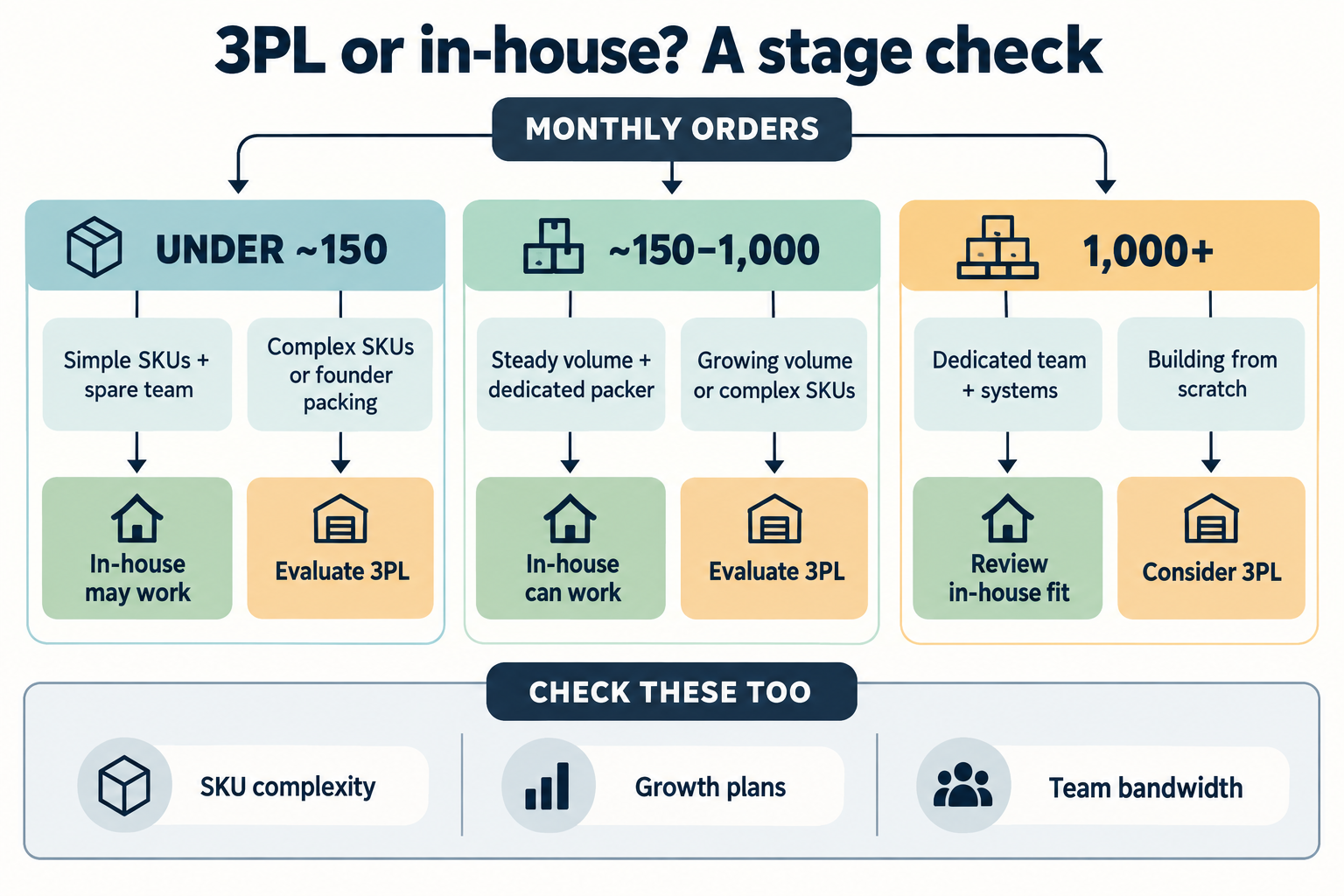
1. What's your current monthly order volume?
Under ~150 orders/month
SKU count under ~20, no bundling/kitting, team has spare capacity → In-house is usually still workable. Revisit this tree again once volume or SKU count increases.
SKU count high, bundles/kits involved, or the founder is the one packing orders → Worth evaluating 3PL now, even at low volume — the constraint here is complexity and founder time, not volume.
~150–1,000 orders/month
Growth trajectory is flat or seasonal-only → In-house can still work if you have a dedicated (not founder-shared) packing resource and simple SKUs. Reassess before any planned growth push.
Growth trajectory is actively increasing month over month → This is the range where most creator brands transition to 3PL, because hiring and space needs escalate faster than revenue does at this stage.
SKU complexity is rising (new variants, kitting, fragile/perishable items) → Lean 3PL regardless of the growth answer above — complexity compounds faster than volume in this band.
1,000+ orders/month
You already have a dedicated ops team, warehouse space, and systems built for this volume → In-house can remain viable, but should be reviewed against opportunity cost: is ops management the best use of your team's time?
You don't have dedicated infrastructure yet → 3PL is almost always the more defensible choice at this volume; building in-house capability from scratch at this stage carries significant execution risk.
2. Regardless of volume — check team bandwidth. If the people currently doing fulfilment are also doing marketing, product development, or customer service, that's a signal on its own: the true cost of in-house fulfilment isn't just wages, it's what isn't getting done elsewhere in the business.
3. Regardless of volume — check growth stage. If you're about to run a launch, a wholesale push, or paid acquisition at scale, model your fulfilment capacity before the spike, not during it. Order volume during a launch can outpace an in-house team's capacity long before your average monthly volume "justifies" a 3PL on paper.
None of these branches produce a universally "right" answer — they produce a reasonable default for your current stage, which is the most a framework like this can honestly offer without seeing your actual numbers.
Where This Leaves You
If you've read through the framework above and you're still not sure which branch you're on — or your numbers straddle two branches — that's normal, and it's usually a sign the decision is close enough to be worth a second set of eyes. You can see current service tiers on our pricing page, but the more useful next step for a genuinely close call is to compare your operating model directly: talk to us about where your brand sits on this decision tree, and we'll work through your actual order volume, SKU mix, and growth plans rather than a generic average.
Compare your operating model — it's a 20-minute conversation, not a sales pitch, and it's the fastest way to turn this framework into a decision specific to your business.
FAQ
Does switching to a 3PL mean giving up control of the customer experience?
Not entirely — packaging, inserts, and branding can usually still be specified in a 3PL contract, but day-to-day pack quality is monitored through reporting and audits rather than direct observation, which is a real shift in how you maintain quality, not a loss of ability to set standards.
Can a brand move from 3PL back to in-house later?
Yes, this happens in both directions as SKU count, order volume, and team bandwidth change over time — the scale condition tree above is worth revisiting periodically rather than treated as a one-time decision.
Is there a "middle ground" between fully in-house and a full 3PL?
Some brands run a hybrid model — for example, handling made-to-order or highly custom SKUs in-house while sending high-volume, standard SKUs to a 3PL. Whether that's worth the added coordination complexity depends on the specific SKU split, which is a good question to work through on a feasibility call.