
If you sell products online and you've started researching how to get orders out the door faster, you've probably run into the term "3PL" more than once. It shows up in ads, in founder forums, in supplier onboarding calls — usually without anyone stopping to explain what it actually means or where its responsibilities start and stop.
This guide answers that plainly. It covers what a 3PL is, what it typically does and doesn't cover, and gives you a practical checklist to work out whether your brand is even at the stage where evaluating 3PL providers makes sense.
For the bigger picture on how this decision fits into scaling a creator or product brand in Australia — including where 3PL sits alongside other fulfilment models — see the companion guide, Ecommerce Fulfilment in Australia for Creator Brands.
What Does 3PL Actually Mean?
3PL stands for third-party logistics. A 3PL provider is an external company that handles the physical, operational side of getting orders from a warehouse to a customer's door — on behalf of a brand that doesn't want to (or can't yet) do that in-house.
The "third party" part matters. In a typical ecommerce relationship there are two obvious parties: the brand and the customer. A 3PL is the outside operator that sits between them, handling the logistics work so the brand doesn't have to lease a warehouse, hire a pick-and-pack team, or manage freight relationships directly.
It's a service category, not a single company type. 3PLs range from small regional operators running one facility to large national networks — and the term is used loosely enough in marketing that two providers calling themselves "3PL" can offer genuinely different scopes of service. That's exactly why understanding the boundaries below matters more than the label itself.
What a 3PL Provider Typically Covers
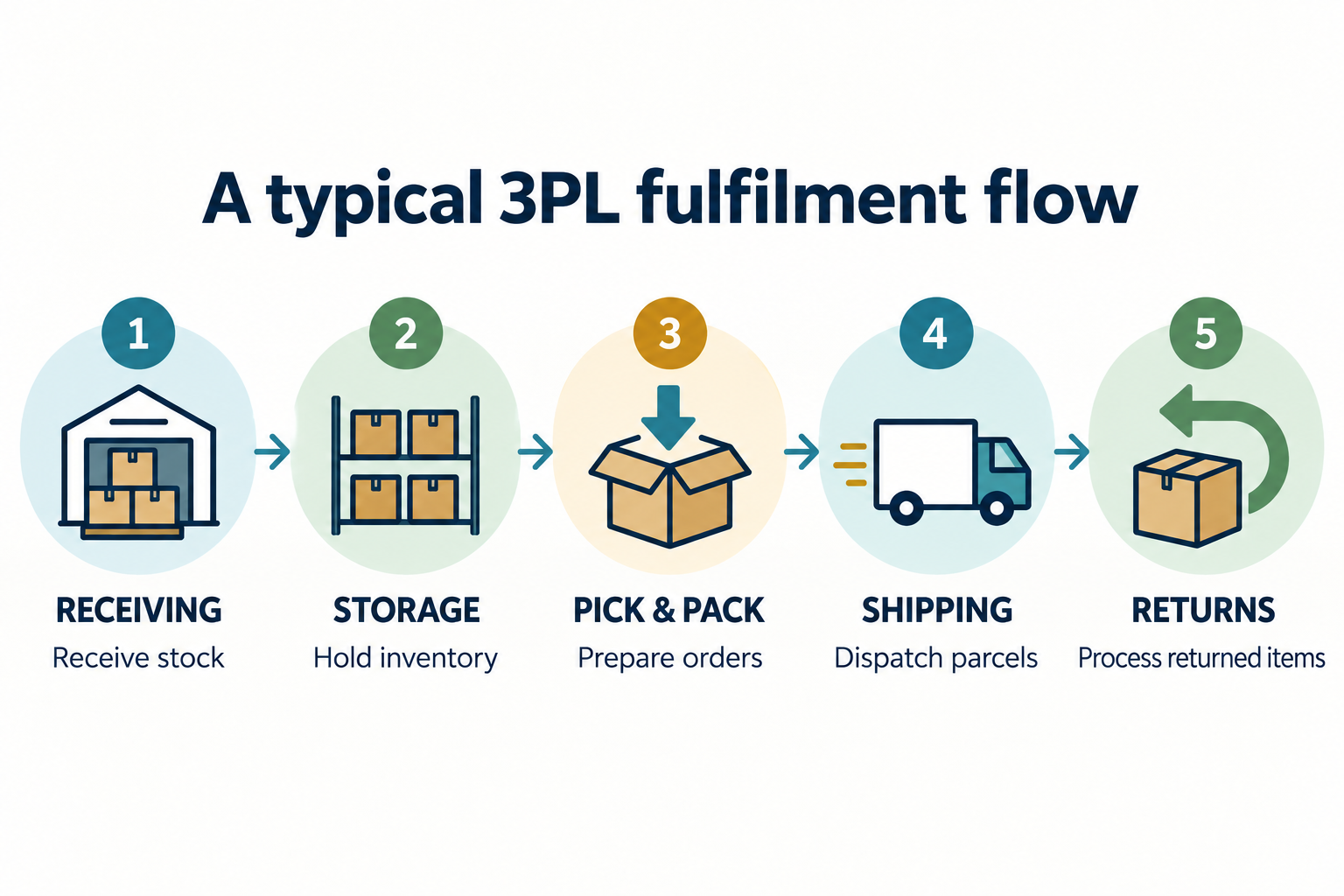
Most 3PL arrangements are built around five core functions. These are the services you should expect to see clearly defined in any 3PL's service agreement:
1. Receiving and inbound — The 3PL accepts inventory arriving from a brand's manufacturer or supplier, checks it against purchase orders, and logs it into their warehouse management system. This step is where discrepancies (wrong quantities, damaged stock) typically get caught and reported back to the brand.
2. Storage — Once received, stock sits in the 3PL's warehouse space until it's needed to fulfil an order. Storage is usually billed by space used (per pallet, per bin, or per cubic metre) and by time held — which is why slow-moving inventory tends to be one of the more overlooked cost drivers in a 3PL relationship.
3. Pick, pack and fulfilment — When an order comes in — usually synced automatically from the brand's online store — warehouse staff locate the item(s), pack them according to agreed specifications (branded packaging, inserts, gift notes, etc.), and prepare the parcel for dispatch.
4. Outbound shipping — The 3PL hands the packed order to a carrier (or manages carrier selection on the brand's behalf) and generates tracking information. Some 3PLs have negotiated bulk carrier rates, which can be a meaningful part of the value they offer.
5. Returns processing — When a customer sends an item back, the 3PL receives it, inspects its condition, and — depending on the agreement — restocks it, disposes of it, or holds it for the brand's instruction.
These five functions are the backbone of what "3PL fulfilment" means in practice. Anything a provider offers beyond this is worth treating as a value-add, not an assumption.
What a 3PL Typically Does NOT Cover
This is the part brands most often get wrong, usually because sales conversations blur the line. In most standard arrangements, a 3PL does not handle:
Manufacturing or production. A 3PL stores and ships finished goods — it doesn't make your product. That's a separate sourcing or manufacturing relationship entirely.
Sourcing or supplier selection. Finding, vetting, and negotiating with suppliers is a distinct discipline from warehousing and shipping, even though brands sometimes assume one provider does both.
Marketing, merchandising, or demand generation. A 3PL fulfils the orders your marketing generates; it isn't involved in generating them.
Customer service, in most cases. Some 3PLs offer basic returns-related support as an add-on, but front-line customer service — order status queries, refund decisions, product questions — usually stays with the brand or a separate support function.
Inventory planning and forecasting, as a default. Many 3PLs will report stock levels, but deciding how much to reorder and when is typically the brand's call unless a specific planning service has been agreed and paid for separately.
Assuming a 3PL will absorb any of the above without confirming it in writing is one of the most common sources of friction between brands and providers in the first few months of a contract.
Why the Boundary Matters More Than the Label
Because "3PL" is used so broadly across the industry, two providers can use the same term to describe fairly different scopes of service. One might bundle in basic reporting and light customer support; another might do strictly warehousing and shipping and nothing else. Neither is wrong — but a brand that doesn't clarify scope upfront can end up with unexpected gaps.
This is also where it's worth separating the service model (3PL) from the decision of whether it's the right model for your brand at all. Plenty of brands are better served running fulfilment in-house for longer than they expect, or using a hybrid approach for part of their catalogue. Once you understand the basics covered here, it's worth taking the next step and [comparing 3PL against running fulfilment in-house for creator brands](LINK: F-04 companion article) before committing to either path.
The Fit Checklist: Is Your Brand Ready to Evaluate 3PL Providers?
Before you start requesting quotes, it helps to know whether you're actually at the stage where 3PL conversations are productive. Work through the items below honestly — the goal isn't to score well on all of them, it's to know where you stand.
You've outgrown manual, founder-led packing. If order volume means fulfilment is now eating hours that should go to product or growth, that's a real signal — not just a feeling of being busy.
Your order volume is consistent enough to forecast, even roughly. Most 3PLs price around expected volume and storage needs. If your monthly order count swings wildly and unpredictably, you may not yet have the data a provider needs to quote accurately.
Your SKU count and packaging requirements are documented. Can you list every product variant, its dimensions, and any special packing instructions (fragile items, branded inserts, bundles)? A 3PL will ask for this before quoting, and vague answers usually mean vague quotes.
You know your current cost-per-order, even approximately. You don't need exact figures, but you should be able to estimate what it currently costs you (in time and dollars) to pack and ship one order in-house. Without this baseline, you can't tell whether a 3PL quote is actually an improvement.
You have a returns policy that's written down, not just understood. A 3PL needs clear rules for what to do with returned stock — restock, discard, or hold for review. If this only exists in your head, it will slow onboarding and cause errors early on.
Your inventory data is reasonably clean. If your stock counts in your store platform don't match reality, that mismatch will follow you into a 3PL relationship and cause fulfilment errors on day one.
You understand which integrations you'll need. Most 3PLs connect to ecommerce platforms (Shopify, WooCommerce, etc.) via an order management system or API. Knowing what your current tech stack requires avoids surprises during setup.
You're prepared for a minimum contract term or volume commitment. Many 3PLs require a baseline commitment to make the relationship viable for them. If your volume is still highly seasonal or unproven, factor this into your evaluation.
You can define what "good service" looks like for your brand. Fast dispatch might matter more to you than low storage cost, or vice versa. Going into evaluations without your own priorities ranked makes every provider's pitch sound equally appealing.
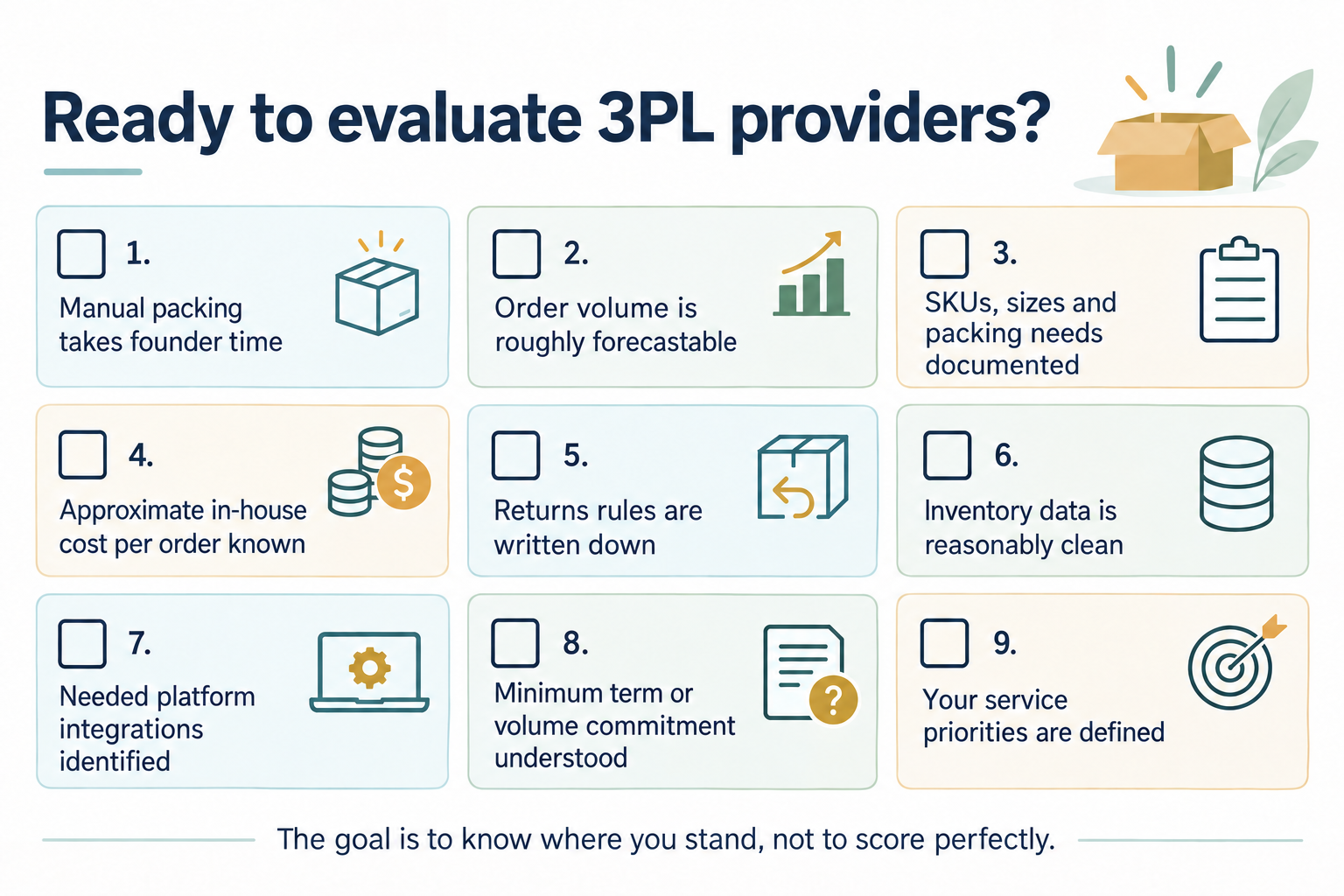
If you're confidently checking off most of these, you're in a good position to start requesting and comparing 3PL quotes. If several feel shaky, that's not a failure — it usually just means there's a bit more groundwork worth doing first, which is a normal and common stage for growing brands.
Making the Decision
Understanding what a 3PL is and does is only step one. The more important question for most brands is whether outsourcing to a 3PL is the right move right now, versus continuing in-house a while longer or exploring a hybrid setup. That comparison — cost structures, control trade-offs, and the operational thresholds where each model tends to make sense — is covered in [3PL vs In-House Fulfilment for Creator Brands](LINK: F-04 companion article), and it's worth reading before approaching any provider for a quote.
If you'd rather talk through where your brand currently sits before deciding, a feasibility call is a low-commitment way to get a second opinion based on your actual numbers rather than general guidance — you can see how these consultations are scoped on the pricing page.
FAQ
Is a 3PL the same thing as a warehouse?
Not quite. A warehouse is the physical space; a 3PL is the company that operates that space (or a network of them) and provides the services — receiving, storage, pick-pack, shipping, returns — built around it. A brand can rent warehouse space without a 3PL relationship, but a 3PL relationship always includes warehouse access as part of the service.
Does a 3PL handle international shipping?
Many do, but it varies significantly by provider and depends on their carrier relationships and customs experience. This is a specific question to raise during evaluation rather than something to assume is included by default.
Can a 3PL handle a small brand with low order volume?
Some 3PLs specialise in working with smaller or emerging brands, while others set minimum volume thresholds that make them a better fit later in a brand's growth. This is exactly why the fit checklist above is worth working through before approaching providers — it helps you target the right type of 3PL rather than the first one you find.