
Incoterms are the eleven standard three-letter trade terms, published by the International Chamber of Commerce (ICC), that say where a seller's job ends and the buyer's begins: who pays for each leg of the journey, who handles export and import clearance, and at what point the risk of loss or damage moves to the buyer. The current version is Incoterms 2020.
POV: your first supplier quote arrives and the price is followed by "FOB", "CIF" or "DDP". You nod like you know. Plot twist: those three letters decide which costs are inside the price and which ones will turn up later on your own invoices. Reading a quote based on vibes is how a "cheap" unit price ends up expensive.
This guide explains what Incoterms cover (and what they don't), shows all 11 rules on one chart, picks out the four you'll meet on a first order, and shows how to write a term on a quote so nobody can misread it.
This is what we do at My Selection: we help creators develop products and work with factories, including reading quotes and shipping terms. If you're about to place a first order, tell us what you're making.
In this guide:
- What Incoterms cover, and what they don't
- All 11 Incoterms on one chart
- The four you'll meet on a first order
- Common misunderstandings
- Vague vs usable quote wording
- How to choose
- FAQ
What Incoterms cover, and what they don't
Every Incoterms rule answers the same questions for one sale:
- Delivery: the place where the seller has done its job.
- Risk: the moment the risk of loss or damage passes from seller to buyer.
- Costs: who pays for loading, transport to the port, export clearance, main freight, insurance, import clearance and duties, and delivery.
- Documents: which paperwork each side provides.
The official text is the ICC's Incoterms 2020 rules. This guide is a plain-language summary to help you read quotes, not legal, customs or insurance advice.
Just as useful is what Incoterms don't cover. They don't set the price, the payment terms (deposit, balance, when you pay), when ownership of the goods passes to you, what happens if the goods are faulty, or what duty rate applies. Those belong in the sales contract, the purchase order and your country's customs rules. A quote that says "FOB" tells you who pays for what up to the ship. It doesn't tell you when you pay the balance.
All 11 Incoterms on one chart
Incoterms 2020 has eleven rules. Seven can be used for any mode of transport (truck, rail, air, sea, or a mix). Four are only for sea and inland waterway shipments.
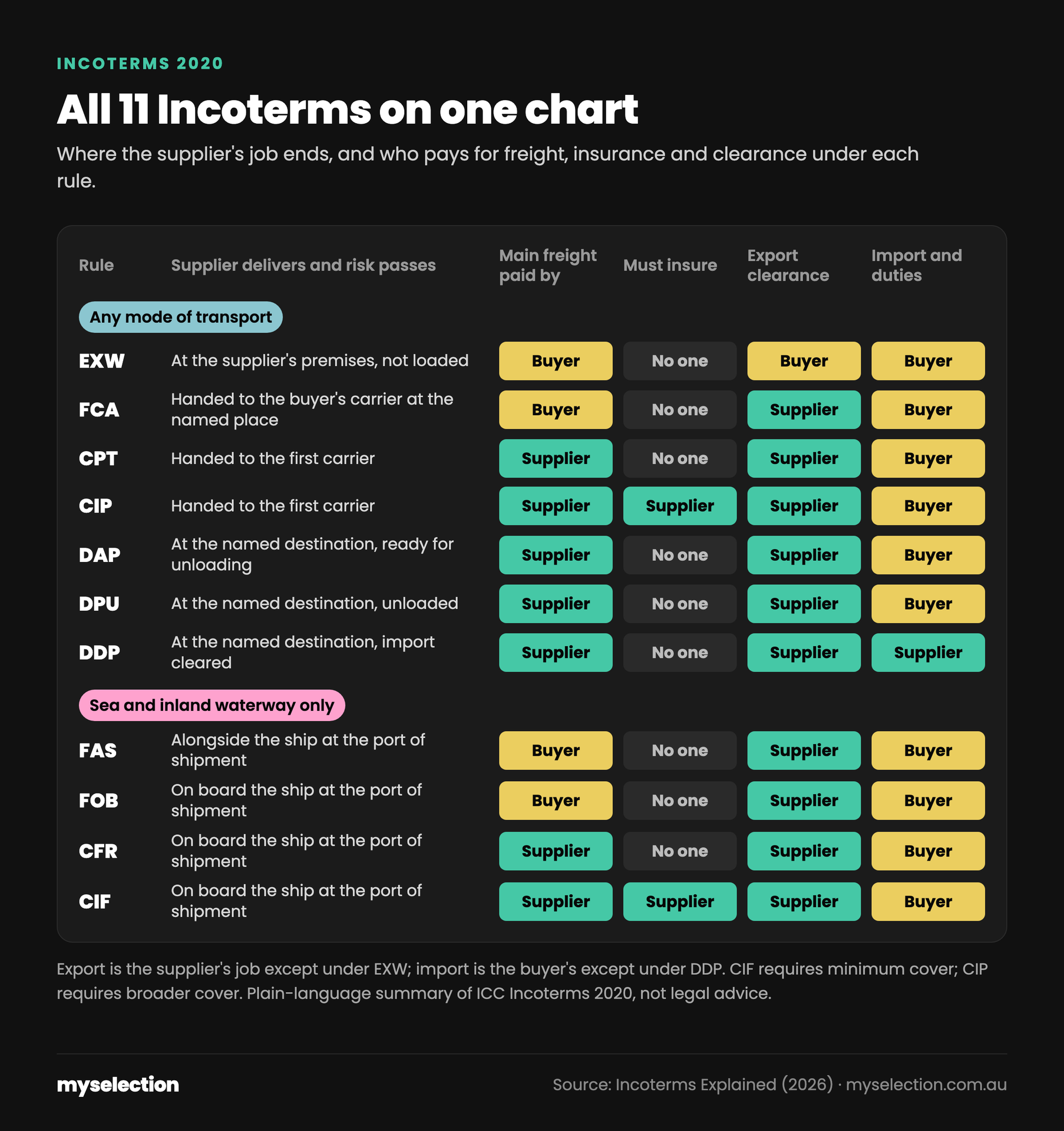
All 11 Incoterms 2020 rules on one page. Free to share with a link back to this guide.
| Rule | Supplier delivers, and risk passes, when the goods are… | Main freight paid by | Insurance must be bought by | Export clearance | Import clearance and duties |
|---|---|---|---|---|---|
| EXW Ex Works | Made available at the supplier's premises, not loaded | Buyer | No one | Buyer | Buyer |
| FCA Free Carrier | Handed to the buyer's carrier at the named place | Buyer | No one | Supplier | Buyer |
| CPT Carriage Paid To | Handed to the first carrier | Supplier, to the named destination | No one | Supplier | Buyer |
| CIP Carriage and Insurance Paid To | Handed to the first carrier | Supplier | Supplier | Supplier | Buyer |
| DAP Delivered at Place | At the named destination, ready for unloading | Supplier | No one | Supplier | Buyer |
| DPU Delivered at Place Unloaded | At the named destination, unloaded | Supplier | No one | Supplier | Buyer |
| DDP Delivered Duty Paid | At the named destination, cleared for import, ready for unloading | Supplier | No one | Supplier | Supplier |
| FAS Free Alongside Ship (sea) | Alongside the ship at the port of shipment | Buyer | No one | Supplier | Buyer |
| FOB Free on Board (sea) | On board the ship at the port of shipment | Buyer | No one | Supplier | Buyer |
| CFR Cost and Freight (sea) | On board the ship at the port of shipment | Supplier, to the destination port | No one | Supplier | Buyer |
| CIF Cost, Insurance and Freight (sea) | On board the ship at the port of shipment | Supplier | Supplier | Supplier | Buyer |
Two patterns make the chart easier to remember:
- Export clearance is the supplier's job under every rule except EXW. Import clearance is the buyer's job under every rule except DDP.
- Only CIF and CIP oblige anyone to buy insurance. Under CIF the default is minimum cover (Institute Cargo Clauses (C)); under CIP, Incoterms 2020 raised it to the broader Institute Cargo Clauses (A) or similar, according to the ICC. Under every other rule, no one has to insure; whoever carries the risk on a leg usually decides whether to cover it.
The four Incoterms you'll meet on a first order
Most first quotes use one of four families. Here's what each one leaves for you to sort out.
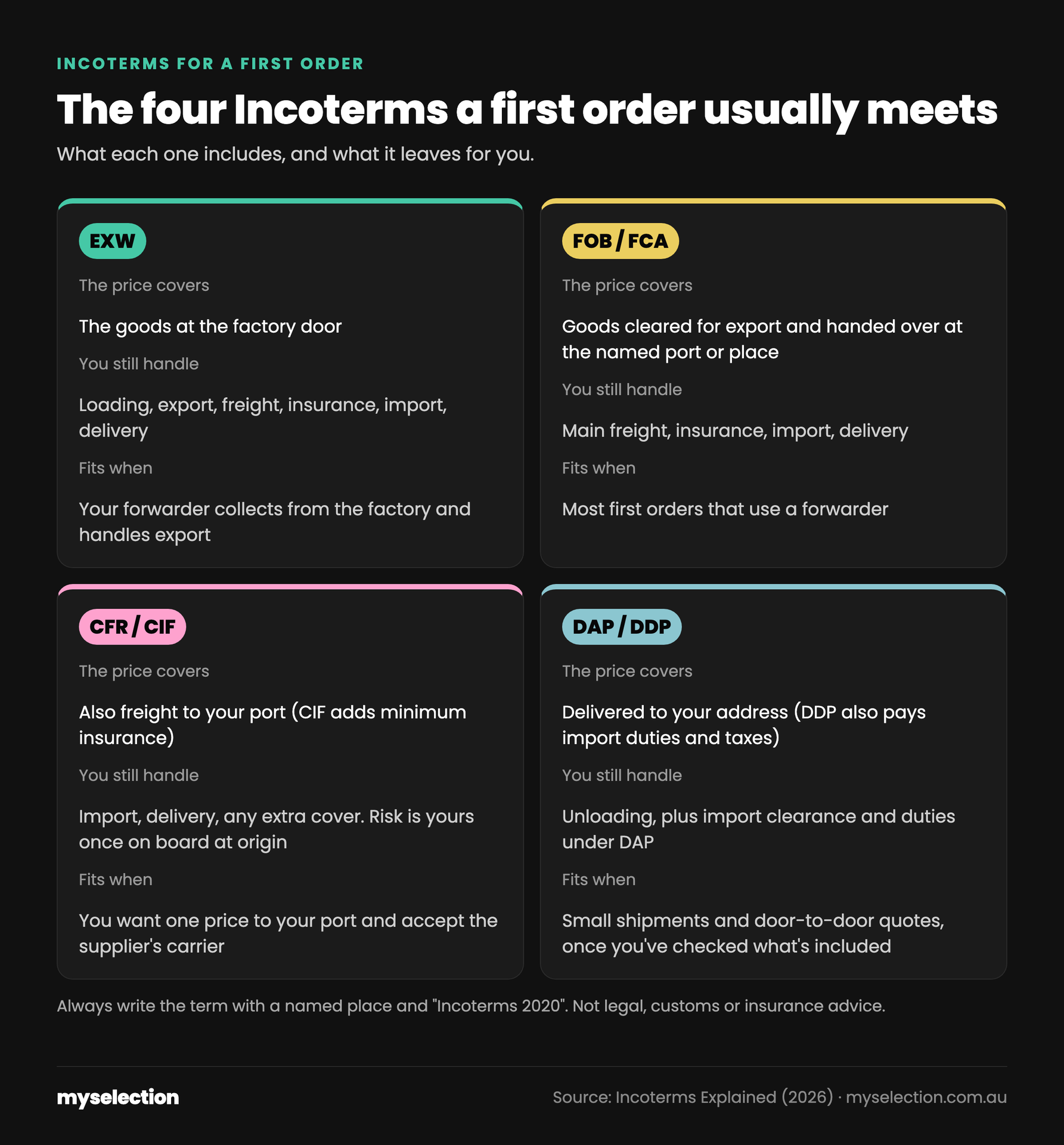
Four Incoterms families and what each leaves for you. Free to share with a link back to this guide.
EXW (Ex Works). The supplier's price covers the goods at its door. Loading, trucking to the port, export clearance, freight, insurance, import and delivery are all yours. It works when your freight forwarder collects from the factory and can handle export clearance at origin.
FOB (or FCA). The supplier clears the goods for export and gets them on board the ship at the named port (FOB) or hands them to your carrier at a named place (FCA). You book the main freight, usually through your forwarder, and handle everything after that. FOB is sea-only, so air freight needs FCA. For container shipments the ICC also recommends FCA, because the container is usually handed over at a terminal before it is loaded on board. Our guide to EXW vs FOB compares the two step by step, including how to put quotes on different terms on the same footing.
CFR or CIF. The supplier also books and pays for sea freight to your port, and under CIF buys minimum insurance. The catch: risk still passes to you when the goods are on board at the port of shipment, not when they arrive. If something happens at sea, you're the one claiming: under CIF on the policy the supplier bought, under CFR on whatever cover you arranged.
DAP or DDP. The supplier delivers to the named address. Under DAP you still handle import clearance, duties and taxes. Under DDP the supplier handles those too. Door-to-door courier quotes for samples and small shipments often look like this. Before you rely on DDP, check that the quote really includes duties and import taxes and that the supplier (or its carrier) can actually clear goods into your country as the importer.
Common misunderstandings
"CIF means the supplier is responsible until my port." It doesn't. Under CFR and CIF the supplier pays freight to your port, but the risk passes at the port of shipment. The same split applies to CPT and CIP.
"FOB China is a complete term." It isn't. Every Incoterm needs a named place: FOB plus the specific port of shipment, DAP plus the delivery address. "FOB China" leaves the most expensive question, which port, open.
"Incoterms decide when I pay and when I own the goods." They don't. Payment terms and ownership come from your contract and purchase order.
"If it says DDP, there are no other costs." Usually there are still some: unloading at your end, and anything the quote quietly left out. Ask for the delivered price to state what's included.
"The version doesn't matter." Incoterms 2010 terms still circulate in old templates, and the 2020 rules changed some details (the 2010 term DAT became DPU, for example). Write "Incoterms 2020" after the term.
Vague vs usable quote wording
| Vague | Usable |
|---|---|
| "FOB China" | "FOB [named port of shipment], Incoterms 2020" |
| "Price includes shipping" | "DAP [your warehouse address], Incoterms 2020. Import clearance, duties and taxes paid by buyer" |
| "CIF, insurance included" | "CIF [named destination port], Incoterms 2020. Insurance certificate sent to buyer; cover level stated" |
| "DDP, all in" | "DDP [your warehouse address], Incoterms 2020. Quote lists duties and import taxes included; supplier confirms who clears import" |
| "Ex factory price" | "EXW [factory address], Incoterms 2020. Goods packed and ready for collection on the agreed date" |
The pattern is always the same: term + named place + "Incoterms 2020", plus anything the term itself doesn't settle.
How to choose Incoterms for your order
- Decide who will manage the freight. If you have a forwarder (or someone helping you), FOB or FCA at a named port or place is the usual starting point. If you don't, a CFR/CIF or DAP quote hands more of the journey to the supplier, but you lose control of the carrier and, under CFR/CIF, you still carry the risk at sea.
- Match the term to the transport. FAS, FOB, CFR and CIF are for sea and inland waterway only. For air freight, couriers and most container shipments, use the "any mode" rules (FCA, CPT, CIP, DAP, DPU, DDP).
- Ask for the same term from every supplier you're comparing, or convert quotes to the same point before comparing.
- Decide on insurance. Unless the term is CIF or CIP, no one has to insure. Talk to your forwarder about cargo insurance from the point where risk becomes yours.
- Write it fully on the quote and purchase order: term, named place, Incoterms 2020.
- Add up everything the supplier isn't paying for. Freight, insurance, clearance, duties and delivery under your chosen term all belong in your landed cost, the real per-unit cost of getting a product to your door. That's the number your retail price has to be built on.
Conclusion
Incoterms don't set your price, but they decide what the price includes. Learn the chart's two patterns (export is the supplier's job except under EXW; import is yours except under DDP), remember that under C-terms the risk passes at origin, and always write the term with a named place and "Incoterms 2020". Then cost out whatever the term leaves to you.
FAQ
How many Incoterms are there? Eleven in Incoterms 2020: seven for any mode of transport (EXW, FCA, CPT, CIP, DAP, DPU, DDP) and four for sea and inland waterway transport only (FAS, FOB, CFR, CIF). The ICC publishes the official text and guidance on choosing a rule.
Which Incoterm is best for a first order? There isn't one best term, but many first orders use FOB (or FCA for containers and air freight) because the supplier handles export and you keep control of the main freight through your forwarder. If you don't have a forwarder, compare a DAP or CIF quote, and check exactly what it leaves out.
Are Incoterms legally binding? Incoterms aren't a law. They're ICC rules that apply when your contract, quote or purchase order names them, so the term binds you because you both agreed to it. For anything beyond that, ask a trade lawyer. Write the version ("Incoterms 2020") and the named place so it's clear which rule you meant.
Do Incoterms include customs duties? Under DDP, the seller pays import duties and taxes. Under every other rule the buyer handles import clearance and duties. Incoterms don't set the duty rate itself; that depends on the product and your country's customs rules. Export formalities at origin are the seller's job under every rule except EXW.
Discuss your product idea
Want a second pair of eyes on a quote before you pay the deposit? Discuss your product idea with us. My Selection helps creators turn an audience into a product brand, working with long-term partner factories in Jiangsu, Zhejiang and the Pearl River Delta and our own development team in China. Our supplier network covers 867 suppliers across 34 countries, with 10+ designers on the team. Which products fit and what's included are confirmed per project. Lead times, MOQs and unit costs depend on the product, so we confirm those too.