Dropshipping vs private label comes down to one trade: dropshipping lets you sell without buying stock, while private label means you buy your own branded stock and control the product. Dropshipping is cheaper and faster to start; private label costs more upfront but gives you control over the product, the packaging and the margin. For a creator, the right answer depends on whether you're testing an idea or building a brand your audience will remember.
POV: your audience trusts your taste. Plot twist: with a generic dropshipped product, the same item can turn up in other stores at a different price, and your followers will find it. That's not always a problem, but it changes what you're building. This guide compares the two models on the dimensions that matter to a creator, says who each one fits, and shows how to move from one to the other.
This is what we do at My Selection: we help creators develop their own branded products and coordinate production. If you're ready to move beyond generic stock, tell us what you're making.
The quick definitions
Dropshipping: you list a supplier's product in your store. When a customer orders, the supplier ships it directly to them. You don't hold inventory. Shopify's help center describes it as a way to sell products without handling inventory or shipping, while you stay responsible for customer service and order tracking.
Private label: a manufacturer makes a product, often based on one it already produces, with your brand, packaging and agreed changes. You buy a production run and own that stock. It's the model behind most private label products for creators.
Print-on-demand is a variant of dropshipping: each item is printed after it's ordered, with your design on a stock blank. It's dropshipping with your artwork, not a product you've developed.
Upfront cash
Dropshipping: very little. You pay for each item after a customer orders it.
Private label: you pay for samples, any tooling, and a first production run before you sell anything. Factories set minimum order quantities, so the first run is a real commitment.
Decision rule: if you can't fund a first run without stress, test with a low-stock model first and use pre-orders to fund the run later.
Margin control
Dropshipping: the supplier sets the base price and can change it. Because the same product is often sold by many stores, you compete on price.
Private label: your unit cost falls as quantity rises, and because the product is yours, you aren't compared like-for-like with other sellers. But you also carry freight, duties, storage and unsold stock.
Decision rule: private label gives you more margin control, not guaranteed margin. Run the numbers on your own costs before you assume it pays more.
Product control
Dropshipping: you sell what exists. You can't change materials, fit, colour or quality.
Private label: you approve a sample and can change the agreed details: materials, colours, finish, packaging. You can fix the thing your audience complained about.
Decision rule: if your audience's request is "make it better than what's out there", only private label (or full custom development) can do that.
Brand and unboxing
Dropshipping: packaging is usually the supplier's. Some suppliers offer branded inserts or packaging, which helps, but the product itself is still generic.
Private label: your logo, your box, your insert card. The product and the unboxing look like your brand, which matters when your audience films and shares what they get.
Decision rule: if your content is part of the product (unboxings, behind-the-scenes, reviews), private label fits the way you already work.
Customer experience
Dropshipping: shipping times and quality depend on the supplier; you handle the complaints. Split orders from several suppliers arrive separately.
Private label: you (or your fulfilment partner) ship from your own stock, so you control packing, delivery options and returns.
Decision rule: if a slow or messy delivery would hurt your reputation more than it would hurt a faceless store, weigh this heavily.
Effort and risk
Dropshipping: low setup effort, low stock risk, ongoing effort spent on customer service and supplier issues.
Private label: higher setup effort (development, samples, quality checks, shipping), and the risk that stock doesn't sell. The work is front-loaded.
Decision rule: the risk of private label is unsold stock. Validate demand before the order, not after.
Dropshipping vs private label: side by side
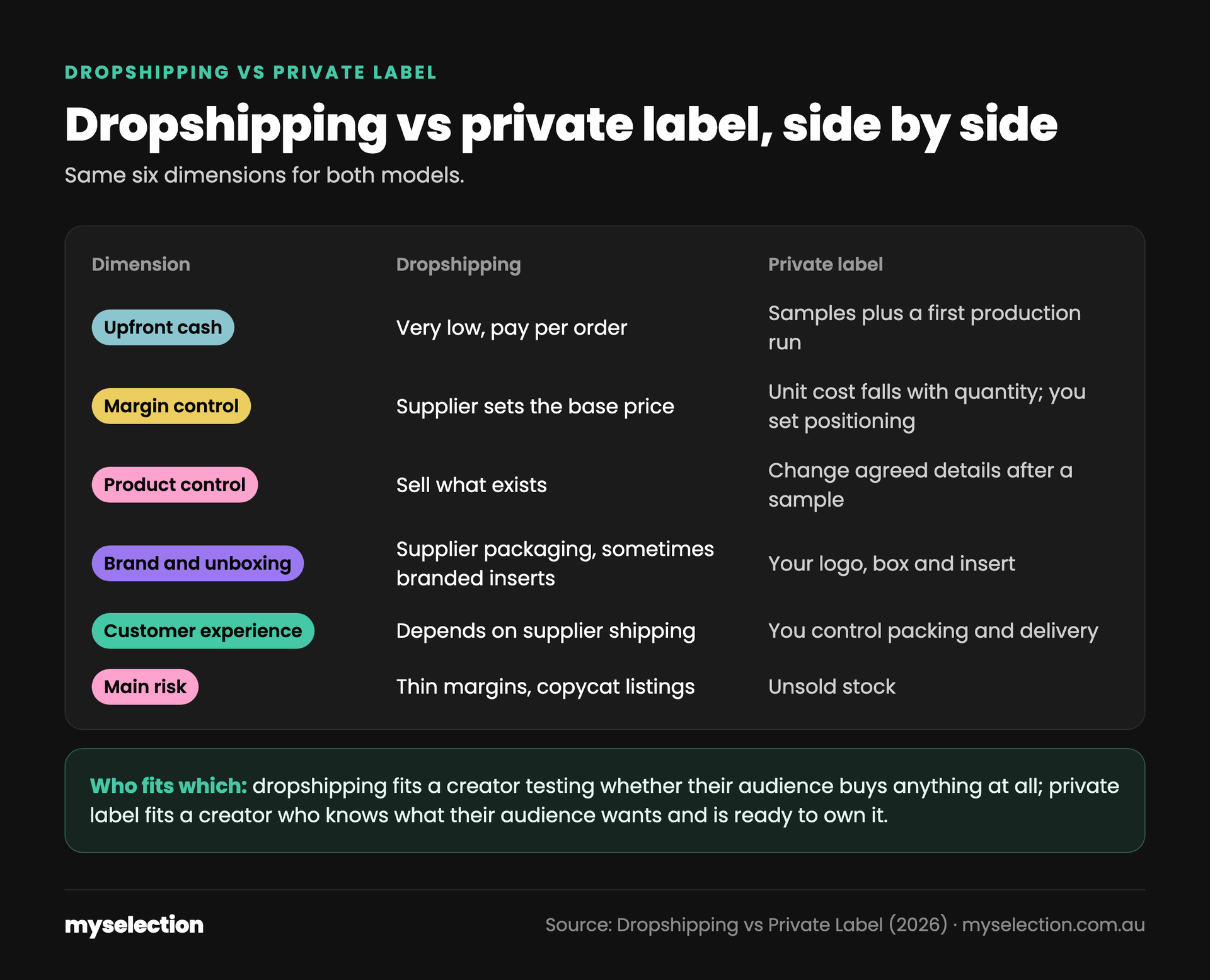
Same dimensions for both models. Free to share with a link back to this guide.
| Dimension | Dropshipping | Private label |
|---|---|---|
| Upfront cash | Very low, pay per order | Samples plus a first production run |
| Margin control | Supplier sets the base price | Unit cost falls with quantity; you set positioning |
| Product control | Sell what exists | Change agreed details after a sample |
| Brand and unboxing | Supplier packaging, sometimes branded inserts | Your logo, box and insert |
| Customer experience | Depends on supplier shipping | You control packing and delivery |
| Main risk | Thin margins, copycat listings | Unsold stock |
Who fits which, in one line: dropshipping fits a creator testing whether their audience buys anything at all; private label fits a creator who knows what their audience wants and is ready to own it.
Weak vs strong reasons to choose
| Weak reason | Strong reason |
|---|---|
| "Private label because it sounds more legit." | "Private label because 40% of my waitlist (illustrative) asked for the same change to existing products." |
| "Dropshipping because it's free." | "Dropshipping for 60 days to test which of three product types my audience buys." |
| "Whatever the guru said." | "The model that matches my cash, my content and my audience's request." |
How to switch from dropshipping to private label
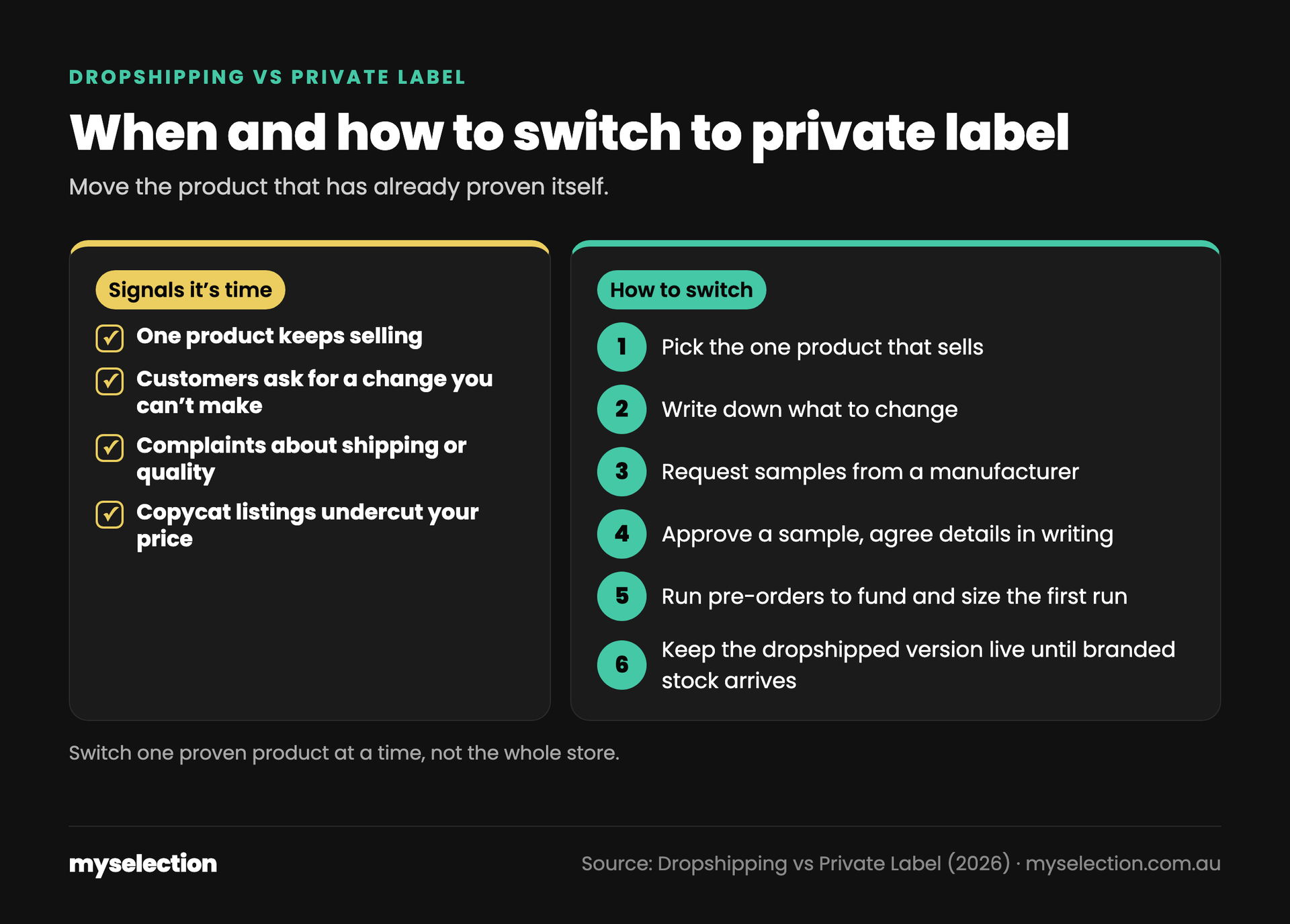
Switch one proven product at a time. Free to share with a link back to this guide.
Signals it's time to switch:
- One product keeps selling.
- Customers ask for a change you can't make.
- Complaints about shipping or quality keep coming.
- Copycat listings undercut your price.
Then:
- Pick the one product that sells, not the whole store.
- Write down what you'd change: material, colour, size, packaging.
- Ask a manufacturer for samples of your improved version.
- Approve a sample and agree the details in writing.
- Use pre-orders or a waitlist to fund and size the first run.
- Keep the dropshipped version live until your branded stock arrives.
If you're choosing between a fully custom product and putting your logo on an existing one, our guide to private label vs white label explains the difference.
Conclusion
Dropshipping is a test; private label is a brand. Start with dropshipping or print-on-demand if you need to learn what sells with almost no cash at risk. Move to private label when one product has proven itself and your audience is asking for a version only you can make.
FAQ
Is private label more profitable than dropshipping? It can be, because unit costs fall with quantity and you aren't competing on an identical product. But you also pay for samples, stock, freight, storage and unsold units. Compare both models on your own costs before deciding.
Can you do private label dropshipping? Some suppliers hold branded stock for you and ship it in your packaging. It reduces the logistics work, but you usually still pay for a production run, so it isn't the zero-stock model of standard dropshipping.
Is print on demand dropshipping or private label? Print-on-demand is a form of dropshipping: the item is made after each order using a standard blank and your artwork. You get your design, but not your own product specification.
Discuss your product idea
Ready to turn a product that sells into one that's yours? Discuss your product idea with us. My Selection helps creators launch physical products under their own name, working with long-term partner factories in Jiangsu, Zhejiang and the Pearl River Delta and our own development team in China. Our supplier network covers 867 suppliers across 34 countries, with 10+ designers on the team. Which products fit and what's included are confirmed per project. Lead times, MOQs and unit costs depend on the product, so we confirm those too.