POV: two suppliers send you the "same" product. One says white label, the other says private label. Plot twist: they're not the same deal. White label products are ready-made products a manufacturer sells to many brands, each adding its own logo. Private label products are made for one brand, usually adjusted to that brand's spec and sold only under its name.
The short version of private label vs white label: white label is faster and cheaper to start; private label takes more work but gives you a product that's actually yours. This guide compares them side by side and gives you a checklist to decide.
Private label vs white label: the quick definitions
White label means the manufacturer makes one standard product and lets many sellers put their own branding on it. The product itself doesn't change between brands. Think of the same phone case, tote bag or candle sold by dozens of shops with different logos.
Private label means the manufacturer makes a product for your brand, usually starting from its own base product but changed to your brief (material, colour, size, scent, features, packaging), and is usually sold only under your brand (confirm exclusivity in writing; it isn't automatic). Our guide to private label products for creators explains how private label works and how to pick a first product.
You'll also see "white label" used for software and marketing services resold under another company's name. Same idea, different industry. This article is about physical products.
People use the two terms loosely, so a supplier's label for its offer means less than what's written in the quote. Always ask what you can change and who else can buy the same thing.
Side-by-side comparison
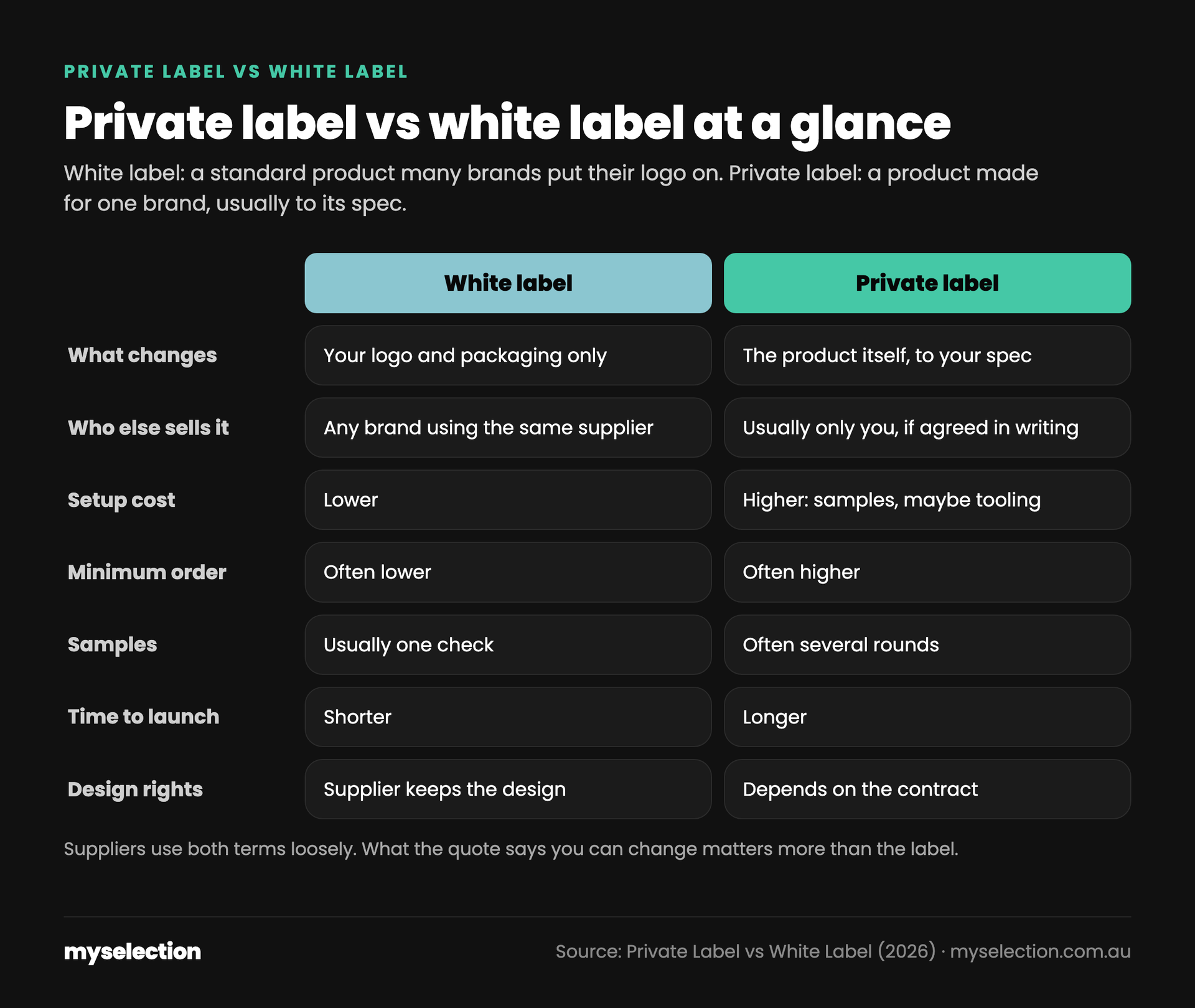
Private label vs white label at a glance. Free to share with a link back to this guide.
| White label | Private label | |
|---|---|---|
| What changes | Your logo and packaging only | The product itself, to your spec, plus branding |
| Who else sells it | Any brand that buys from the same supplier | Usually only you, if exclusivity is agreed in writing |
| Setup cost | Lower: little or no development | Higher: samples, possible tooling, more back-and-forth |
| Minimum order | Often lower, because the base product is shared | Often higher, especially for custom materials or colours |
| Samples | Usually one sample to check quality and branding | Often several rounds until the changes are right |
| Time to launch | Shorter | Longer |
| Differentiation | Mostly your branding, content and price | The product itself can be different |
| Design rights | The supplier keeps the product design | Depends on the contract; ask about moulds, files and formulas |
Minimums vary a lot by category and factory, in both models. Our MOQ meaning guide shows how minimums change your real cost per unit and the cash you need.
When white label fits
- You want to test whether your audience buys a product at all.
- The product is a commodity, and your brand, content and community are the difference.
- You need stock soon, for a drop, a collab or a seasonal moment.
- Your budget for a first run is tight.
The catch: if your audience can find the same product under another name, the comparison becomes price. Some creators are fine with that for a first test. Just go in knowing it.
When private label fits
- Your audience keeps asking for a specific improvement ("I wish it came in a bigger size").
- You want reviews and repeat buyers attached to a product nobody else sells.
- You're ready to pay for samples and wait a little longer to get it right.
- You plan to build a product line, not one drop.
The catch: more decisions, more sampling and usually more cash upfront. Getting it right is a product project, not a quick merch run.
Which one fits you? A quick checklist
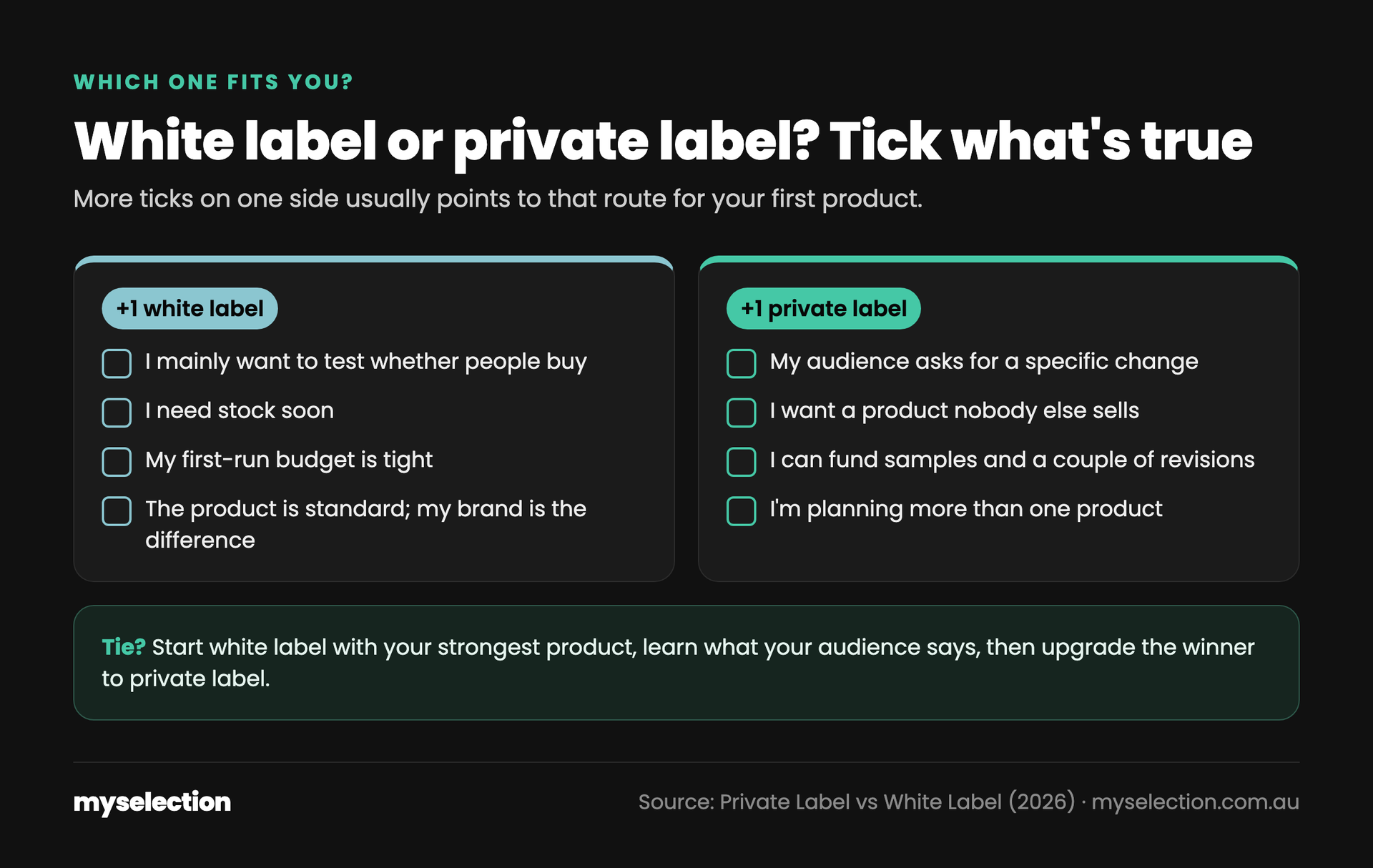
Tick what's true for you. More ticks usually wins.
Tick everything that's true for you:
White label points
- I mainly want to test whether people buy
- I need stock soon
- My first-run budget is tight
- The product is fairly standard, and my brand is the difference
Private label points
- My audience asks for a specific change
- I want a product nobody else sells
- I can fund samples and a couple of revision rounds
- I'm planning more than one product
More ticks on one side usually points to that route. Tie? Start white label with your strongest product, learn what your audience says, then upgrade the winner to private label.
The upgrade path: white label first, private label next
Lots of brands don't choose once. They start white label to prove demand, then move the best seller to private label when they know exactly what to change. If you plan to do this, ask your supplier early:
- Can this product be changed later (material, colour, size, features)?
- What does the minimum become once we change it?
- If we change it, will you sell our version to other brands?
- Who owns the moulds, design files or formula we pay for?
- Do the existing tests or certificates still apply after the changes?
Changing who makes the product can also change the manufacturing model behind it. Our guide to OEM vs ODM explains the difference between customising a factory design and manufacturing your own.
Contract points to get in writing
Whichever route you choose, a short email or contract clause beats a verbal "no problem":
- What exactly you can change, and what the price is for each change
- Whether the product or your version is exclusive to you, and for how long
- Who owns any moulds, tooling, design files or formulas you pay for
- The approved sample that production must match
- What gets checked before shipping, and what happens if units fail
This is general guidance, not legal advice. For rights, exclusivity and product safety rules in your category, get professional advice before you sign.
How My Selection helps
My Selection helps creators turn audience demand into physical product brands, whether that starts with a branded version of an existing product or a product changed to your spec. We work with long-term partner factories in Jiangsu, Zhejiang and the Pearl River Delta, with our own development team in China, and a supplier network of 867 suppliers across 34 countries. Our team includes 10+ designers.
Which route fits, what can be changed and what quantities make sense are confirmed per project. We don't publish fixed lead times, MOQs or unit costs, because they depend on the product.
FAQ
Is private label better than white label? Neither is better in general. White label is better for speed and testing; private label is better for a product only your brand sells.
Is white label the same as dropshipping? Not quite. White label is about branding a standard product. Dropshipping is a delivery model where the supplier ships each order. Some white label suppliers also dropship.
Can a white label product become private label? Often, yes. Many suppliers can change materials, colours or features once you're ready, usually with a new sample and a new minimum order.
Do I own a white label product? You own your brand and packaging artwork. The product design usually stays with the supplier, which is why other brands can sell the same item.
Not sure which route fits?
Tell us what your audience keeps asking for. Discuss your product idea with us, and we'll help you decide between white label and private label for your first product.