POV: your audience trusts your taste so much they'd buy a water bottle if you put your name on it. Plot twist: you don't need your own factory to make that happen. Private label products are products made by a manufacturer and sold under your brand, usually with your own spec, packaging and branding. The factory makes it; your brand owns the shelf, the story and the customer.
This guide explains what private label means, how it works step by step, how it compares with other ways to get a product, and how to pick a first product with a simple scorecard and a list of questions to ask suppliers.
What is private label?
Private label is a business model where one company manufactures a product and another company sells it under its own brand name. Supermarket store brands are the classic example. For creators, it means a product made by a manufacturer, adjusted to your brief, and sold only under your brand.
Private label manufacturing is the factory side of that deal: the manufacturer produces to your agreed spec, applies your branding and packaging, and ships the finished stock to you. You usually don't design the product from scratch. You start from something the factory already knows how to make, then change what matters to your audience.
Private label is one of several ways to get a branded product. They suit different budgets and stages:
| Route | What you get | Fits when |
|---|---|---|
| Print on demand | Your design printed on a standard blank, one order at a time | You want to test designs with almost no stock risk |
| White label | A ready-made product, your logo on it, little or no change | You want speed and the lowest setup |
| Private label | A factory product adjusted to your spec, sold only under your brand | You want your own product without a full design project |
| Custom product | A product built to your own design, often with new tooling | You need something that doesn't exist yet |
If you're stuck between the middle two, our guide to private label vs white label compares them line by line. If you're weighing a factory design against your own, see OEM vs ODM. And if you want help across the whole path, see our packages for product development support.
How private label products work
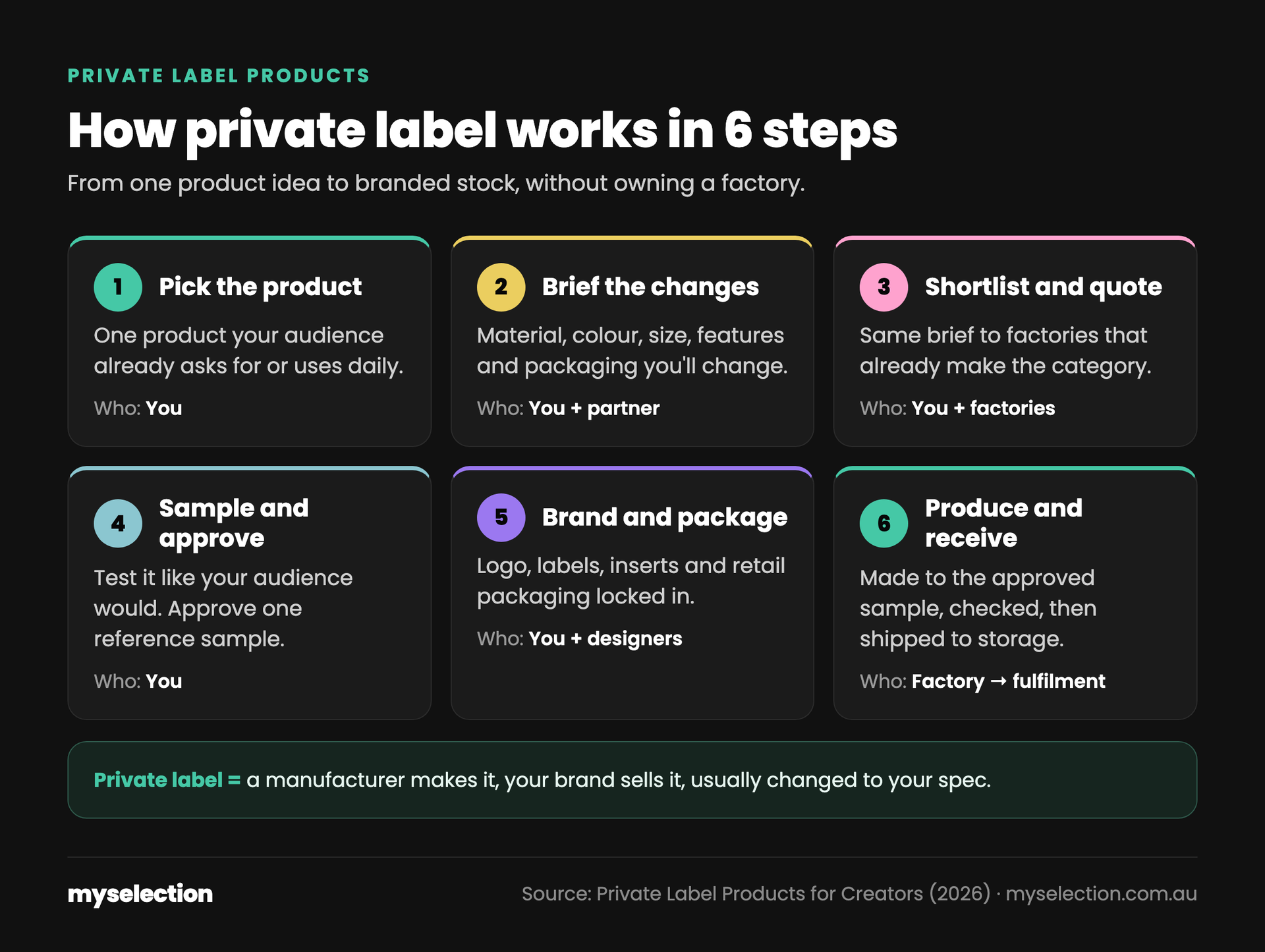
How private label works, from idea to stock. Free to share with a link back to this guide.
- Pick the product. Choose one product your audience already asks for or uses daily (the scorecard below helps).
- Brief the changes. Decide what you'll change from the factory's standard version: material, colour, size, scent, fit, features, packaging.
- Shortlist and quote. Send the same brief to a few manufacturers who already make the category, so the quotes compare like-for-like.
- Sample and approve. Test samples the way your audience would use them. Confirm every change in writing, then approve one reference sample.
- Brand and package. Lock logo placement, labels, inserts and retail packaging. Packaging often has its own minimum order.
- Produce and receive. The factory produces to the approved sample, stock is checked before it ships, then it moves to your storage or fulfilment partner.
Our product sourcing guide goes deeper into briefs, quote comparison and samples, which are the same skills private label relies on.
Why creators choose private label
- Your brand, not the factory's. Customers buy from you, review you and come back to you.
- Faster than a fully custom product. Starting from a proven base usually means fewer development rounds and less new tooling.
- Room to stand out. Small, smart changes (a better size, a colour your audience voted for, packaging that matches your content) make the product feel like yours.
- Better control than reselling. You set the spec, the price and the story, instead of competing with every other seller of the same item.
The trade-offs are real too. You'll usually need to buy stock upfront, meet a minimum order, wait for samples and own the quality conversation with the factory. Private label isn't free money based on vibes; it's a product business.
How to pick your first private label product
The best first product isn't the trendiest one. It's the one your audience already wants, that you can explain in one video, and that won't wreck your cash flow if the first run sells slower than planned.
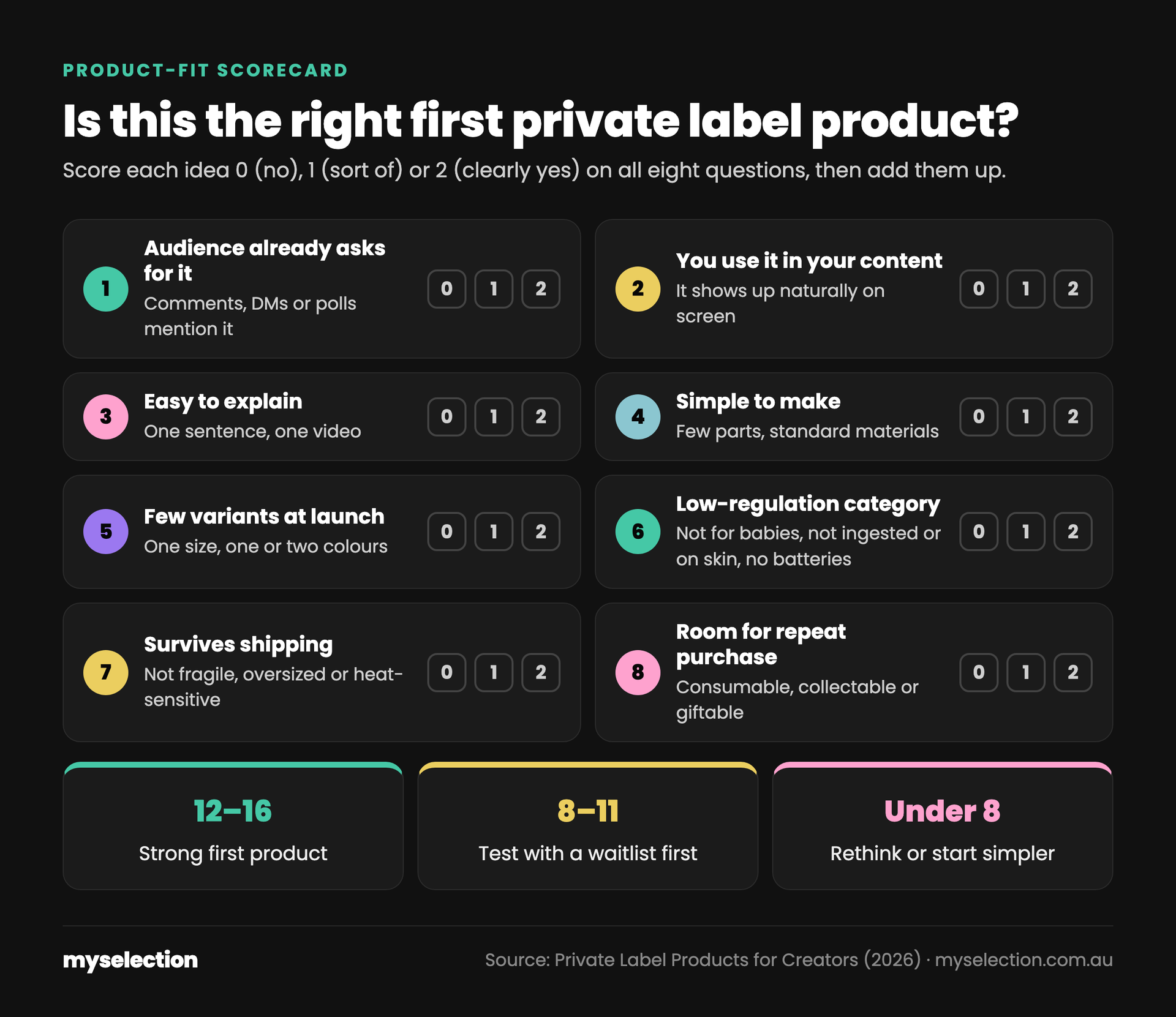
Score each idea from 0 to 2 on all eight questions.
Score each product idea from 0 (no) to 2 (clearly yes):
| Question | What a 2 looks like |
|---|---|
| Does your audience already ask for it? | Comments, DMs or polls mention it without prompting |
| Do you use it in your content? | It shows up naturally in your videos or posts |
| Can you explain it in one sentence? | "A gym bottle that doesn't sweat in your bag" |
| Is it simple to make? | Few parts, standard materials, no electronics |
| Can you launch with few variants? | One size, one or two colours |
| Is the category low-regulation? | Not for babies, not ingested, not applied to skin, no batteries |
| Will it survive shipping? | Not fragile, not oversized, not temperature-sensitive |
| Would customers buy it again? | Consumable, collectable or giftable |
12–16: strong first product. 8–11: worth testing with a waitlist or pre-orders first. Under 8: keep it on the list for later, or pick a simpler product to start.
Illustrative example (not a real client): a yoga creator compares a printed mat, a scented candle and a cork yoga block. The block scores highest: the audience keeps asking about the one on screen, it's simple to make, needs one colour, ships flat and isn't a regulated category. The candle scores well on repeat purchase but lower on shipping and safety rules, so it waits for run two.
Questions to ask private label suppliers
Use these before you pay for samples. The answers tell you as much about the supplier as about the product.
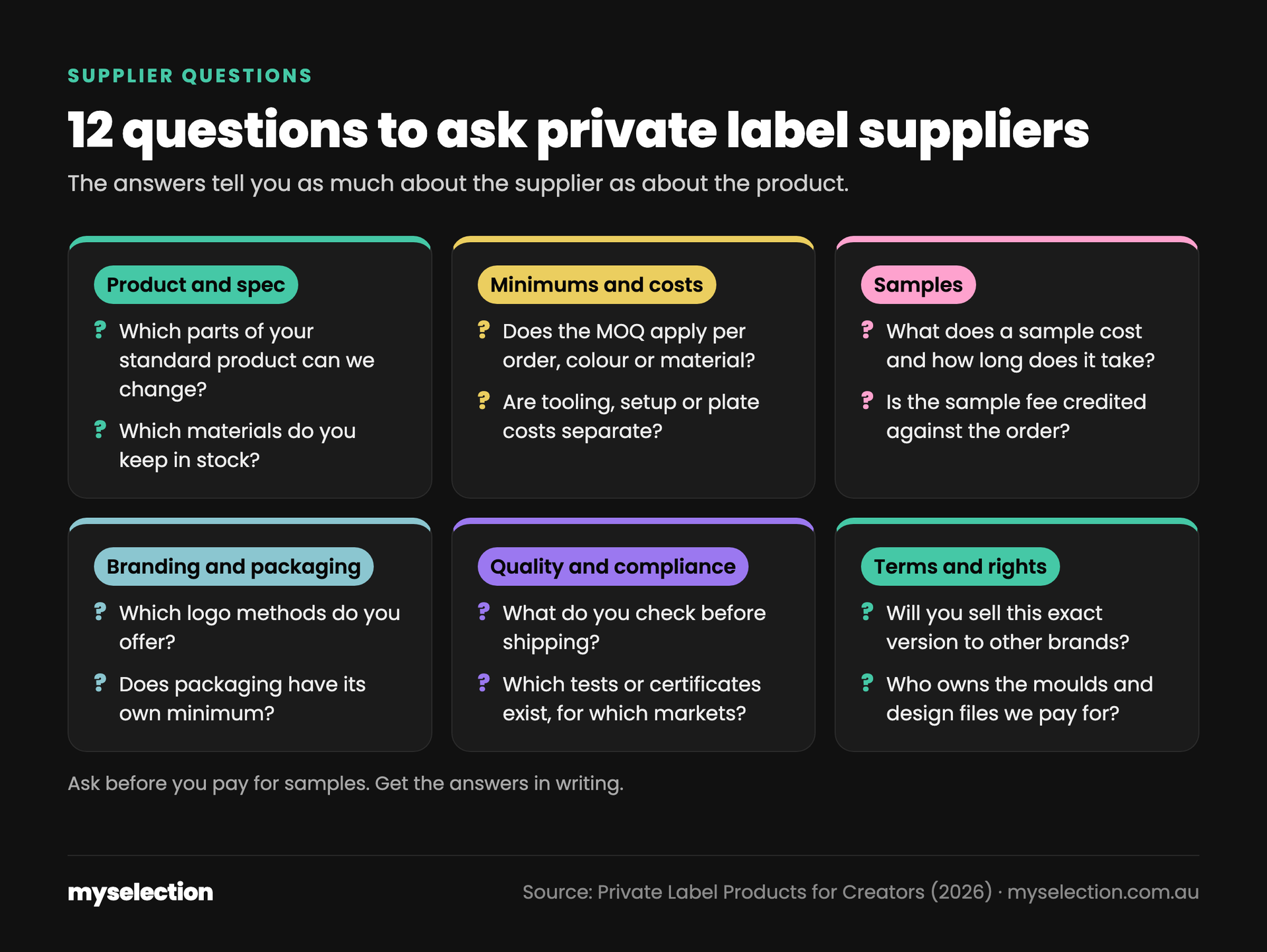
Ask these before you pay for samples.
| Topic | Ask |
|---|---|
| Product and spec | Which parts of your standard product can we change? Which materials do you keep in stock? |
| Minimums and costs | What does the MOQ apply to: the order, each colour or each material? Are tooling, setup or plate costs separate? |
| Samples | What does a sample cost and how long does it take? Is the sample fee credited against the order? |
| Branding and packaging | Which logo methods do you offer? Does the packaging have its own minimum? |
| Quality and compliance | What do you check before shipping? Which tests or certificates already exist for this product, and for which markets? |
| Terms and rights | Will you sell this exact version to other brands? Who owns the moulds and design files we pay for? |
MOQ questions deserve a closer look, because the same MOQ line on a quote can mean very different things. Our guide to MOQ meaning explains the types and how they change your real cost per unit.
What private label costs to plan for
We won't quote numbers, because they depend on the product, materials and quantity. But every private label budget has the same lines, and your quotes should show each one separately:
- Samples and sample shipping
- Unit cost at your order quantity
- Tooling, moulds, plates or setup (usually paid once)
- Branding (printing, embroidery, engraving) and labels
- Retail packaging and inserts
- Pre-shipment inspection
- Freight, import duties and taxes
- Storage and fulfilment once stock lands
- Product photos and launch content (you're probably great at this part)
Common private label mistakes
| Mistake | What happens | Fix |
|---|---|---|
| Picking a trend, not a fit | The product doesn't match why people follow you | Use the scorecard and your own comments |
| Changing nothing | You're selling the same item as everyone else | Change at least one thing your audience cares about |
| Too many variants | MOQs multiply and cash gets stuck | Launch with one or two variants |
| Skipping samples | Production surprises you after you've paid for the full run | Approve a physical sample against a written spec |
| Assuming exclusivity | The factory sells your version to other brands | Agree exclusivity and design rights in writing |
| Ignoring category rules | Stock gets stuck or recalled | Check product safety and labelling rules early |
A note on product safety and labelling
Private label doesn't move responsibility to the factory. The brand selling the product is usually expected to meet the product safety and labelling rules of each market it sells into. Categories like cosmetics, supplements, food, children's products and electronics have specific requirements and often need professional advice. Regulators such as the US Consumer Product Safety Commission and Product Safety Australia publish guidance by product type. This article explains the business model; it isn't legal or compliance advice for your product.
How My Selection helps with private label products
My Selection helps creators turn audience demand into physical product brands. For private label, that means helping you choose a product, brief the changes and work with factories, through long-term partner factories in Jiangsu, Zhejiang and the Pearl River Delta and our own development team in China. Our supplier network covers 867 suppliers across 34 countries, and our team includes 10+ designers.
Which categories fit, what quantities make sense and what's included are confirmed per project. We don't publish fixed lead times, MOQs or unit costs, because they depend on the product.
FAQ
Are private label products good quality? They can be. Quality depends on the factory, the spec you agree and the sample you approve, not on the label. Many private label products come from experienced manufacturers in their category.
Is private label the same as dropshipping? No. Dropshipping usually means selling a supplier's existing product without holding stock. Private label means a product made under your brand, usually bought in bulk.
Do I own a private label product? You own your brand and usually your packaging artwork. Whether you own the product design, moulds or formula depends on the contract. Ask before you pay and get the answer in writing.
How do I start a private label brand as a creator? Pick one product with the scorecard, write a short brief, get comparable quotes, approve a sample, then launch to the audience that asked for it.
Ready to pick your first product?
Got an audience and a product idea that keeps coming up in your comments? Discuss your product idea with us, and we'll help you work out whether private label is the right route and what to do first.