POV: you finally find the perfect factory, the sample looks amazing, and then the quote lands: "MOQ 1,000 pcs". Your budget had room for 200. So what does that actually mean?
MOQ stands for minimum order quantity: the smallest number of units, or the smallest order value, a supplier will accept in one order. If a factory's MOQ is 500 units, you can't order 300 at the normal price.
Below you'll find the different kinds of MOQ, why factories set them, how an MOQ changes your real unit cost and the cash you need, and seven practical ways to work with a high one.
What does MOQ mean in manufacturing and wholesale?
The meaning is the same whether you hear it from a factory, a wholesaler or a packaging supplier: it's their floor for a single order. MOQ is one step in the wider product sourcing process, and it shows up in almost every quote you'll get.
What changes is what the minimum applies to. Always ask, because "MOQ 500" can mean very different things.
| Type of MOQ | What it means | Example |
|---|---|---|
| Per order | Minimum units across the whole order | 500 units total, any mix |
| Per style or SKU | Minimum for each product design | 300 units of each hoodie design |
| Per colour or variant | Minimum for each colour or size set | 200 units per colour |
| Per material | Minimum tied to buying raw material | One full fabric roll or dye batch |
| Order value | Minimum spend instead of units | A minimum invoice value per order |
| Packaging and add-ons | Separate minimums for boxes, labels, inserts | Printed boxes ordered in larger batches |
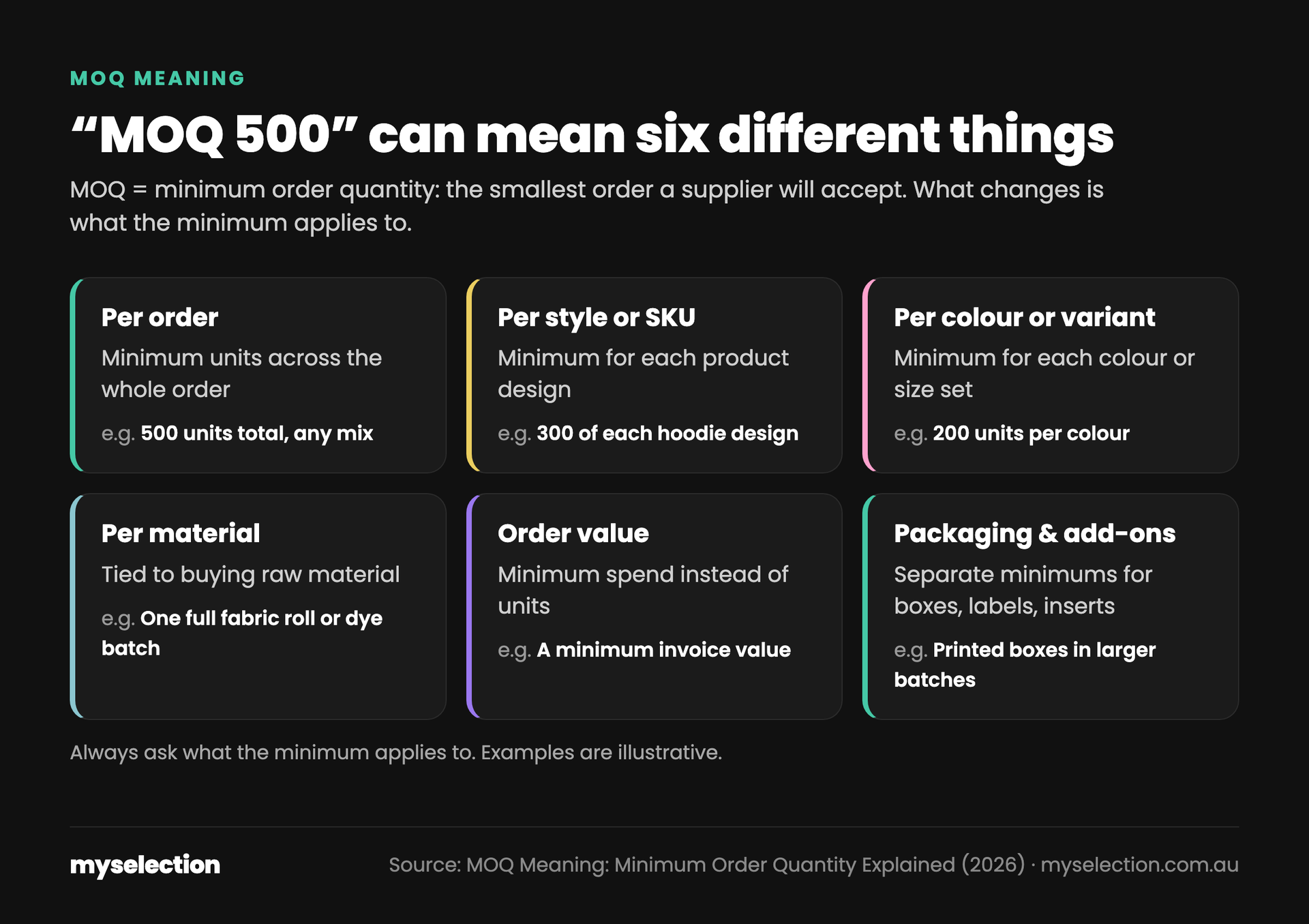
“MOQ 500” can mean six different things. Always ask what the minimum applies to.
The last row catches a lot of first-time brands out. Your product MOQ might be 300, while custom printed boxes come with a much higher minimum of their own.
Why do factories set minimum order quantities?
An MOQ isn't the factory being difficult. It usually covers costs that hit every order, no matter how small.
- Setup costs. Machines need setting up, and many products need moulds, printing plates, screens or patterns before the first unit is made.
- Material minimums. Factories buy fabric by the roll, plastic by the bag and coatings by the batch. Leftover material is a cost someone has to carry.
- Labour efficiency. A production line runs best on longer runs. Stopping and restarting for tiny orders wastes time.
- Admin and quality checks. Every order needs paperwork, inspection and packing, whatever its size.
- Capacity. A small order takes up line time that a bigger customer could have used.
How MOQ changes your unit cost and cash
Fixed costs get spread across the units you order. Fewer units means each one carries a bigger share.
Illustrative example (round numbers to show the maths, not a real quote; any currency works the same way): say an order has $600 of one-off setup cost and each unit costs $4 to make.
| Units ordered | Setup cost per unit | Making cost per unit | Real cost per unit | Cash needed for the order |
|---|---|---|---|---|
| 100 | $6.00 | $4.00 | $10.00 | $1,000 |
| 200 | $3.00 | $4.00 | $7.00 | $1,400 |
| 300 | $2.00 | $4.00 | $6.00 | $1,800 |
| 1,000 | $0.60 | $4.00 | $4.60 | $4,600 |
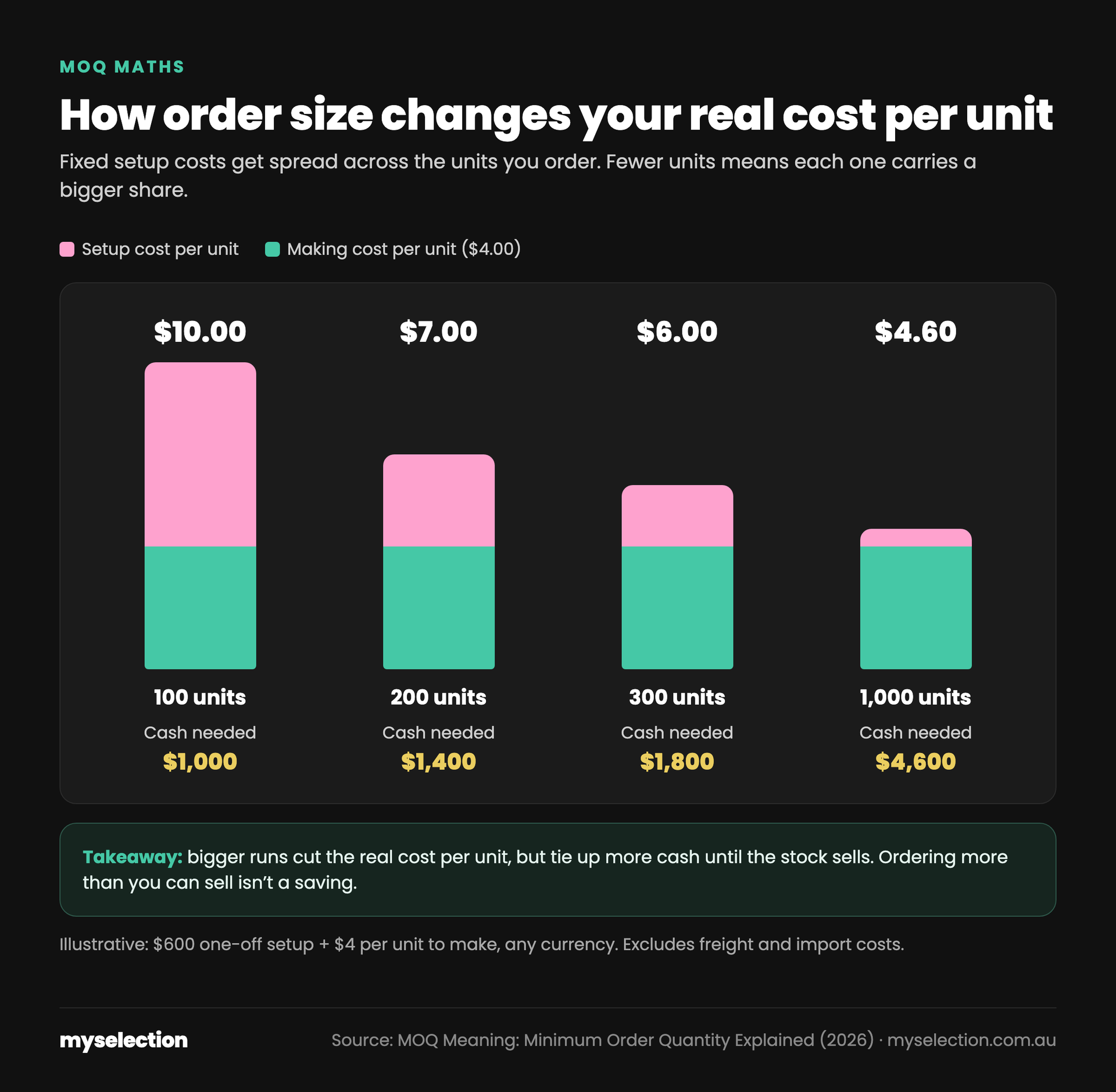
The same example as the table above, as a chart.
Two things jump out. Bigger orders are cheaper per unit, which is why factories push them. But bigger orders also need more cash up front, and that cash stays tied up until the stock sells. Add freight, import costs and storage on top. Ordering more than you can sell isn't a saving.
Is MOQ negotiable? 7 ways to work with a high minimum
Often there's some room, especially if you can show you understand the factory's costs. These are the levers that most often help.
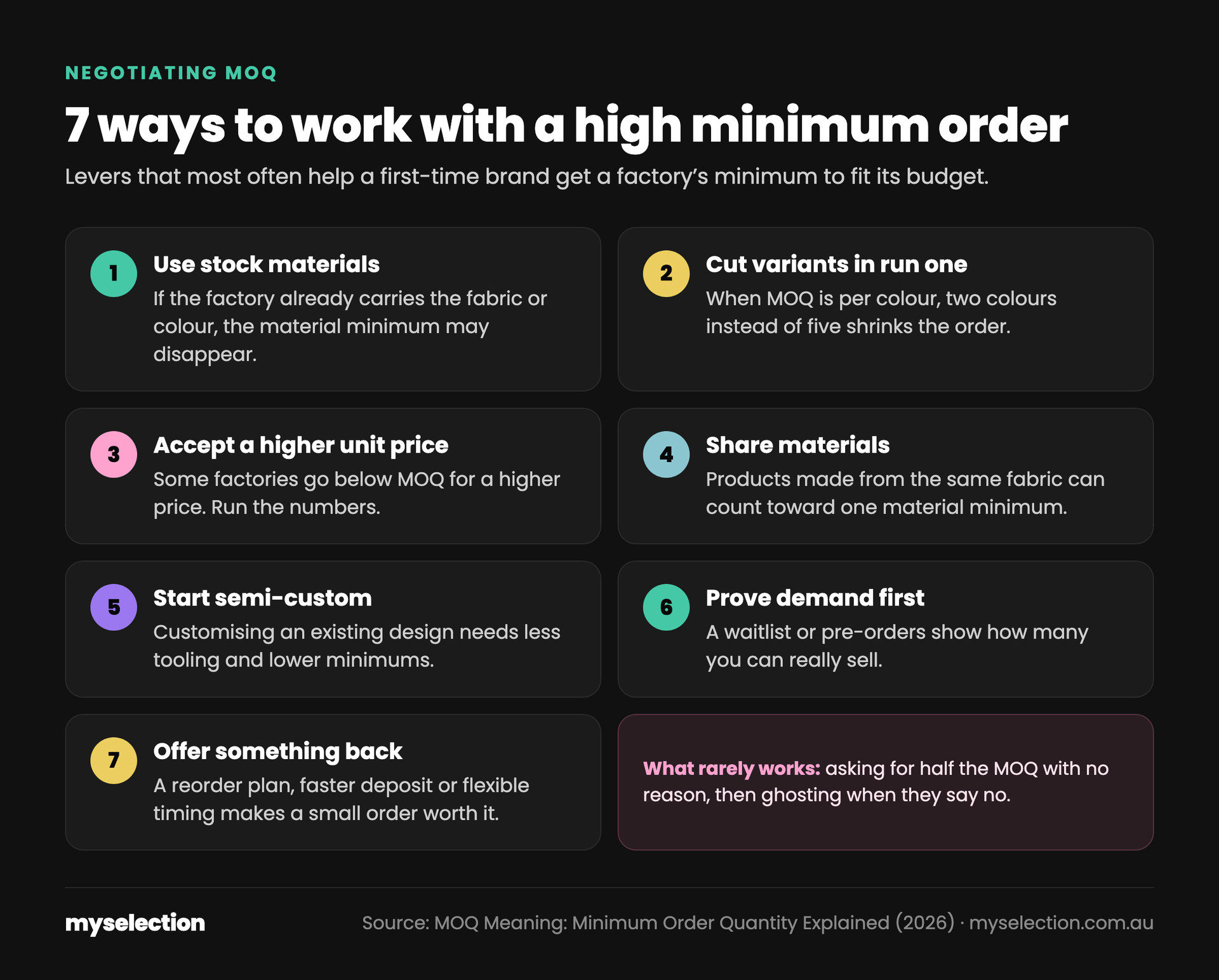
Seven levers for making a factory’s minimum fit a first run.
- Use the factory's stock materials and colours. If they already carry the fabric or colour, the material minimum may disappear.
- Cut variants in your first run. If the MOQ is per colour, launching with two colours instead of five can shrink your total order dramatically.
- Accept a higher unit price for a smaller run. Some factories will go below their MOQ for a higher unit price. Run the numbers before saying no.
- Share materials across products. Two products made from the same fabric can sometimes count toward one material minimum.
- Start semi-custom. Customising an existing factory design (new colour, logo, packaging) usually needs less tooling and lower minimums than a design made from scratch.
- Prove demand first. A waitlist or pre-order campaign tells you how many you can really sell, and can help fund the order.
- Offer something back. A clear reorder plan, a faster deposit or flexible timing can make a smaller first order worth the factory's while.
What rarely works: asking for half the MOQ with no reason, then ghosting when they say no. Factories remember.
What about low MOQ manufacturers? Factories that advertise low minimums do exist, and they can be a good fit for a first run. The usual trade-offs are a higher unit price, a narrower choice of materials and colours, and designs based on what they already make. Compare them on total cost and quality, not just on the minimum.
How many units can you actually carry? A quick worksheet
Before you negotiate, work out your own number. Fill these in with your real figures.
| Question | Your number |
|---|---|
| A. Cash you can spend on this order | |
| B. One-off costs (setup, tooling, samples) | |
| C. Cost per unit, including freight and import costs | |
| D. Maximum units you can afford ((A − B) ÷ C) | |
| E. Units you expect to sell in your first sales window | |
| F. Your safe first order (the lower of D and E) | |
| G. The factory's MOQ |
If F is at or above G, you're good. If F is below G, use the levers above, or look for a factory whose minimums match your stage.
Not sure what to put in E? Look at what your audience has actually bought before (links clicked, past drops, pre-order sign-ups), not just how many followers you have.
Questions to ask a supplier about MOQ
- Is the MOQ per order, per design, per colour or per material?
- Do packaging, labels and inserts have their own minimums?
- What's the unit price below the MOQ, if you'll go below it at all?
- Can we use stock materials or colours to lower the minimum?
- Is the MOQ the same for reorders?
- Are sample costs credited against the first order?
MOQ red flags
- The MOQ changes after the sample. Get MOQ and pricing in writing before you pay for samples.
- "No MOQ" with no detail. It can mean stock products with your logo added, or a unit price that quietly covers the setup cost. Ask what's included.
- No breakdown at all. If a supplier can't explain what the minimum covers, it's harder to negotiate and harder to trust.
If managing these conversations across several factories sounds like a lot, that's one of the jobs a sourcing agent can take on. And before you commit to anyone, run the checks in our guide to finding real-deal suppliers.
FAQ
What does "MOQ 500 pcs" mean? The supplier won't accept an order under 500 pieces at its normal price. Check whether that's 500 in total or 500 per colour or design.
What does no MOQ mean? The supplier will take orders of any size. Check whether the product is a stock item with your branding added, and compare the unit price with factories that do have minimums.
Is MOQ per order or per year? Usually per order. Some suppliers also offer pricing based on yearly volume, but that's a separate agreement.
What's the difference between MOQ and EOQ? MOQ is the supplier's minimum. EOQ (economic order quantity) is an inventory formula you can use to find your own ideal order size by balancing the cost of placing each order against the cost of holding stock (storage and tied-up cash).
Got an MOQ that doesn't fit your budget?
Bring the quote. Discuss your product idea with us, and we'll help you work out a first run that fits your audience, your cash and the factory's minimums.