POV: you've messaged 13 factories, nine ghosted you, three sent quotes in three different formats, and one wants a deposit before answering a single question. This is usually the moment creators start googling "sourcing agent".
A sourcing agent is a person or company that works on your behalf to find, check, negotiate with and manage suppliers, often in another country. They don't make your product, and they shouldn't be selling it to you either. Their job is to represent you on the supply side.
This guide covers what a sourcing agent does and doesn't do, how they differ from trading companies and agencies, how they usually get paid, and a simple scorecard to decide whether you need one. An agent is one way to run the bigger product sourcing process, so read that first if the whole path is new to you.
What a sourcing agent does
The exact scope varies, so treat this as the menu, not a promise. Most agents cover some or all of these:
| Stage | What the agent does for you |
|---|---|
| Brief | Turns your idea into a spec factories can quote from |
| Factory search | Finds manufacturers that make your category at your quantities |
| Checks | Verifies the factory is real, capable and willing to put terms in writing |
| Quotes and negotiation | Collects comparable quotes and negotiates price, MOQ and payment terms |
| Samples | Requests samples, passes on your feedback and tracks revisions |
| Production follow-up | Keeps the timeline moving and flags problems early |
| Quality checks | Arranges or carries out inspections before goods ship |
| Shipping hand-off | Coordinates with the freight forwarder so stock leaves on time |
What a sourcing agent doesn't do
Knowing the boundaries saves a lot of awkward conversations later.
- Guarantee a price or a timeline. Unit costs, minimums and lead times are negotiated, and factories can change them.
- Sign off compliance for you. A good agent will flag that your category has rules, but checking the requirements for the markets you sell into is still your responsibility.
- Take over fulfilment. Once stock is made, storing it and shipping orders is a separate job, unless the agent also offers it as a separate service.
- Replace your own judgement. You still approve the sample and the spec. An agent can't decide what your audience will love.
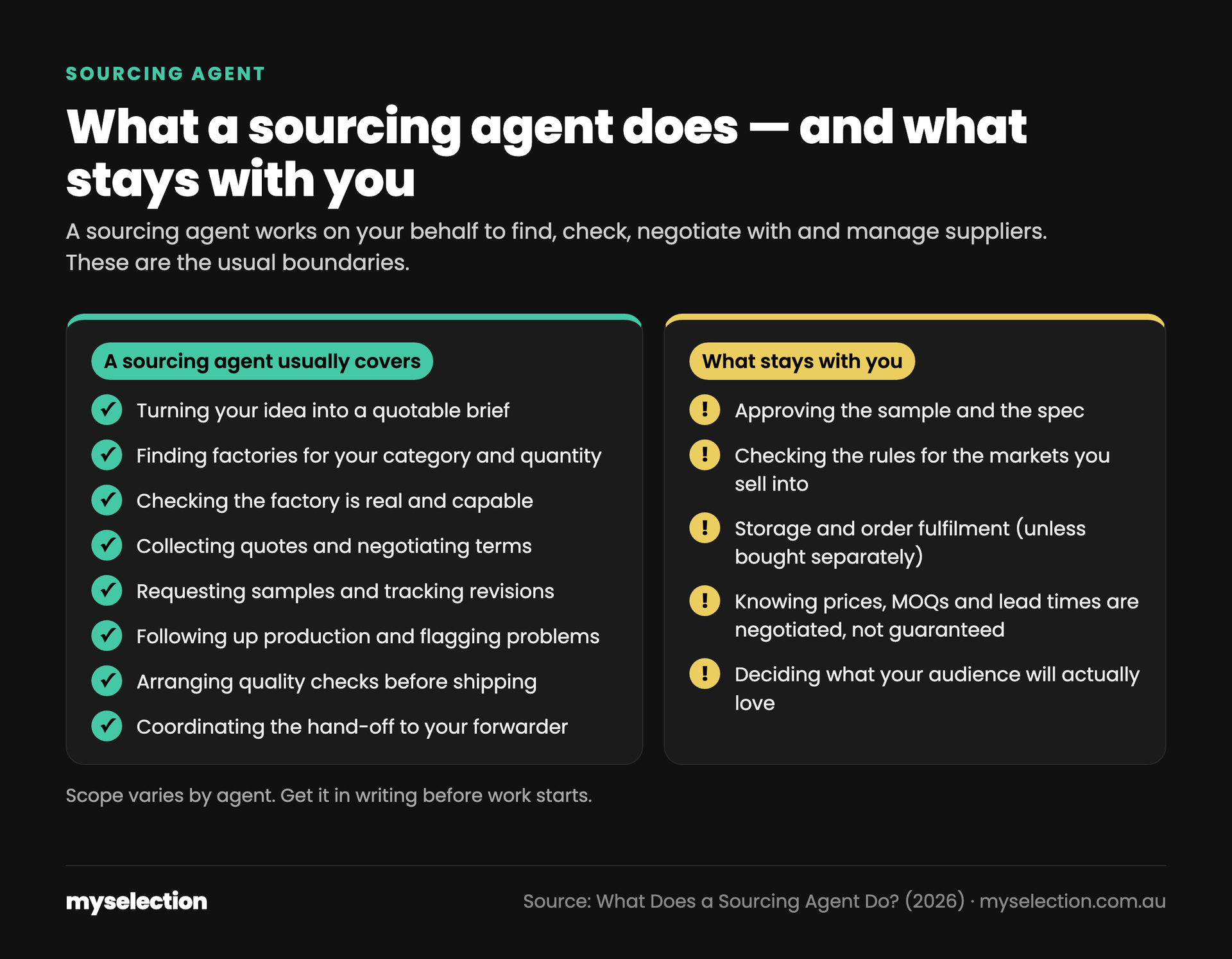
What a sourcing agent does, and what stays with you.
Sourcing agent vs trading company vs going direct
These options often get mixed up, especially in online marketplaces where everyone calls themselves a "factory".
| Option | Who they work for | How they make money | Do you know the factory? | Best for |
|---|---|---|---|---|
| Sourcing agent | You | A fee or commission you agree on | Should be yes | First products, several factories, limited time |
| Sourcing agency | You | Fees, often with a wider service menu | Should be yes | Brands that want a team, not one person |
| Trading company | Itself | A margin built into the unit price | Often no | Simple stock items, small quantities |
| Going direct | You manage it yourself | No middle layer | Yes | Experienced founders with time and a simple product |
| Product partner | You, across the whole launch | Setup and service fees, sometimes plus a share of sales | Ask; policies vary | Creators who want design, sourcing and launch in one team and are happy with a longer-term arrangement |
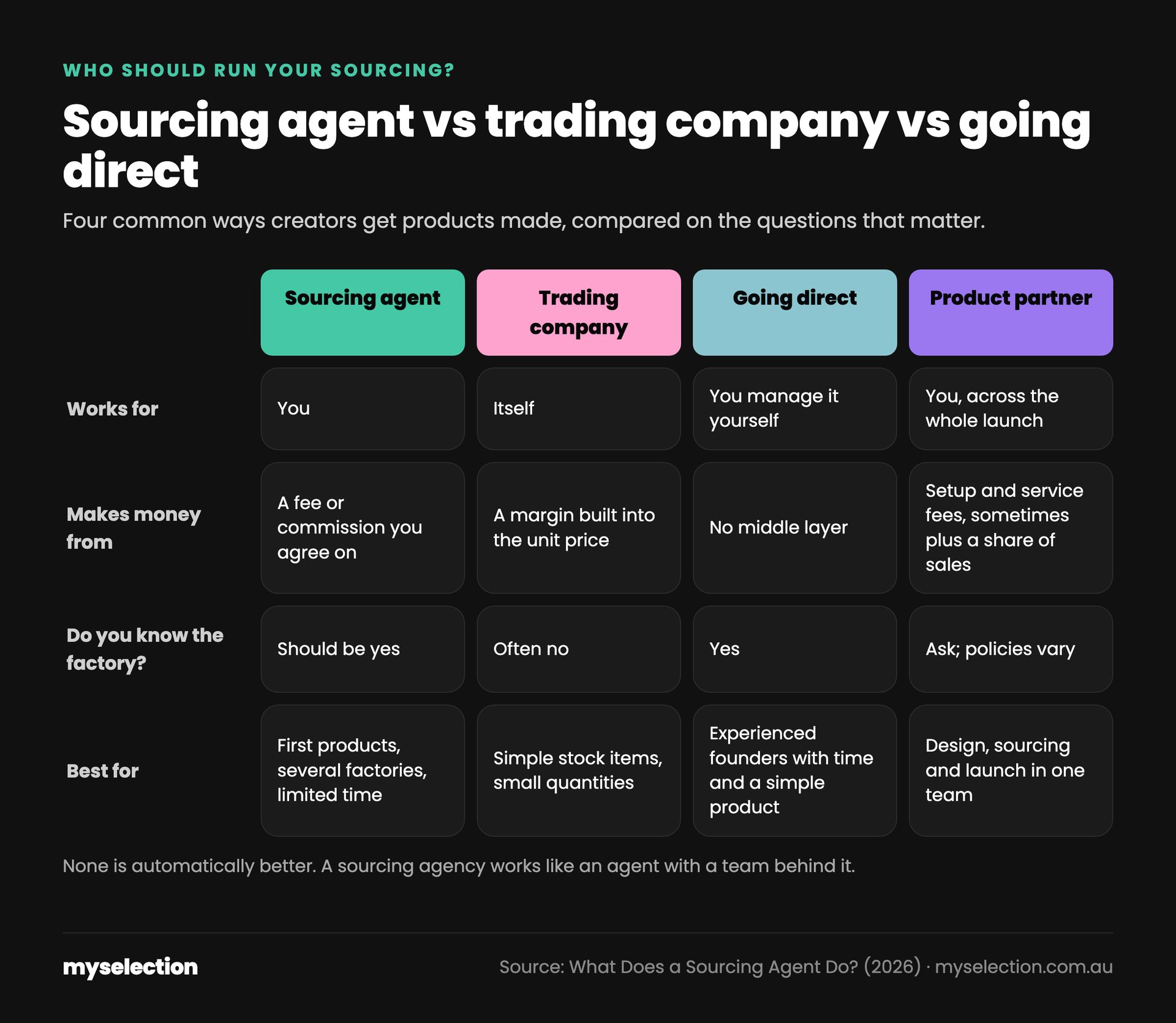
The four routes side by side.
None of these is automatically better. The right choice depends on your product, your experience and how much time you can give it.
How sourcing agents get paid
There's no single standard, so always get the fee model in writing before work starts.
| Fee model | How it works | Watch out for |
|---|---|---|
| Commission | A percentage of the order value | Make sure it's on your invoice, not hidden in the unit price |
| Fixed project fee | One price for an agreed scope | Check exactly what's included, such as sample rounds and inspections |
| Retainer or hourly | Ongoing fee for ongoing work | Fine for steady work, costly if you only need one product |
| Markup on unit price | The agent buys and resells to you | That's really a trading company. You won't see the factory price |
A transparent agent will tell you how they're paid without being asked twice. If the answer is vague or based on vibes, that's your answer.
Do you need a sourcing agent? A quick scorecard
Score your situation honestly.
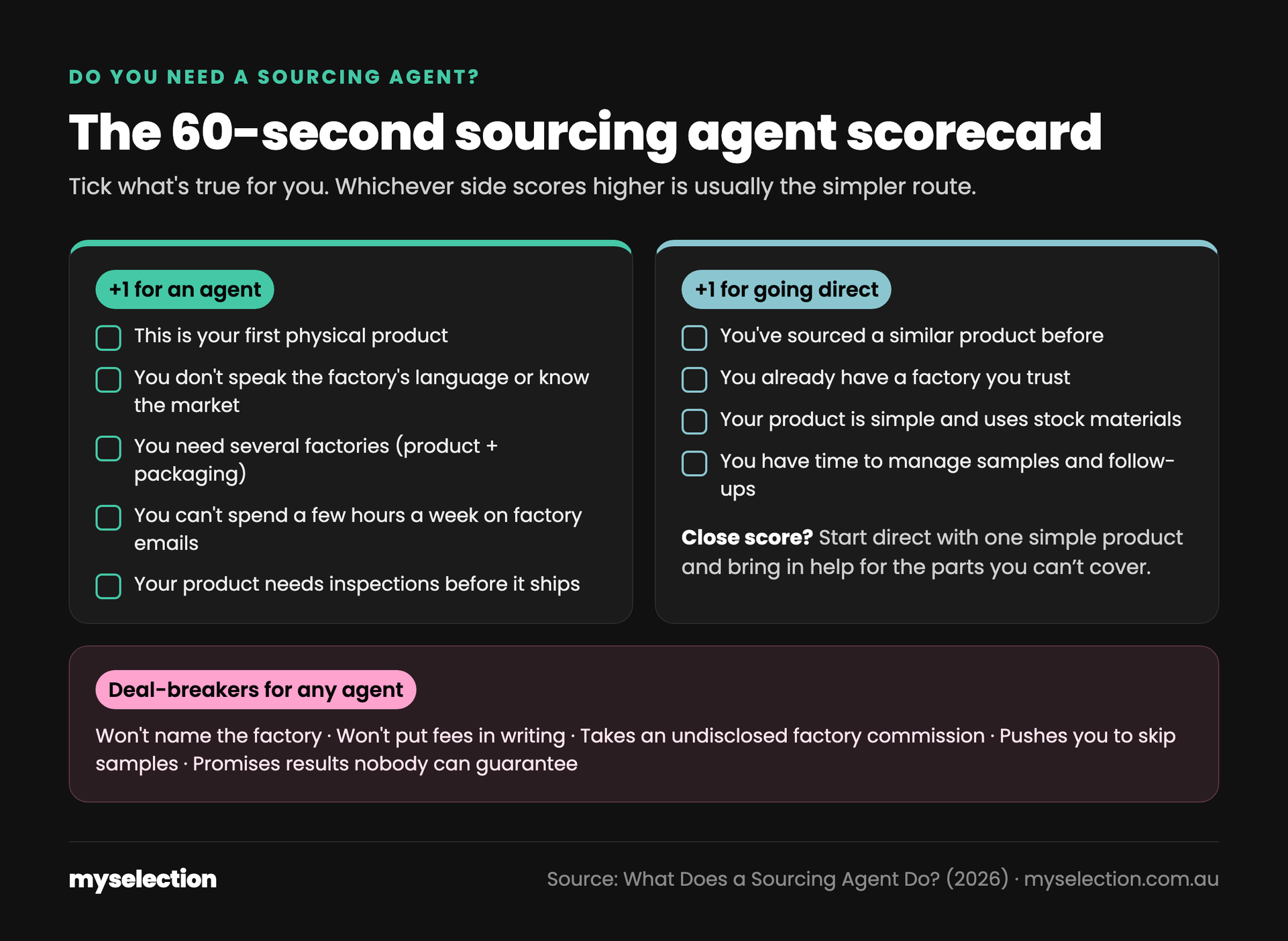
The 60-second scorecard. Tick what’s true for you.
Points in favour of an agent (one point each):
- This is your first physical product
- You don't speak the factory's language or know the local market
- You need several factories, such as one for the product and one for packaging
- You can't spend a few hours a week on factory emails and calls
- Your product needs inspections before it ships
Points in favour of going direct (one point each):
- You've sourced a similar product before
- You already have a factory you trust
- Your product is simple and uses stock materials
- You have time to manage samples and follow-ups yourself
If the first list wins, an agent or a product partner will probably save you time and mistakes. If the second list wins, going direct may be fine, especially with a solid checklist. If it's close, start direct with one simple product and bring in help for the parts you can't cover.
Deal-breakers for any agent: won't name the factory, won't put fees in writing, also takes an undisclosed commission from the factory, pushes you to skip samples, or promises results nobody can guarantee.
Questions to ask before you hire a sourcing agent
- Which parts of the process are included, and which cost extra?
- How are you paid, and will I see the factory's price?
- Will I know the name and location of the factory?
- Which product categories do you work with most?
- How many sample rounds are included, and who pays for samples?
- How do you check quality before goods ship?
- Who owns the relationship with the factory if we stop working together?
- How often will I get updates, and in what format?
If MOQs are part of the negotiation, our guide to MOQ meaning and how to work with a high minimum will help you go in prepared. And whichever route you choose, the checks in our guide to finding real-deal suppliers still apply.
Where My Selection fits
My Selection works more like a product partner than a single agent. We help creators go from product idea to launch, covering product development, sourcing coordination, ecommerce and fulfilment support, with the exact scope confirmed per project.
Sourcing runs through long-term partner factories in Jiangsu, Zhejiang and the Pearl River Delta and a wider network of 867 suppliers across 34 countries, with our own development team in China keeping development moving in real time. We don't promise fixed unit prices, minimums or lead times up front, because those depend on your product.
FAQ
Is a sourcing agent worth it for small orders? It can be, if the agent works at your quantities and the fee is clear. For very small runs of stock items, a trading company or a semi-custom option can be simpler.
What's the difference between a sourcing agent and a buying agent? The terms are often used interchangeably. Both act for the buyer. Focus on the scope and fee model rather than the job title.
What does a China sourcing agent do differently? The role is the same. A China-based agent adds local language, time zone and supplier knowledge, and can visit factories in person.
Can a sourcing agent help with packaging too? Many can, either through the same factory or a separate packaging supplier. Ask whether packaging minimums and samples are included.
Want help sourcing your first product?
Not sure whether you need an agent, a partner or just a better brief? Discuss your product idea with us, and we'll help you work out the simplest route for your product and your stage.