POV: your comments keep asking "where can I buy this?" Plot twist: the product doesn't exist yet. Product sourcing is how you close that gap. It means finding, checking and agreeing terms with the manufacturer who will make your product, from the first written brief to an approved sample and a confirmed production order.
This guide walks the whole path in the order you'll actually live it. You'll get a product brief template a factory can quote from, a way to compare quotes like-for-like, and a clear picture of where sourcing ends and fulfilment begins.
What product sourcing actually covers
Product sourcing sits between "I have an idea" and "I have stock ready to ship". It is not the same as manufacturing, and it is not fulfilment either. Mixing the three up is how launches slip.
| Stage | The question it answers | Who usually does the work |
|---|---|---|
| Product sourcing | Who will make this, to what spec, at what price and quantity? | You, a sourcing agent, or a product partner |
| Manufacturing | Making the units to the approved sample | The factory |
| Fulfilment | Storing stock and getting orders to customers | You, a 3PL or a fulfilment partner |
A quick note on two words people use loosely. A manufacturer makes the product. A supplier is anyone who sells it to you, which can be the manufacturer, a trading company or a wholesaler. When you are building your own brand, you usually want to know exactly which factory is making your product, even if someone else manages the relationship.
There are a few ways to get products to sell, and they suit different stages:
| Route | What it means | Fits when |
|---|---|---|
| Custom product | Made to your own design and spec | You want something only your brand sells |
| Semi-custom | An existing factory design with your colours, logo and packaging | You want your own brand with less tooling and a smaller first run |
| Wholesale | Buying finished products to resell | You want to test demand quickly, without your own branding |
| Dropship or print on demand | A supplier makes or ships each order for you | You want almost no stock risk and accept thinner margins |
This guide focuses on the first two, where sourcing really matters. If you want help with it as part of a wider launch, see our packages that include product sourcing alongside product development, ecommerce and fulfilment support.
The product sourcing process, step by step
Most creator products go through the same six steps, whatever the category.
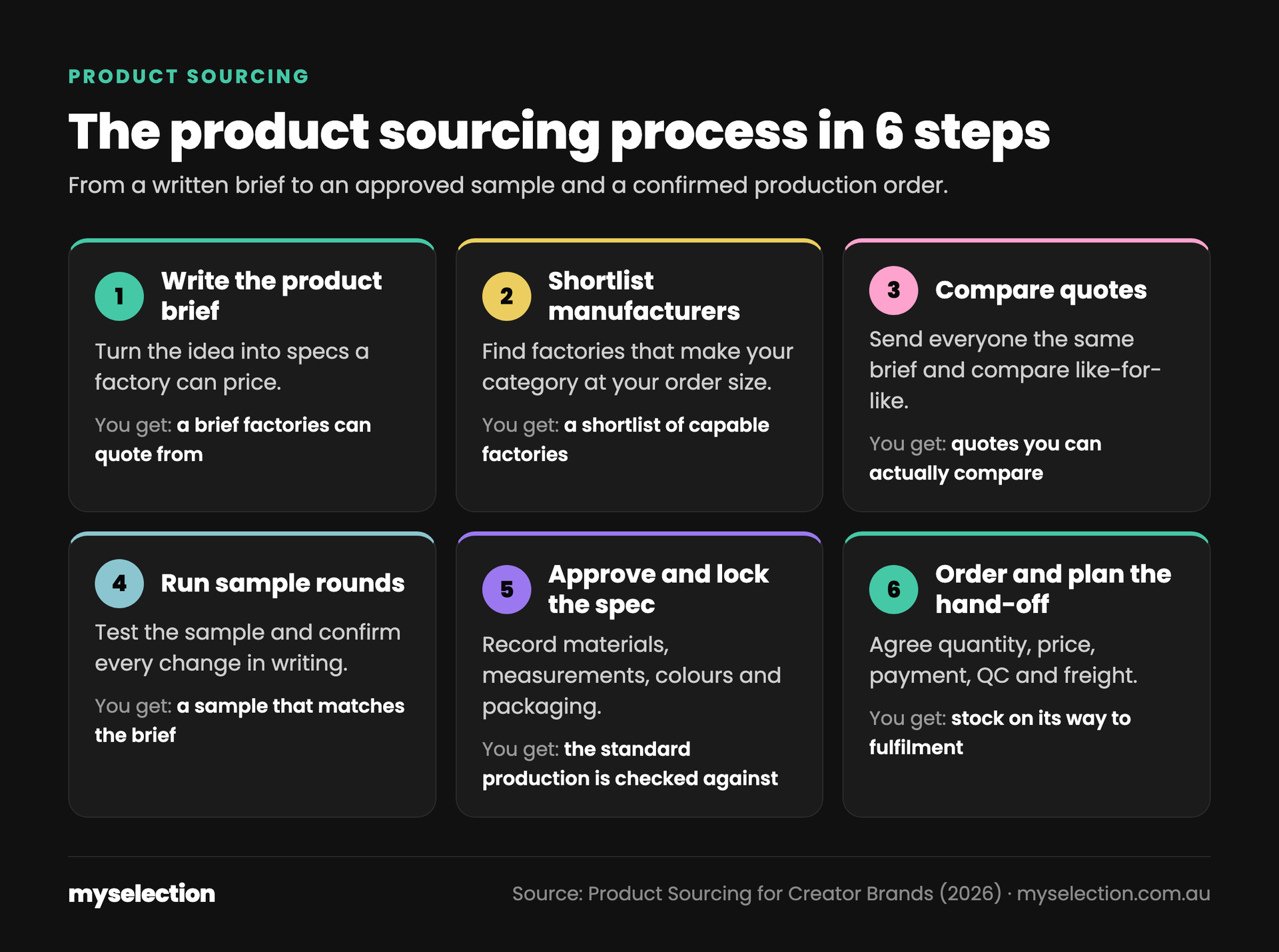
The product sourcing process in 6 steps. Free to share with a link back to this guide.
- Write the product brief. Turn the idea into something a factory can price: what it is, what it's made of, sizes, colours, branding, quantities and your target cost.
- Shortlist manufacturers. Look for factories that already make your category at your order size. A factory that makes great products at 20,000 units is not automatically a fit for a first run of 500.
- Request and compare quotes. Send every factory the same brief so the quotes are comparable (more on that below).
- Run sample rounds. Expect at least one round of changes. A sample is evidence, not a formality.
- Approve the reference sample and lock the spec. Write down exactly what you approved: materials, measurements, colours, packaging. This becomes the standard production is checked against.
- Place the production order and plan the hand-off. Agree quantity, price, payment terms, quality checks and how finished stock leaves the factory and reaches your storage or fulfilment partner.
Before you contact a factory: the readiness checklist
- A written product spec (materials, dimensions, key features)
- A target unit cost and a rough retail price
- A first order quantity you can afford and realistically sell
- Logo files and packaging ideas, even if not final
- The markets you'll sell into and any category rules you know apply
- Budget and time for at least one sample revision
- A plan for where finished stock will go when it lands
Step 1: a product brief a factory can actually quote
Vague briefs get vague quotes, or no reply at all (factory ghosting is real). A good brief answers the questions a factory would otherwise have to ask you.
| Brief field | What to include |
|---|---|
| Product and use | What it is, who uses it, where and how |
| Reference | Photos or links of similar products, plus what you want to change |
| Materials and finish | Fabric, plastic, metal, coating, texture; "or equivalent" if you're flexible |
| Sizes, colours, variants | Every size and colour you want in the first run (fewer is cheaper) |
| Branding | Logo placement and method (print, embroidery, deboss), labels, swing tags |
| Packaging | Retail box, polybag, insert cards, shipping carton needs |
| Quantities | First order quantity per variant, and what you expect to reorder |
| Target cost | The unit cost you need to hit for your retail price to work |
| Quality must-haves | The three or four things that would make you reject a unit |
| Compliance and labelling | Markets you'll sell into and any category rules you already know about |
| Timeline | When you want samples and when you want stock, written as a target |
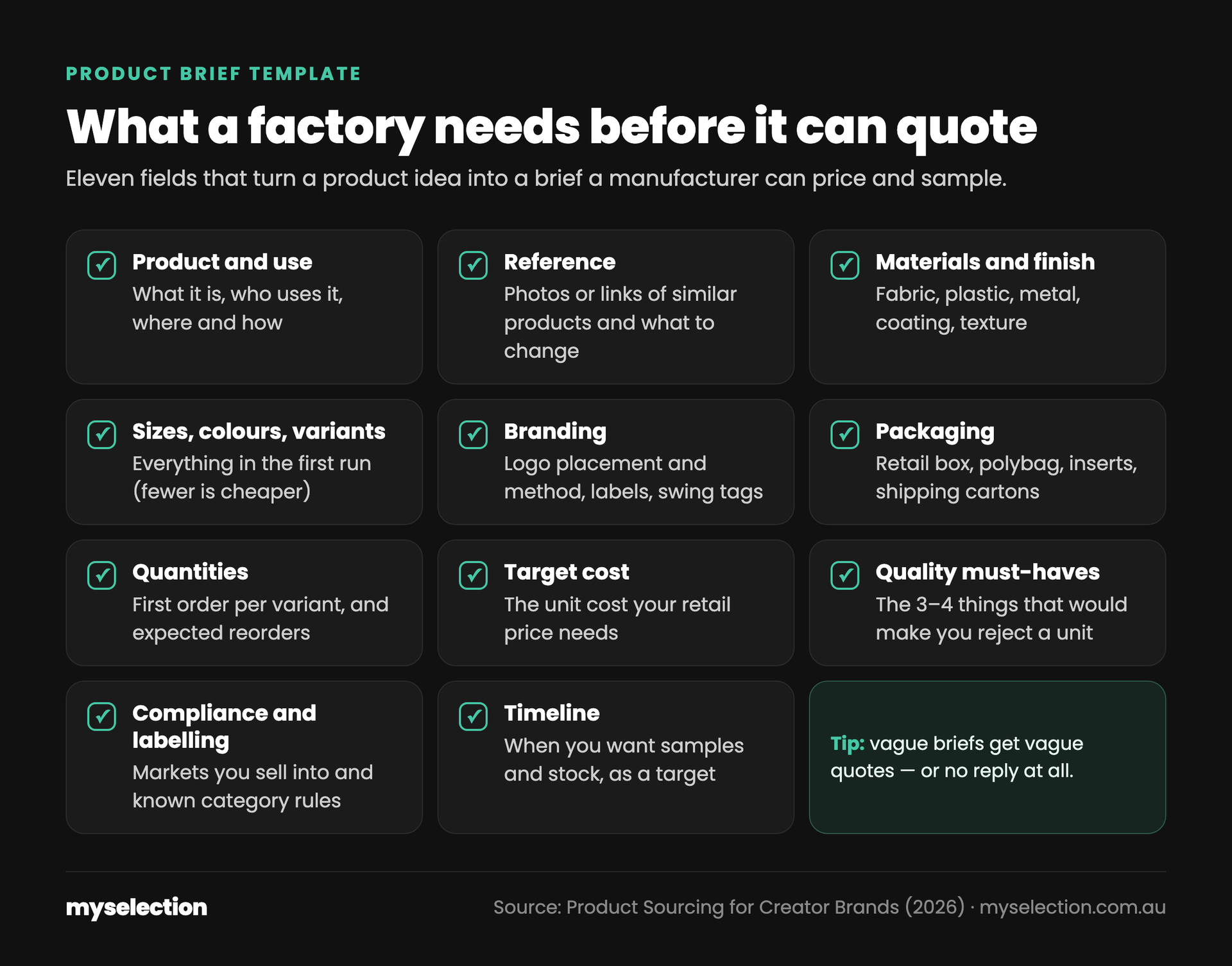
The 11-field product brief, at a glance.
Illustrative example (not a real client): a fitness creator wants an insulated water bottle. The brief says 750 ml, double-wall stainless steel, matte powder coat in two colours, laser-engraved logo, gift box with insert card, 300 units per colour for the first run, a target unit cost that leaves room for a healthy retail margin, and "no leaks after 24 hours upside down" as a must-have.
Step 2: shortlist manufacturers
Where you find factories matters less than how you check them. Trade directories, marketplaces, trade shows, referrals and sourcing partners all work. What matters is confirming the factory makes your category, works at your quantities, can show past samples and will put terms in writing.
Our guide to finding real-deal suppliers covers the checks in more depth, so we won't repeat them all here.
Step 3: compare quotes like-for-like
Two quotes with different assumptions are not comparable, no matter how good one looks based on vibes. Line them up field by field.
| Quote field | Why it matters |
|---|---|
| Unit price at your quantity | The headline number, but only one part of the cost |
| Minimum order quantity (MOQ) | Can be per order, per colour or per material |
| Tooling or setup cost | Moulds, plates or screens, usually paid once |
| Sample cost and timing | Some factories credit sample fees against the order |
| Lead time | Sample lead time and production lead time are different numbers |
| Payment terms | Deposit and balance, and when each is due |
| Shipping term (Incoterm) | Which delivery costs the price covers and where risk passes to you: EXW (you collect from the factory), FOB (loaded on board at the origin port) or DDP (delivered to your door, duties paid) |
| Packaging | Whether branded packaging is included or quoted separately |
MOQ deserves its own read. Our guide to MOQ meaning and how to plan around it shows how minimum quantities change your real unit cost and the cash you need. For shipping terms, the International Chamber of Commerce publishes the official Incoterms rules.
Steps 4 and 5: samples and the approved spec
Ask for photos and measurements before a sample ships, and check the physical sample against your brief line by line. Test it the way your audience will use it. Write every requested change down and get the factory to confirm it in writing.
When a sample is right, treat it as the reference: keep one, photograph it, and record the final spec. Production quality is measured against this, so "close enough" now becomes a problem at 500 units.
Who runs the sourcing: you, an agent or a partner
You can run sourcing yourself, hire a sourcing agent, or work with a partner who covers sourcing as part of product development and launch.
- Doing it yourself works if you have time, some experience and a simple product.
- A sourcing agent finds and manages factories for you, usually for a fee or commission. Our guide to what a sourcing agent does explains the role, the costs and the red flags.
- A product partner covers sourcing alongside design, development and launch, which suits creators who want one team across the whole journey.
Where sourcing ends and fulfilment begins
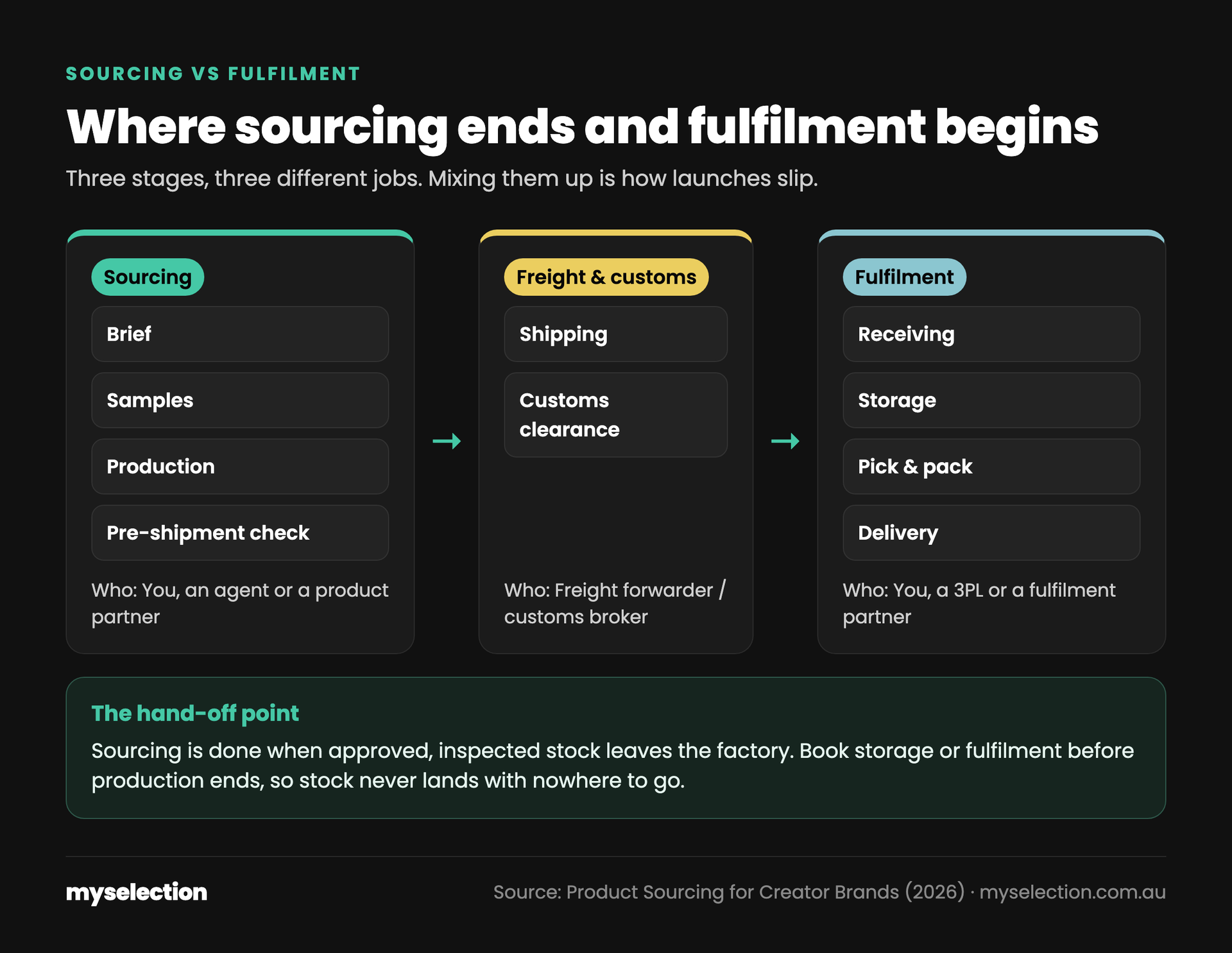
Sourcing ends when approved, inspected stock leaves the factory.
Sourcing's job is done when approved, inspected stock leaves the factory. Freight and customs clearance then get it to your warehouse, where fulfilment takes over: receiving, storage, picking, packing and delivery to customers. Decide where stock will go before production finishes, or you'll have 600 boxes and nowhere to put them. Our guide to how ecommerce fulfilment works explains what happens after the hand-off.
Common sourcing mistakes (and the fix)
| Mistake | What happens | Fix |
|---|---|---|
| Approving on vibes | Production doesn't match what you pictured | Approve a physical sample against a written spec |
| Too many variants in run one | MOQs multiply and cash gets stuck | Launch with your best one or two colours |
| Comparing headline prices only | The "cheap" quote ends up the most expensive | Compare tooling, samples, shipping terms and packaging too |
| No written changes | Requested fixes quietly disappear | Confirm every change by email or in the order |
| No plan for stock | Inventory lands with nowhere to go | Book storage or fulfilment before production ends |
A note on product safety and labelling
Rules depend on the product and the market you sell into. Children's products, cosmetics, food-contact items and electronics often have specific requirements. Check the rules for each market early, for example through the US Consumer Product Safety Commission, Product Safety Australia or the EU's General Product Safety Regulation. This guide explains the sourcing process; it isn't legal or compliance advice for your product.
How My Selection helps with product sourcing
My Selection helps creators turn audience demand into physical product brands. For sourcing, that means working with long-term partner factories in Jiangsu, Zhejiang and the Pearl River Delta, with our own development team in China coordinating development in real time. Our supplier network covers 867 suppliers across 34 countries, and our team includes 10+ designers.
What's included, which categories fit and what quantities make sense are confirmed per project. We don't publish fixed lead times, MOQs or unit costs for products, because they depend on the product.
FAQ
How long does product sourcing take? It depends on the category, how ready your brief is and how many sample rounds you need. Ask each factory for separate sample and production lead times, and plan for at least one revision.
Is product sourcing the same as dropshipping? No. Dropshipping usually sells an existing product shipped by a supplier. Product sourcing for a brand means getting your own version made to your spec.
What does product sourcing cost? Expect samples, unit cost, any tooling, packaging, freight, import costs and, if you use one, agent or partner fees. Your quotes should show each one separately so you can compare them.
Do I need to visit the factory? Not always. Video calls, detailed samples, third-party inspections and a trusted partner on the ground can cover a lot of what a visit would.
Ready to source your first product?
Got an idea and an audience that wants it? Discuss your product idea with us, and we'll help you work out whether it's ready for factories and what the next step should be.