Packaging for small business has three jobs: protect the product, ship without costing a fortune, and look like your brand. For a first production run, the right choice is usually the simplest packaging that does all three, not the most impressive box on your mood board. This guide sorts the options into types first, then compares them, then gives you a spec checklist to send your supplier.
POV: you saved 40 unboxing videos and now want a rigid magnetic box with foil, tissue, a sticker, a thank-you card and confetti. Plot twist: each of those is a separate item with its own minimum order, its own sample and its own chance to be late. Packaging decisions also change your shipping cost, because carriers charge by size as well as weight.
This is what we do at My Selection: we help creators develop physical products and coordinate with factories through samples and production, including the packaging that goes with them. If your first run is coming up, tell us what you're making.
In this guide:
- The three layers of product packaging
- Custom packaging options compared
- Packaging for small business: which option fits which brand
- Packaging spec checklist
- Vague vs usable packaging specs
- FAQ
The three layers of product packaging
Before choosing a box, separate what you need into layers:
- Primary packaging touches the product: a bottle, pouch, polybag or wrap. Often made by the product factory.
- Retail or product packaging is what the customer sees and keeps: a printed box, bag or label. This is where most product packaging design happens.
- Shipping packaging gets it to the customer: a mailer box, padded envelope or outer carton, plus any inserts or fill.
Many small brands combine layers 2 and 3: one printed mailer box that is both the brand moment and the shipping box. That's often the smartest first move.
Custom packaging options compared
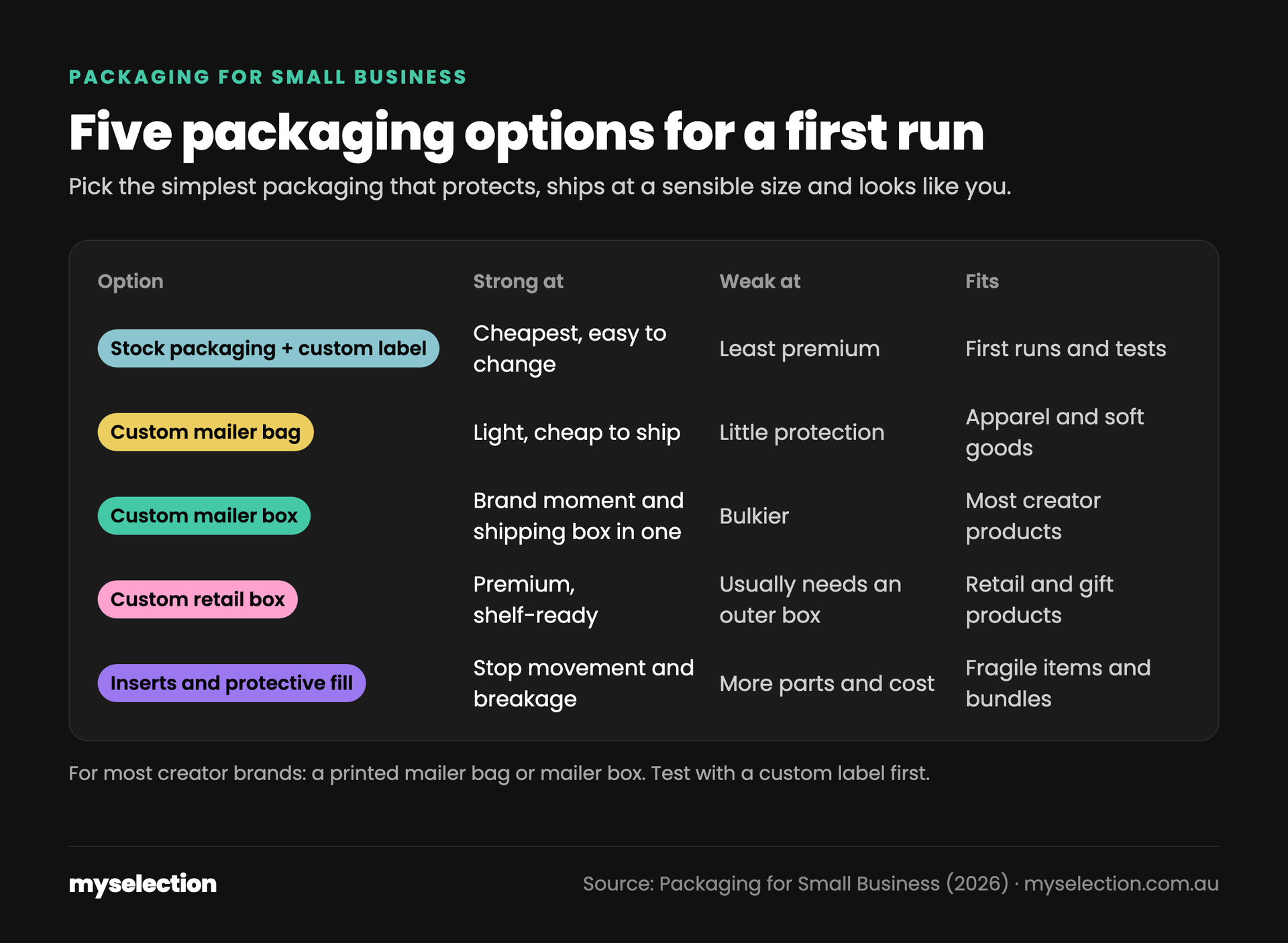
Five common options for a first run. Free to share with a link back to this guide.
1. Stock packaging with a custom label or sticker
- Strong at: low cost, small quantities, easy to change later.
- Weak at: looks less premium; label placement needs care.
- Fits: first runs, product tests, brands still changing their look.
- Doesn't fit: gift-led products where the box is part of the value.
2. Custom-printed mailer bag
- Strong at: light and flat, so it keeps shipping costs down; prints well.
- Weak at: little protection against crushing.
- Fits: apparel and other soft goods.
- Doesn't fit: anything breakable or that needs to arrive with sharp corners.
3. Custom mailer box
- Strong at: protection and the unboxing moment in one box; no separate outer carton for single orders.
- Weak at: bulkier than a bag, so it can push you into a higher shipping band; usually has its own minimum order.
- Fits: most creator products, especially accessories, homewares and bundles.
- Doesn't fit: very small or very cheap items where the box costs more than it adds.
4. Custom retail box (folding carton or rigid box)
- Strong at: premium look, room for product information, shelf-ready for retail.
- Weak at: usually needs an outer shipping box as well; rigid boxes are heavy and take space.
- Fits: gift products, beauty and premium items, or anything heading to retail shelves.
- Doesn't fit: a direct-to-customer brand on a tight first-run budget.
5. Inserts and protective fill
- Strong at: stopping movement and breakage; making a multi-item pack feel organised.
- Weak at: each insert is another part to design, sample and approve.
- Fits: fragile products and bundles.
- Doesn't fit: soft goods that already travel well in a bag.
| Option | Protection | Brand impact | Shipping size | Complexity |
|---|---|---|---|---|
| Stock packaging + custom label | Depends on stock item | Low to medium | Small | Low |
| Custom mailer bag | Low | Medium | Smallest | Low |
| Custom mailer box | Medium to high | High | Medium | Medium |
| Custom retail box | Medium (needs outer box) | High | Larger | Higher |
| Inserts and fill | High | Medium | Adds size | Adds parts |
Packaging for small business: which option fits which brand
- Selling apparel online: a custom mailer bag, with the garment in a polybag inside, plus a printed card if you want a brand moment.
- Selling accessories, homewares or bundles online: a custom mailer box, with an insert only if items move or break.
- Testing a first product with a small run: stock packaging with a good custom label. Upgrade once the product sells through.
- Heading for retail or gifting: a custom retail box, shipped inside plain outer cartons.
Whatever you choose, check it against your product launch checklist: packaging is often the item that runs late, because it has its own samples and printing.
Packaging spec checklist
Packaging is part of the product, so it belongs in the product development process, not as an afterthought once production has started. Send your supplier a spec, not a mood board.
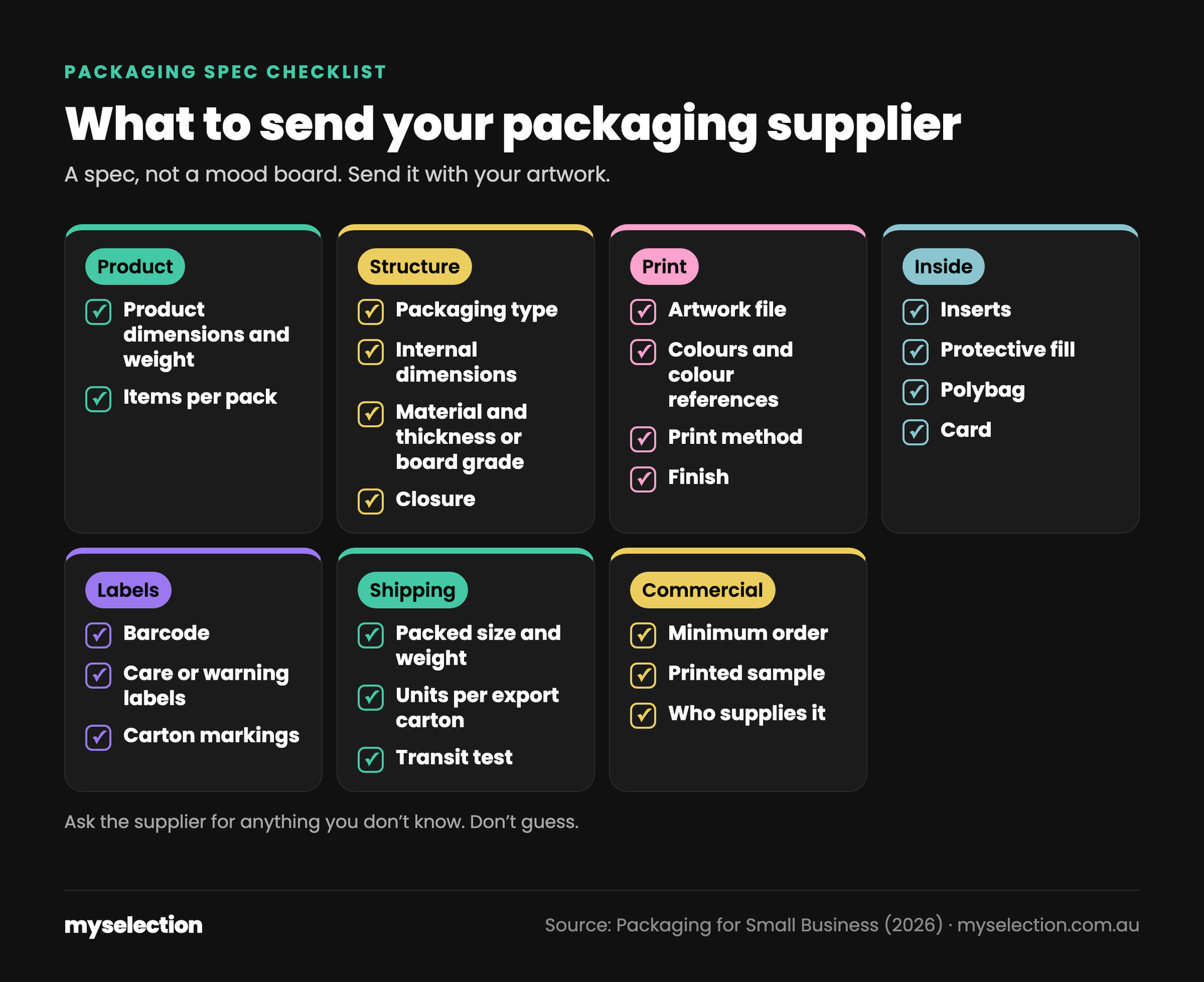
Send this with your artwork. Free to share with a link back to this guide.
- Product: product dimensions and weight; how many items go in each pack.
- Structure: packaging type, internal dimensions, material and thickness (or board grade), and how it closes.
- Print: artwork files, colours with a physical colour reference, print method and finish (matte, gloss, uncoated).
- Inside: inserts, protective fill, polybags, thank-you cards.
- Labels: barcodes if you need them, care or warning labels, export carton markings.
- Shipping: packed size and weight (this drives your shipping rate), units per export carton, and whether to run a transit test. Organisations like ISTA publish standard transit test procedures that packaging suppliers and labs use.
- Materials claims: if you want to say the paper is responsibly sourced, ask for certification you can check, such as FSC certification, rather than a "sustainable" sticker.
- Commercial: the packaging minimum order, a printed sample before bulk, and who supplies it (the product factory or a separate packaging supplier).
If your product already has a tech pack, put the packaging spec in it, so the factory and the packaging supplier work from the same document.
Vague vs usable packaging specs
| Vague | Usable |
|---|---|
| "Nice box" | "Mailer box, white outside, printed 1 colour inside, internal 220 × 160 × 60 mm" |
| "Eco-friendly" | "Recycled-content board with certification we can verify; no plastic window" |
| "Protective" | "Card insert holds the bottle upright; packed unit passes the agreed transit test (for example an ISTA procedure)" |
| "Brand colours" | "Matched to a physical colour reference, printed sample approved before bulk" |
| "Small" | "Packed size and weight within our courier's lower price band" |
All dimensions here are illustrative; yours come from your product. On inspection day, packaging is checked too: a pre-shipment inspection can confirm packing, labels and carton marks match your spec.
Conclusion
Start with the simplest packaging that protects the product, ships at a sensible size and still looks like you. For most creator brands that's a printed mailer bag or mailer box; if you're still testing the product, start with stock packaging and a custom label, then upgrade. Write a proper spec, approve a printed sample, and leave the foil and magnets for the second run, when you know the product sells.
FAQ
What is the cheapest packaging for a small business? Usually stock packaging with a custom label or sticker, or a printed mailer bag for soft goods. Both avoid a custom box's minimum order and keep shipping size down. The real comparison is packaging cost plus shipping cost per order, not the box price alone.
Do I need custom packaging for my first product? No. Custom packaging helps with the unboxing experience, but a first run can launch in good stock packaging with a custom label. Many brands upgrade once the product has sold through and they know their volumes.
Who makes product packaging: the factory or a separate supplier? Either. Simple packaging like polybags and labels often comes from the product factory. Printed boxes and inserts often come from a packaging supplier. Agree who supplies what and who approves the printed sample.
Discuss your product idea
Planning packaging for your first run? Discuss your product idea with us. My Selection helps creators with creator product development, working with long-term partner factories in Jiangsu, Zhejiang and the Pearl River Delta and our own development team in China. Our supplier network covers 867 suppliers across 34 countries, with 10+ designers on the team. Which products fit and what's included are confirmed per project. Lead times, MOQs and unit costs depend on the product, so we confirm those too.