POV: your comments keep asking when you'll make your own version. You say "soon", then open a factory website and close it again. Plot twist: nobody needs to know everything about manufacturing on day one. You need to know what comes next, and what has to be true before you pay for it.
This guide shows how to create a product step by step, from a rough idea to stock you can sell. It's written for creators making a physical product for the first time. Instead of another list of steps, you get the decision to make at each stage and the proof you should have in hand before moving on, so your budget goes on evidence rather than vibes.
If you want support along the way, see our packages for product development support.
How to create a product in 7 stages: the product development process
The product development process is the sequence that takes a product from idea to something a factory can make again and again. New product development in big companies uses the same logic: break the work into stages, and put a go/no-go decision between them, so a bad idea gets stopped while it's still cheap.
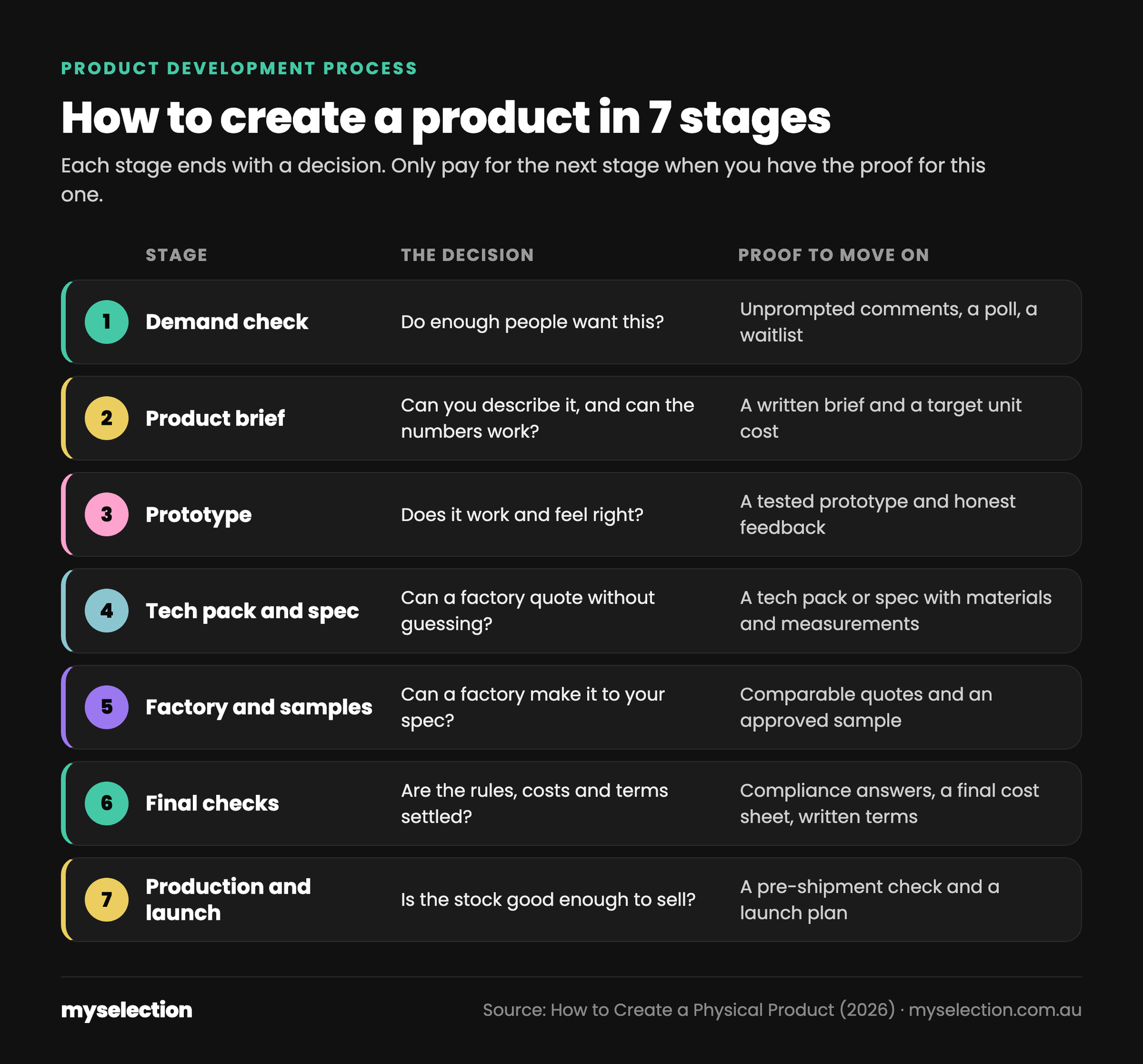
Seven stages, seven decisions. Free to share with a link back to this guide.
| Stage | The decision | Proof you need to move on |
|---|---|---|
| 1. Demand check | Do enough people want this? | Unprompted comments, a poll, a waitlist |
| 2. Product brief | Can you describe it, and can the numbers work? | A written brief and a target unit cost |
| 3. Prototype | Does it work and feel right? | A tested prototype and honest feedback |
| 4. Tech pack and spec | Can a factory quote without guessing? | A tech pack or spec with materials and measurements |
| 5. Factory and samples | Can a factory make it to your spec? | Comparable quotes and an approved sample |
| 6. Final checks | Are the rules, costs and terms settled? | Compliance answers, a final cost sheet, written terms |
| 7. Production and launch | Is the stock good enough to sell? | A pre-shipment check and a launch plan |
Stage 1: check demand before you design anything
Your audience is your unfair advantage here, so use it. Look for people asking for the product without being prompted, then test it: a poll, a "would you buy this?" story, or a waitlist.
Likes are nice. A waitlist with email addresses is better, because it costs people a little effort. Pre-orders are stronger still, but only take them when you can deliver. Don't promise a date you don't have yet; that's how you end up ghosting your own customers.
Move on when: you can point to real people asking for this specific thing, not just people who like you.
Stage 2: write the product brief
A brief turns an illustrative "better gym bottle" into something you can check: who it's for, what it does, the materials you have in mind, the sizes and colours, how it's branded and packaged, and the unit cost your retail price needs.
Work out that target cost now. Start from the price your audience would pay, then take off your margin, shipping, fulfilment and platform fees. What's left is what the product can cost to make. If the idea only works at a price nobody would pay, you've just saved yourself a lot of money.
This is also where you choose your route. Starting from a factory's existing product is very different from designing from scratch; our guides to private label products and OEM vs ODM explain the options.
Move on when: someone who has never heard your idea could read the brief and picture the same product.
Stage 3: make a prototype
A prototype is an early version built to answer a question: does it work, does it fit, does it feel right in the hand? It doesn't need to look finished. It needs to teach you something before you pay for a factory sample.
Use it the way your audience would. Give it to people who will tell you the truth, then write down what they struggled with. Our guide to prototype manufacturing compares the methods, from 3D printing to sewn mock-ups, and helps you pick one.
Move on when: the prototype has answered your biggest questions and you know what to change.
Stage 4: turn it into a tech pack or spec
Factories can't price a vibe. A tech pack is the document that spells out your product: drawings, measurements, materials, colours, construction, branding and packaging. Apparel and soft goods use the term most; hard goods often call it a spec pack with CAD files, but the job is the same.
Move on when: two different factories could read it and quote the same product.
Stage 5: find a factory and approve a sample
Send the same documents to a shortlist of factories that already make your category, so the quotes compare like-for-like. Then sample. Expect more than one round, and record every change in writing. Our product sourcing guide covers shortlisting, quotes and sample rounds in detail.
Check what the minimum order applies to while you're here; the same number can mean very different things. See MOQ meaning for how it changes your real cost per unit.
If your sample needs a mould, agree its cost and who owns it before you pay for tooling.
Move on when: you've signed off one physical reference sample. That sample, along with the spec, is what production gets checked against.
Stage 6: settle the rules, costs and terms
This is the stage people skip because the sample looks great. Before you pay a production deposit, get clear on three things:
- Rules: which safety, testing and labelling requirements apply to your category in the markets you sell into. The brand selling the product is usually expected to meet them, and regulators such as the US Consumer Product Safety Commission and Product Safety Australia publish guidance by product type. Categories like cosmetics, supplements, food, children's products and electronics often need professional advice.
- Costs: the full cost per unit, including packaging, inspection, freight, duties and fulfilment, not just the factory price.
- Terms: quantity, payment schedule, what happens if the stock fails inspection, and who owns the moulds and design files you pay for.
Move on when: the numbers still work with every cost included and the terms are in writing.
Stage 7: produce, check and launch
Ask for a check before the stock ships, while you still have leverage to get problems fixed. Book storage or fulfilment before production ends, so stock never lands with nowhere to go.
On the content side, you have a head start most brands would pay for: your audience has watched the product come together. Show the ugly prototypes and the sample that failed. People who saw the plot twists have a reason to care about the finale.
You're done when: checked stock is on its way, fulfilment is booked and your waitlist knows what's coming.
Do you need every stage?
Not always. How much development you do depends on how much of the product already exists. Skipping design work is fine. Skipping evidence isn't.
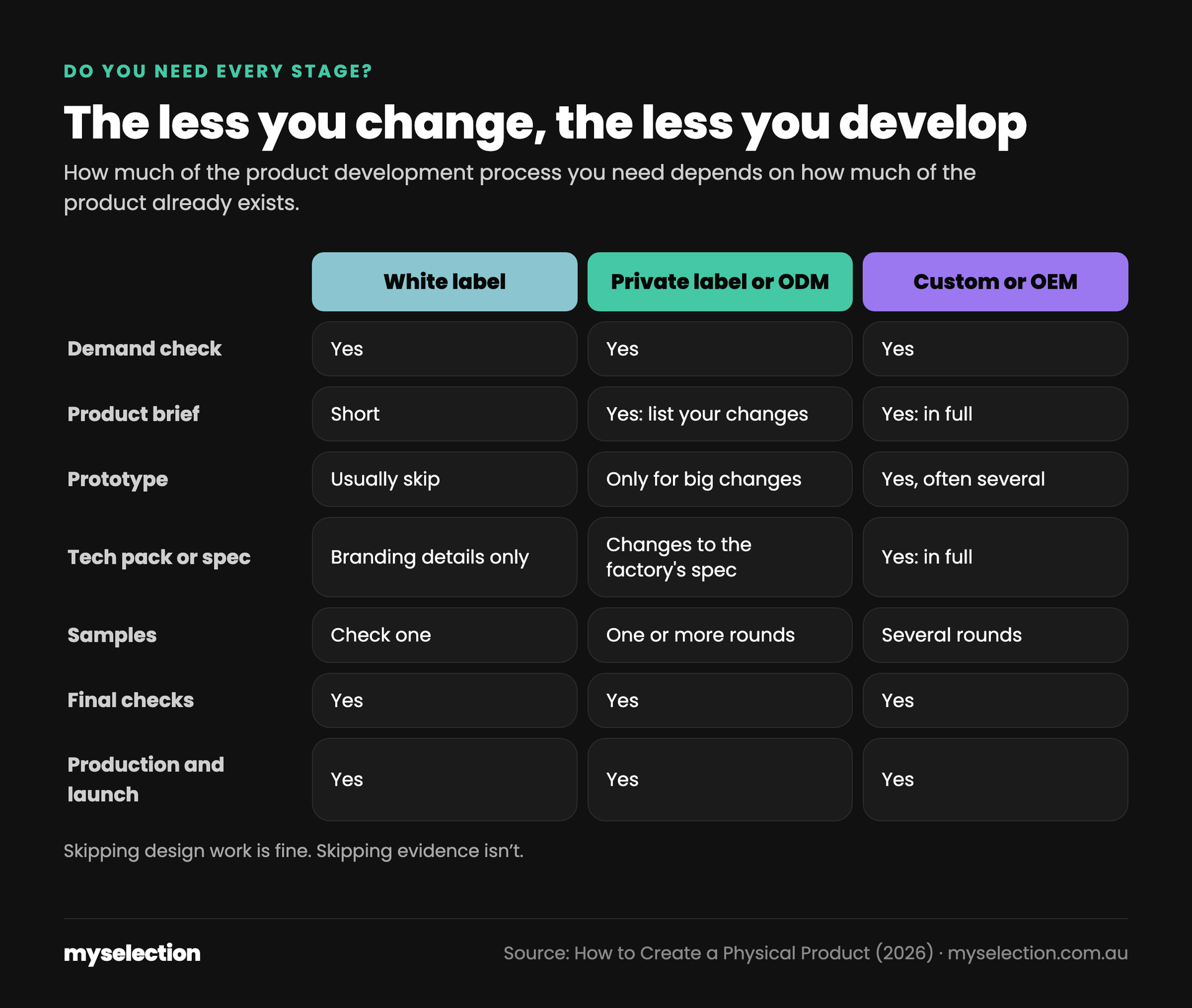
The less you change, the less you develop. Demand checks and final checks apply to everyone.
| Stage | White label | Private label or ODM | Custom or OEM |
|---|---|---|---|
| Demand check | Yes | Yes | Yes |
| Product brief | Short | Yes: list your changes | Yes: in full |
| Prototype | Usually skip | Only for big changes | Yes, often several |
| Tech pack or spec | Branding details only | Changes to the factory's spec | Yes: in full |
| Samples | Check one | One or more rounds | Several rounds |
| Final checks | Yes | Yes | Yes |
| Production and launch | Yes | Yes | Yes |
Illustrative example (not a real client): a yoga creator wants a cork block. Factories already make them, so they choose private label and skip the prototype, changing only the density, size and logo. A camera-gear creator wants a mount that doesn't exist yet, so they go custom, build several prototypes and write a full spec.
Common mistakes when creating a product
| Mistake | What happens | Fix |
|---|---|---|
| Starting with the factory | Quotes arrive for a product you haven't defined | Finish the brief first |
| Treating likes as demand | The launch is quieter than the comments suggested | Use a waitlist or pre-orders |
| Falling for the first prototype | Early flaws get carried into production | Test with people who will be honest |
| Too many variants | Minimums multiply and cash gets stuck | Launch with one or two |
| Ignoring the full cost | The margin disappears once freight and fulfilment are added | Build the cost sheet at stage 2, confirm at stage 6 |
| Announcing a date too early | You end up apologising to your audience | Share dates after production terms are agreed |
How My Selection helps you create a product
My Selection helps creators turn audience demand into physical product brands. That can mean shaping the brief, developing the design and working with factories, through long-term partner factories in Jiangsu, Zhejiang and the Pearl River Delta and our own development team in China. Our supplier network covers 867 suppliers across 34 countries, and our team includes 10+ designers.
Which categories fit, what quantities make sense and what's included are confirmed per project. Lead times, MOQs and unit costs depend on the product, so we confirm those too.
FAQ
How do you make a product with no experience? Follow the stages in order and only pay for the next one when you have the proof for the current one. You don't need to be an engineer. You do need a clear brief, honest testing and people who know the parts you don't.
How long does it take to develop a product? It depends on the product and route. A small change to an existing product can move much faster than a new design that needs tooling and several sample rounds. Ask each factory for its own sample and production timelines.
How much does it cost to create a product? There's no honest single number. Costs depend on materials, tooling, quantity and how much development you need. Plan for prototypes and samples, tooling, the production run, packaging, inspection, freight and fulfilment.
Should I patent my product first? Maybe. It depends on the product and where you sell, so talk to a qualified IP professional early, ideally before sharing a new design widely. Many products based on existing designs have nothing new to patent; your brand may be the asset to protect.
What's the difference between product development and sourcing? Product development decides what the product is. Sourcing finds who can make it and at what terms. They overlap at the sample stage.
Ready to start on your product?
Got a product idea your audience keeps asking for? Discuss your product idea with us, and we'll help you work out which stage you're really at and what to do next.