A product launch checklist is the list of everything that has to be true before you open sales: stock is approved and on its way, the store can take orders, your content is ready, and someone can pack and ship. This version is for creators launching a physical product, so it's ordered around the one date that moves everything else: when stock actually arrives.
POV: you announced a drop date in your stories. Plot twist: the cartons are still at the factory and your product page says "Lorem ipsum". Most launch checklists online are written for software, where "shipping" means pressing a button. A physical product launch has samples, inspections, freight and packaging in the way, and every one of them can move your date.
This is what we do at My Selection: we help creators develop physical products and coordinate with factories from sample to production, so launch day has real stock behind it. If you're planning a launch, tell us what you're making.
In this guide:
- Set the launch date last
- The product launch checklist, in countdown order
- Vague vs launch-ready
- What to do when something slips
- FAQ
Set the launch date last
The most common launch mistake is picking the date first. For a physical product, the launch date comes after three other dates are confirmed: production finished, inspection passed, and stock received where you'll ship from. If you're still at the idea or sample stage, start with the product development process from idea to production run; the checklist below assumes you have an approved sample.
A sensible product launch strategy works backwards: confirm when stock will be ready to sell, add a buffer for freight and receiving, then set the public date. Until then, talk about the product, not the date.
The product launch checklist, in countdown order
Here's the full checklist in one picture. The countdown is illustrative: stretch or squeeze it to your own production schedule, which your factory confirms per product.
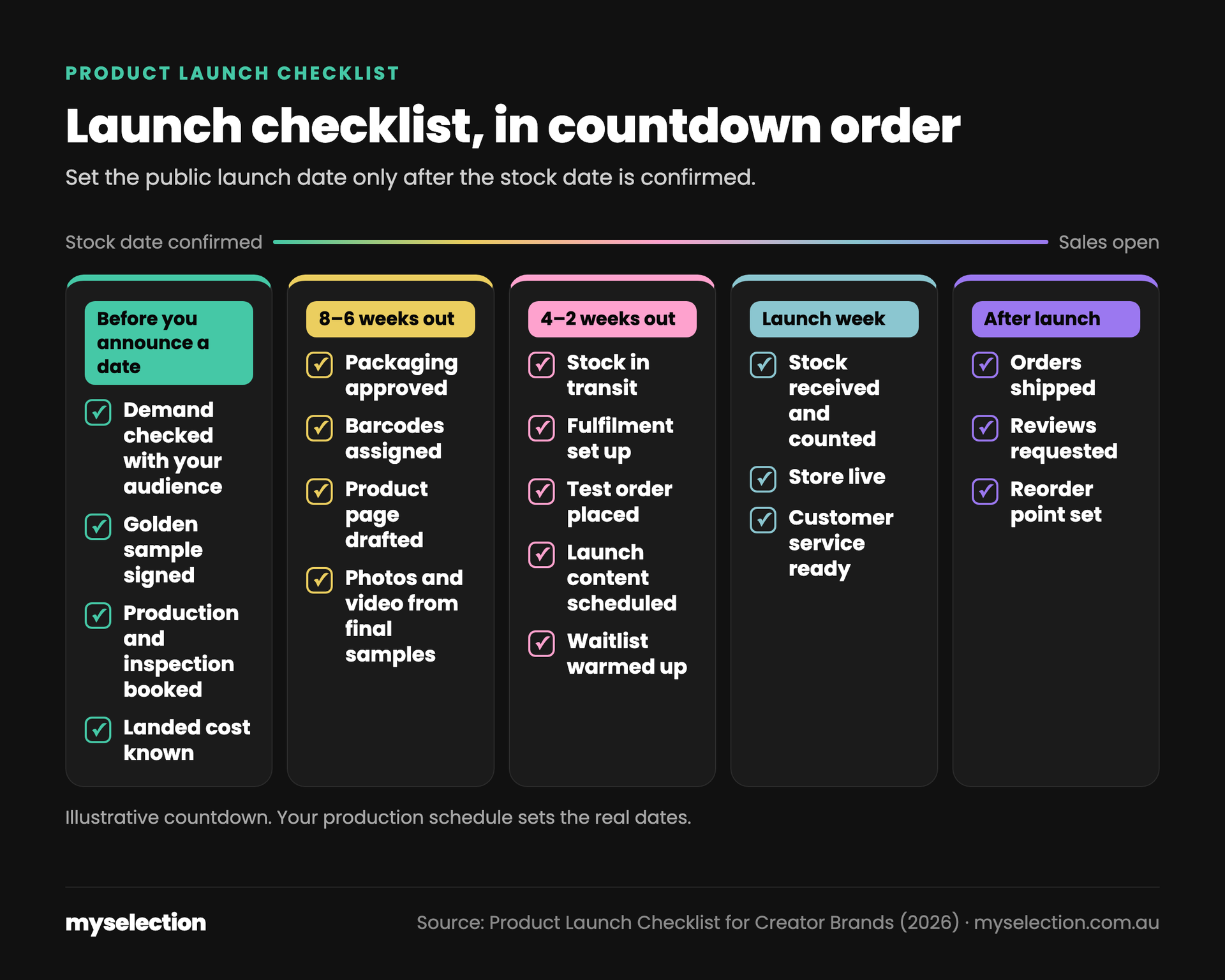
Illustrative countdown. Free to share with a link back to this guide.
Before you announce a date
- Demand checked. You've tested interest beyond likes: a waitlist, a poll with a real question, or pre-orders. If you haven't, see how to validate a product idea with your audience first. Pass: you can name roughly how many people asked to buy, not just how many said "cute".
- Golden sample signed. Approved samples signed in duplicate, one kept by you and one by the factory, are the reference for production. Pass: you have your copy in hand, with the spec version it matches.
- Production and inspection booked. The factory has confirmed a production schedule, and a pre-shipment inspection is booked before the balance is paid. Pass: the dates are in writing.
- Landed cost known. You know what one unit costs delivered to you, including freight, duties and fees, so the price makes sense. Pass: your retail price leaves a margin after landed cost, platform fees and shipping to customers.
8 to 6 weeks out (illustrative)
- Packaging approved. Mailer, retail box or bag, inserts and labels signed off as a printed sample, not a PDF. Our guide to planning packaging for your first run covers the options. Pass: the product fits, survives a drop, and the packed size works with your shipping rates.
- Barcodes assigned. If you'll sell through retailers or marketplaces that require them, get barcodes from GS1, the organisation that issues them, and put them on packaging before printing. Pass: each variant (size, colour) has its own code.
- Product page drafted. Title, description, size guide, materials, care instructions, price, shipping and returns. Your store platform's help centre covers the setup; for example, Shopify's guide to adding and updating products. Pass: someone who has never seen the product can understand what they're buying.
- Photos and video shot. Use pre-production or production samples, not early prototypes, so what people see is what they get. Pass: colours match the real product.
4 to 2 weeks out (illustrative)
- Stock in transit and tracked. You have the shipping documents and an expected arrival date. Pass: you know who to call if it's held.
- Fulfilment set up. Whether you pack at home or use a warehouse, the receiving process, packing materials and courier accounts are ready. Pass: you know who counts the stock when it lands.
- Test order placed. Buy your own product through the live checkout (then refund it), or use your platform's test payment mode. Pass: payment, confirmation email, shipping rate and tax all look right.
- Launch content scheduled. Teasers, launch-day posts, emails to your waitlist, and a story plan for the first week. Pass: every post has a link that works.
- Waitlist warmed up. Tell people what's coming and when sales open, once stock dates are confirmed.
Launch week
- Stock received and counted. Count cartons and spot-check units against the golden sample before you open sales. Pass: sellable stock matches what your store says you have.
- Store live. Inventory numbers set, product published, discount codes tested.
- Customer service ready. Answers ready for sizing, shipping times and returns, plus a way to handle "where's my order?" messages. Pass: someone is assigned to the inbox.
After launch
- Orders shipped and tracked. Ship in the order they came in; send tracking.
- Reviews and photos requested. Ask buyers a set time after delivery, not on day one.
- Reorder point set. Decide how many units left triggers the next production run, based on how long a reorder takes for your product. Pass: you know the number before you need it.
Vague vs launch-ready
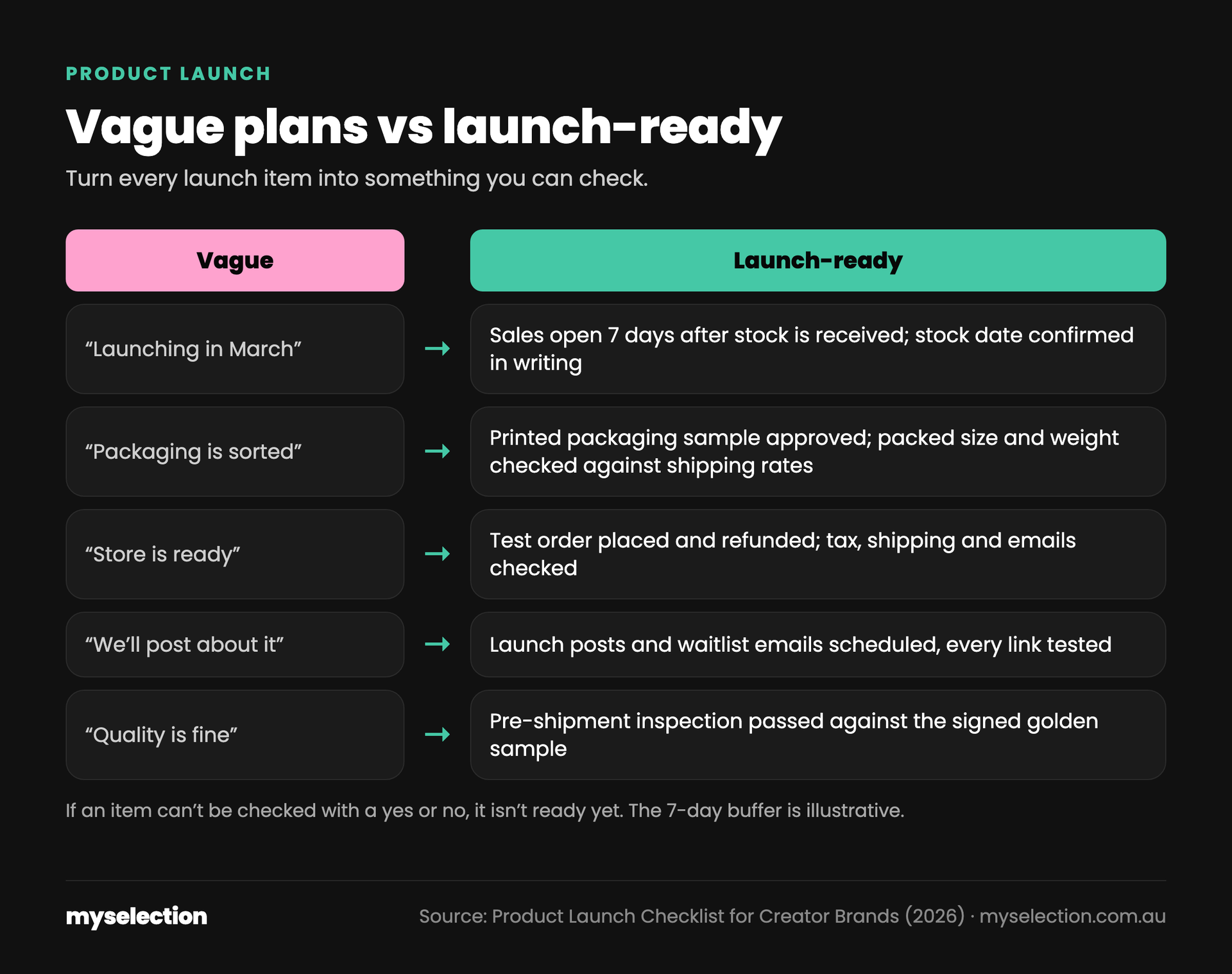
Turn every launch item into something you can check.
| Vague | Launch-ready |
|---|---|
| "Launching in March" | "Sales open 7 days after stock is received; stock date confirmed in writing" (illustrative buffer) |
| "Packaging is sorted" | "Printed packaging sample approved; packed size and weight checked against shipping rates" |
| "Store is ready" | "Test order placed and refunded; tax, shipping and emails checked" |
| "We'll post about it" | "Launch posts and waitlist emails scheduled, every link tested" |
| "Quality is fine" | "Pre-shipment inspection passed against the signed golden sample" |
If an item on your list can't be checked with a yes or no, it isn't ready yet.
What to do when something slips
Something usually slips. What matters is how you handle it:
- Production or inspection delayed. Don't announce a new date until the factory confirms one in writing. Tell your audience early and honestly; "the first batch didn't pass our quality check, so we're fixing it" builds more trust than ghosting your own launch.
- Freight delayed. Keep the date if the buffer covers it; if not, open pre-orders with a clear ship-by window instead of a hard launch.
- Packaging late. Shipping in plain mailers with a printed insert is better than holding finished stock.
- Stock arrives short or damaged. Count before you sell. Sell only what you've counted; deal with the factory and freight claim separately.
Conclusion
A product launch checklist for physical goods is really a list of dates and proofs. Lock the stock date first, set the public launch date after it, and make every item checkable: signed sample, passed inspection, test order, counted stock. Do that and launch day is about selling, not apologising.
FAQ
How far in advance should you plan a product launch? Plan from the stock date, not the calendar. Start launch content and store setup once production is scheduled, and set the public date only when you know when stock will be received. How long that takes depends on the product, the factory's schedule and freight, so get those dates confirmed before announcing.
What should be on a product launch checklist? For a physical product: validated demand, a signed golden sample, booked production and inspection, known landed cost, approved packaging, barcodes if needed, a finished product page, tested checkout, fulfilment set up, scheduled launch content, counted stock, and a reorder point.
How do you start a product line as a creator? Start with one product your audience has already asked for, validate demand before paying for production, then expand into variants or related products once the first one sells through. A launch checklist like this one keeps each new product from repeating the same mistakes.
Discuss your product idea
Want a second pair of eyes on your launch plan? Discuss your product idea with us. My Selection helps creators build a product brand around their audience, working with long-term partner factories in Jiangsu, Zhejiang and the Pearl River Delta and our own development team in China. Our supplier network covers 867 suppliers across 34 countries, with 10+ designers on the team. Which products fit and what's included are confirmed per project. Lead times, MOQs and unit costs depend on the product, so we confirm those too.