POV: the product looks perfect in your head, your notes app and your mood board. Then you hold the first version and the handle digs into your palm. Plot twist: that's the prototype doing its job, and it just saved you from finding out after a full production run.
Prototype manufacturing means making early versions of a product to test its design, fit and function before paying for production. This guide explains what a prototype needs to prove, compares the main methods from 3D printing to factory samples, and helps you choose the one that fits your product and your stage.
It's stage three of how to create a physical product, our guide to the full path from idea to stock.
What a product prototype actually needs to prove
A common mistake is trying to make one perfect prototype. Product teams usually split the job, because each question needs a different kind of prototype.
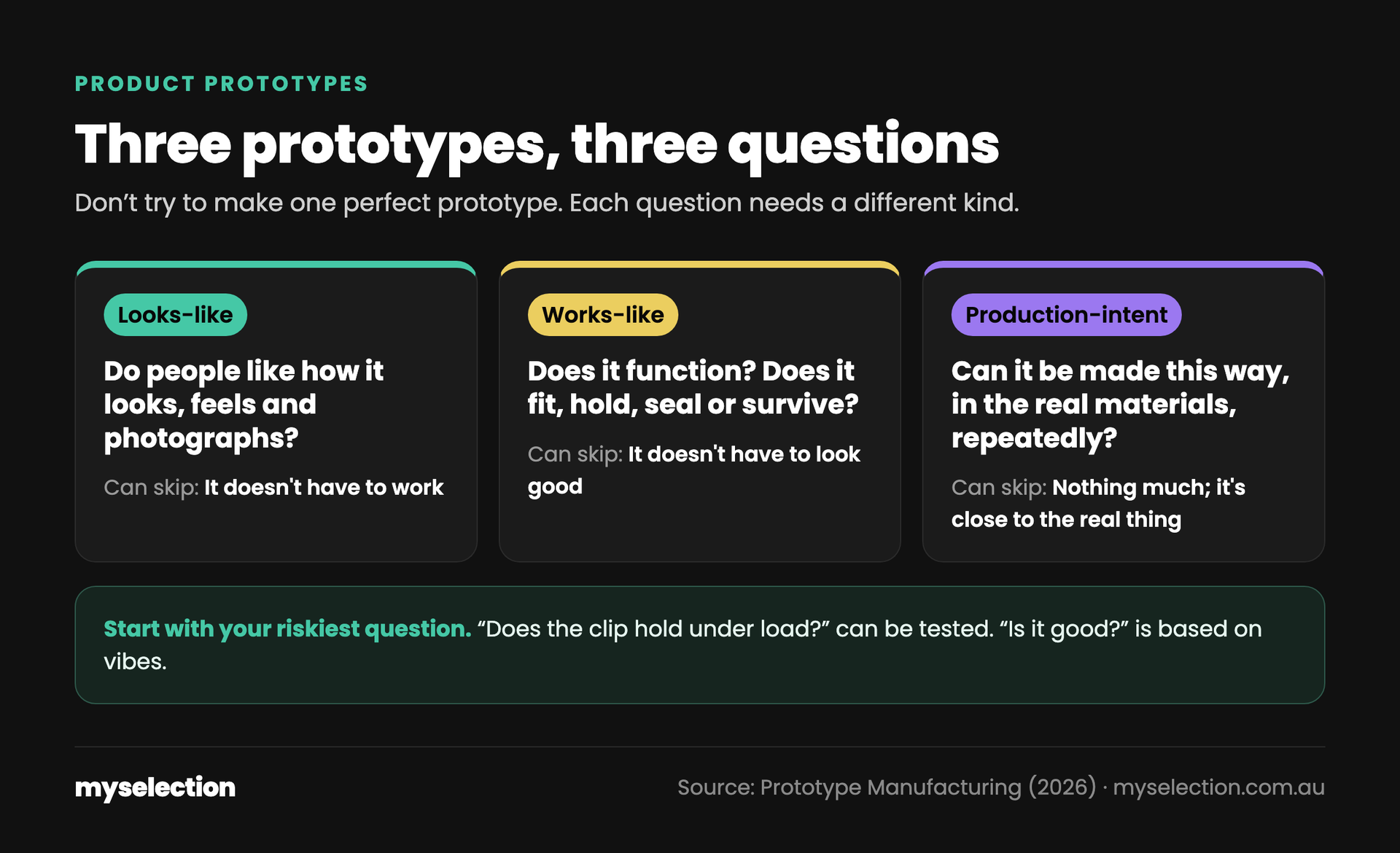
Three prototypes, three questions. Free to share with a link back to this guide.
| Type | Question it answers | What it can skip |
|---|---|---|
| Looks-like | Do people like how it looks, feels and photographs? | It doesn't have to work |
| Works-like | Does it function? Does it fit, hold, seal or survive? | It doesn't have to look good |
| Production-intent | Can it be made this way, in the real materials, repeatedly? | Nothing much; it's close to the real thing |
Start with your riskiest question. For illustration: if you're making a water bottle, the shape might be the risk and a looks-like model tells you plenty. If you're making a phone mount, the risk is whether it holds a phone on a bumpy road, so you want a works-like version first, however ugly.
Write the question down before you make anything. "Does the clip hold under load?" is a question you can test. "Is it good?" is based on vibes.
Prototype manufacturing methods compared
There's no single best method. The right one depends on the product, the material and what you need to learn. The ratings below are relative and vary a lot by product, so ask suppliers for real quotes and timings.
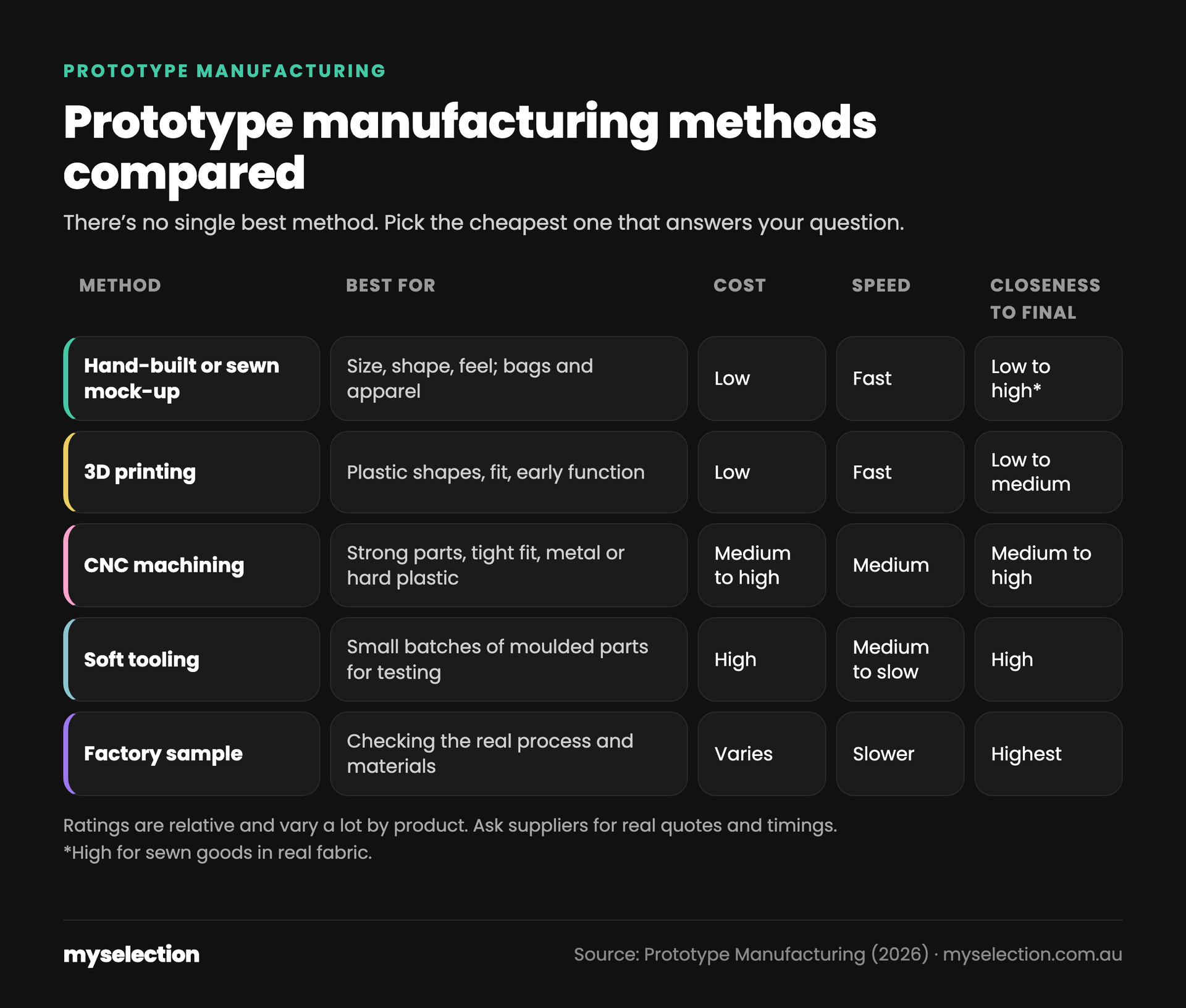
Ratings are relative and vary by product. Ask suppliers for real quotes.
| Method | Best for | Relative cost | Relative speed | Closeness to final |
|---|---|---|---|---|
| Hand-built or sewn mock-up | Size, shape, feel; bags and apparel | Low | Fast | Low to high (high for sewn goods in real fabric) |
| 3D printing | Plastic shapes, fit, early function | Low | Fast | Low to medium |
| CNC machining | Strong parts, tight fit, metal or hard plastic | Medium to high | Medium | Medium to high |
| Soft tooling | Small batches of moulded parts for testing | High | Medium to slow | High |
| Factory sample | Checking the real process and materials | Varies | Slower | Highest |
Hand-built and sewn mock-ups
Foam, card, modified existing products, or a pattern sewn up in a similar fabric. This is the most underrated method. Cutting up a product you already own can teach you more in an afternoon than a week of design files. For soft goods like apparel and bags, a sewn prototype in real or close-to-real fabric is simply how prototyping works.
3D printing
A printer builds the shape layer by layer from a digital model. It's a good way to check size, fit and ergonomics, and it's easy to change and reprint. You can print yourself or use an online printing service. Printed parts don't always behave like moulded parts, because the material and internal structure differ, so don't rely on them for final strength results.
CNC machining
A machine cuts the part from a solid block of metal or plastic. It suits parts that need to be strong or precise, and it can use materials close to the final ones. The trade-off is that it usually costs more per part, and very complex shapes can be hard to cut.
Soft tooling
A cheaper, shorter-life mould, for example silicone moulds for casting or an aluminium mould instead of hardened steel. It lets you make a small batch of parts that look and behave much like moulded ones, which is useful for testing with real users or showing a near-final product in content. It's worth it when a design is mostly settled, not while you're still changing the shape.
Factory samples
The factory makes your product using its own process and, ideally, the real materials. It's the closest you'll get to the finished product, and it also shows whether the factory can do the job. Factory samples work best once you have a clear tech pack to sample from. If you're customising a factory's existing design, you may go straight here; OEM vs ODM explains why.
Prototype vs sample: what's the difference?
People use these words interchangeably, and factories may use them differently too, so check what you're being quoted for. As a rule of thumb:
- A prototype answers a design question, and it can be made any way that works.
- A sample is made by the factory to show how your product will come out, and gets compared against your spec.
- An approved reference sample, often called a golden sample, is the standard production gets checked against.
How to make a prototype: 5 steps
- Write down the question. One or two things this version has to prove.
- Pick the cheapest method that answers it. If foam and tape can answer it, don't pay for machining.
- Make it, or brief someone who can. Local makers, online printing services, sewists and product designers can all help. Check who owns the design work before you start, and ask about confidentiality before you share a new design.
- Test it the way your audience would. Take it to the gym, throw it in a bag, drop it, wash it. Get proper advice before testing anything with electronics, food contact or children's use. Give it to people who owe you no compliments and watch them use it without explaining.
- Record what you learned and keep each version's changes small enough to compare. Keep photos and notes. They feed straight into your tech pack, and into some very good behind-the-scenes content.
Big changes are cheap at this stage and expensive after tooling is cut, which is the whole point of prototyping.
When is a prototype ready for a factory?
Move on when you can say yes to these:
- The riskiest question has been answered with a real test.
- People outside your circle have used it and you've acted on what they found.
- You can describe the materials, measurements and construction in writing.
- You've thought about how it would be made, or asked a manufacturer. A shape that's easy to print can be hard or expensive to mould, so get that feedback before the design is final.
- You've checked which safety or labelling rules might apply to your category. Prototype testing doesn't replace any compliance testing your category requires.
Common prototyping mistakes
| Mistake | What happens | Fix |
|---|---|---|
| Going for one perfect prototype | Slow, expensive, and hard to change | Build quick versions that each answer one question |
| Testing with fans only | Everyone says it's amazing | Watch strangers use it, without explaining |
| Trusting printed parts for strength | The moulded version behaves differently | Confirm strength in the real material at sample stage |
| Ignoring manufacturing until the end | The design has to change late | Get a manufacturer's feedback early |
| Paying for tooling too soon | The mould is outdated after the next change | Settle the design first |
| Announcing the prototype as the product | Your audience expects it next week | Show the journey, and save dates for later |
How My Selection helps with prototypes
My Selection helps creators turn audience demand into physical product brands. That can include shaping a brief, developing the design and working through samples with factories, with our own development team in China and long-term partner factories in Jiangsu, Zhejiang and the Pearl River Delta. Our team includes 10+ designers, and our supplier network covers 867 suppliers across 34 countries.
Which categories fit and what's included are confirmed per project. Lead times, MOQs and unit costs depend on the product, so we confirm them per project.
FAQ
How much does prototype manufacturing cost? It depends on the method, material, size and how many rounds you need. A hand-built mock-up can cost very little, while soft tooling costs far more. Ask for quotes based on your actual files or brief.
Do I need a prototype before talking to a factory? Not always. If you're customising a factory's existing product, you can usually go straight to samples. For a new design, a prototype helps you answer the big questions first and gives factories something concrete to quote from.
Can a factory make my prototype? Some can, especially when the sample uses their usual process. Others focus on production and prefer you to arrive with a tested design and a clear spec. Ask what they offer and what it costs before sharing files.
How many prototypes do I need? As many as it takes to answer your riskiest questions. Simple products may need few; products with moving parts or precise fit usually need more. Stop when new versions stop teaching you anything important.
Should I protect my idea before prototyping? It's worth thinking about before sharing a new design. Ask about confidentiality, get ownership of design work in writing, and speak to a qualified IP professional if the design itself is the valuable part.
Got a prototype, or just a sketch?
Whatever stage your idea is at, discuss your product idea with us, and we'll help you work out a sensible way to test it next.