POV: a factory asks "OEM or ODM?" and you nod like you know. Plot twist: the answer decides who owns the design, how much you spend before the first unit and how long it takes. In OEM (original equipment manufacturing), the factory makes a product to your design. In ODM (original design manufacturing), the factory has already designed the product, and you put your brand on it, often with some changes.
So OEM vs ODM comes down to one question: whose design is it? This guide explains both models, compares them on design rights, tooling, minimums and time, and gives you a decision tree to choose.
OEM vs ODM: the definitions
OEM manufacturing means you bring the design (drawings, a prototype, a detailed spec or a tech pack) and the factory manufactures it for you. The product is yours in concept; the factory supplies production capacity, materials and know-how.
ODM manufacturing means the factory owns an existing design it has already developed, and sells it to brands to put their name on. Most ODMs let you change some details: colour, finish, packaging, sometimes materials or features.
Private label products often come from ODM factories: you start from their base product and change what matters. Our guide to private label products for creators explains how that works and how to pick a first product.
A quick heads-up on the other meaning. "OEM" is also used for the brand that originally makes a product or part, like "OEM car parts" versus aftermarket ones. When a factory asks "OEM or ODM?", it means the manufacturing model above, not that.
OEM vs ODM compared
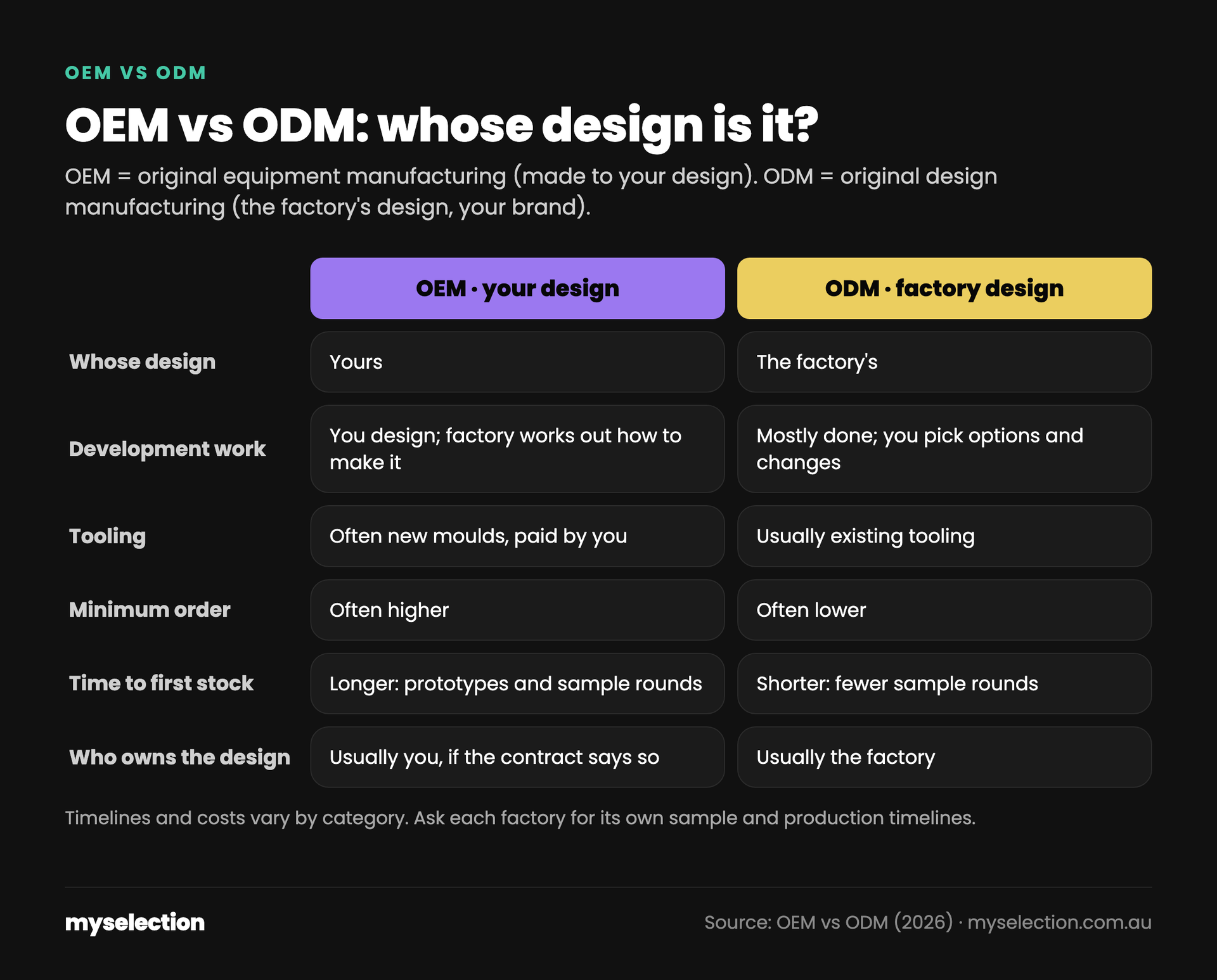
OEM vs ODM at a glance. Free to share with a link back to this guide.
| OEM (your design) | ODM (factory's design) | |
|---|---|---|
| Whose design | Yours | The factory's |
| Development work | You (or your designers) design; the factory works out how to make it | Mostly done; you choose options and changes |
| Tooling | Often new moulds or tooling, paid by you | Usually existing tooling; small changes may need some new parts |
| Minimum order | Often higher, to cover new tooling and materials | Often lower, because the base product already runs |
| Time to first stock | Longer: design, prototypes, sample rounds | Shorter: fewer sample rounds |
| Differentiation | High: the product can be unique | Limited: other brands may sell the same base product |
| Who owns the design | Usually you, if the contract says so | Usually the factory |
You'll see sources quote typical development times or cost gaps for each model. They vary so much by category that we don't repeat them; ask each factory for its own sample and production timelines. Minimums vary too, and our MOQ meaning guide shows how they change the cash you need.
When ODM makes sense
- It's your first product, and you want to learn the process with less risk.
- A good base product already exists, and your audience wants a version of it.
- You need stock in a shorter window.
- Your budget doesn't stretch to new tooling.
ODM is a common starting point for private label. The trade-off is differentiation: if the base product is in the factory's catalogue, other brands can buy it too. Changes you make, plus an exclusivity clause, are how you make it yours.
When OEM makes sense
- The product you want doesn't exist yet.
- The difference is in the design itself (shape, mechanism, fit), not just colour or logo.
- You want to own the design and be able to move production to another factory later.
- You can fund prototypes, sample rounds and possibly tooling.
The trade-off is time and upfront cost. OEM needs a design a factory can actually build from, which is where product development comes in.
The OEM vs ODM decision tree
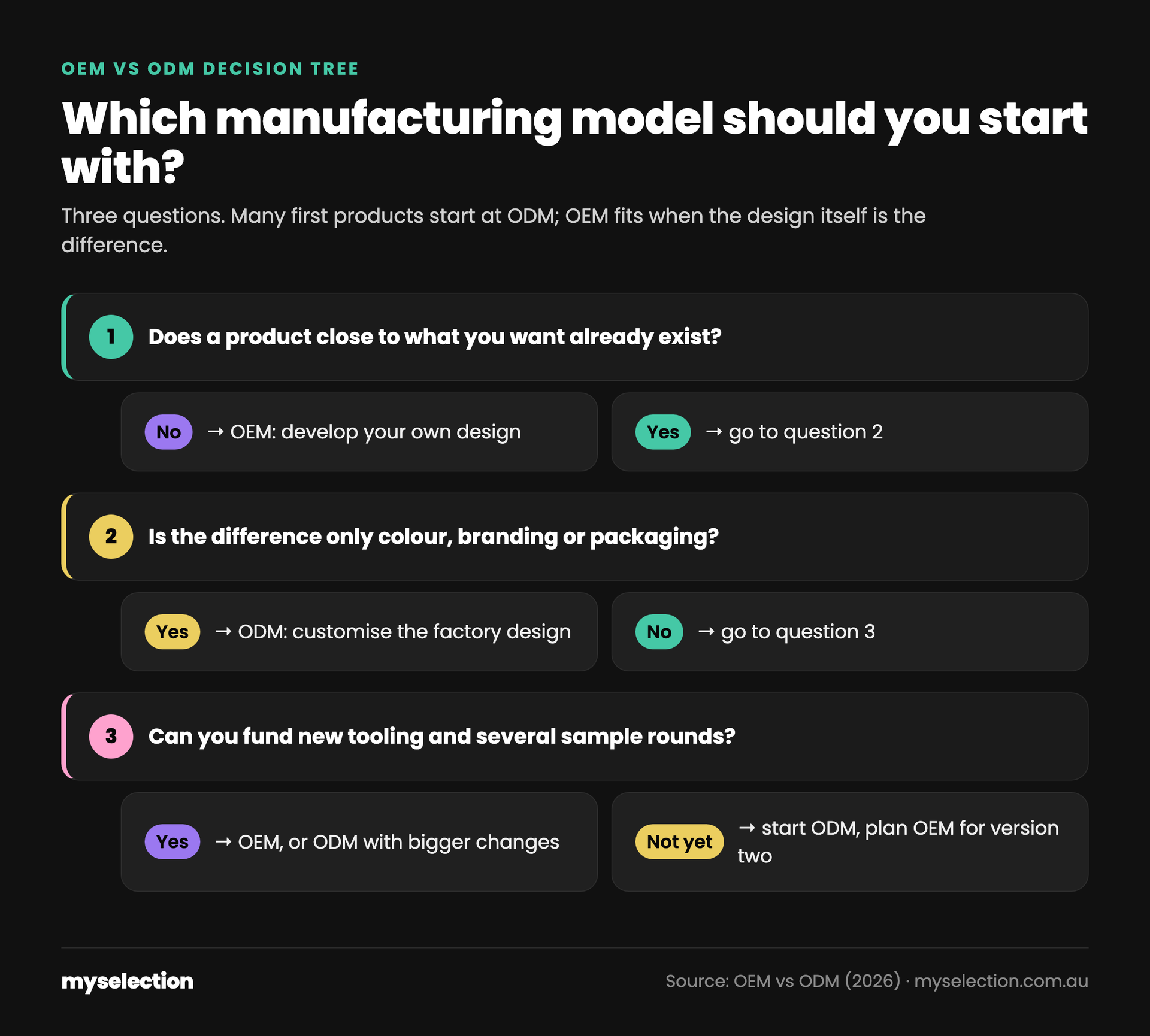
Answer three questions to find your starting model.
- Does a product close to what you want already exist? If no, you're looking at OEM. If yes, keep going.
- Is the difference only colour, branding or packaging? If yes, ODM is usually the simpler route. If the difference is in the product itself, keep going.
- Can you fund new tooling and several sample rounds? If yes, OEM (or an ODM factory willing to make bigger changes). If not yet, start with ODM and plan the OEM version for round two.
Illustrative example (not a real client): a cycling creator wants a bottle cage. ODM factories already make dozens; the creator only wants a matte colour and a laser logo, so ODM wins. A year later, the audience keeps asking for a cage that fits an unusual frame. No base product fits, so that becomes an OEM project.
Questions to ask before you sign
Many OEM and ODM disappointments come from things nobody put in writing. Ask:
- Design and files: Who owns the design, drawings and 3D files, before and after we pay?
- Tooling: If we pay for moulds or tooling, who owns them, where are they kept, and can we move them to another factory?
- Exclusivity: Will you sell our version, or the base design, to other brands?
- Changes: On an ODM product, exactly which details can change, and what does each change do to the price and minimum?
- Samples: How many sample rounds are included, and what does each extra round cost?
- Quality: What is production checked against, and what happens to units that fail?
- Compliance: Which tests and certificates exist for this product, and do they still apply after our changes?
This is general guidance, not legal advice. Design rights and tooling ownership are contract questions, so get professional advice for anything you can't afford to lose.
Want the full path from brief to approved sample? Our product sourcing guide covers briefs, quote comparison and samples step by step. If you're also comparing white label and private label, see private label vs white label.
How My Selection helps
My Selection helps creators turn audience demand into physical product brands, whether that means customising an existing factory design or developing your own. We work with long-term partner factories in Jiangsu, Zhejiang and the Pearl River Delta, with our own development team in China coordinating development in real time, and a supplier network of 867 suppliers across 34 countries. Our team includes 10+ designers.
Which model fits, what's included and what quantities make sense are confirmed per project. We don't publish fixed lead times, MOQs or unit costs, because they depend on the product.
FAQ
Is ODM cheaper than OEM? Usually it costs less upfront, because the design and tooling already exist. Unit cost depends on the product and quantity in both models.
Is OEM or ODM better for private label? Many private label products start as ODM: a factory design with your changes and branding. OEM fits when the product needs to be your own design.
What does OEM mean on a quote? On a factory quote or listing, "OEM" can mean anything from "made to your design" to "our product with your logo". Ask exactly what's being made to your spec.
Can I switch from ODM to OEM later? Yes. Many brands start with an ODM product, learn what their audience wants, then develop an OEM version for the next release.
Not sure which model fits?
Tell us what you want to make and how different it needs to be. Discuss your product idea with us, and we'll help you choose between OEM and ODM for your first product.