A golden sample is the approved, signed and sealed sample of your product that the factory must match in production, and that inspectors compare the finished goods against. It's the physical version of "this, exactly this". In manufacturing it's often the approved pre-production sample, kept as the reference. (If you were searching for golden datasets in machine learning, this is the factory kind.)
POV: you've been through five rounds of samples, approved "the latest one" over chat, and production starts. The bulk arrives and the colour is a shade off, the zip is different and the logo moved two centimetres. Plot twist: which sample did you actually approve? Without a sealed golden sample, nobody can prove it.
This guide covers the sample stages and what you approve at each one, the difference between a golden sample and a pre-production sample, and how to seal and sign one off so it actually protects your order.
This is what we do at My Selection: we help creators develop products and work with factories through sample rounds, approvals and production. If you're in sample rounds now, tell us what you're making.
In this guide:
- Why a golden sample matters
- The sample stages, and what you approve at each one
- Golden sample vs pre-production sample
- How to seal and sign off a golden sample
- Golden sample sign-off sheet
- Vague vs usable approval comments
- Where the golden sample goes next
Why a golden sample matters
A spec sheet describes the product in words and numbers. A golden sample shows it: the exact colour, feel, finish, stitching, print and packaging you said yes to. Together they settle arguments before they start.
A golden sample does three jobs:
- It's the target for production. The factory sets up materials and processes to match it.
- It's the standard for inspection. At a pre-shipment check, the inspector compares the random units pulled from your order against it.
- It's your evidence. If bulk doesn't match, a signed, dated, sealed sample is much stronger than a chat message saying "looks good!".
It doesn't replace the written spec. Some details (tolerances, materials, test requirements) need to be in writing, ideally in your tech pack. The sample shows what the words mean.
The sample stages, and what you approve at each one
Names vary by factory and category, but most product development runs through stages like these:
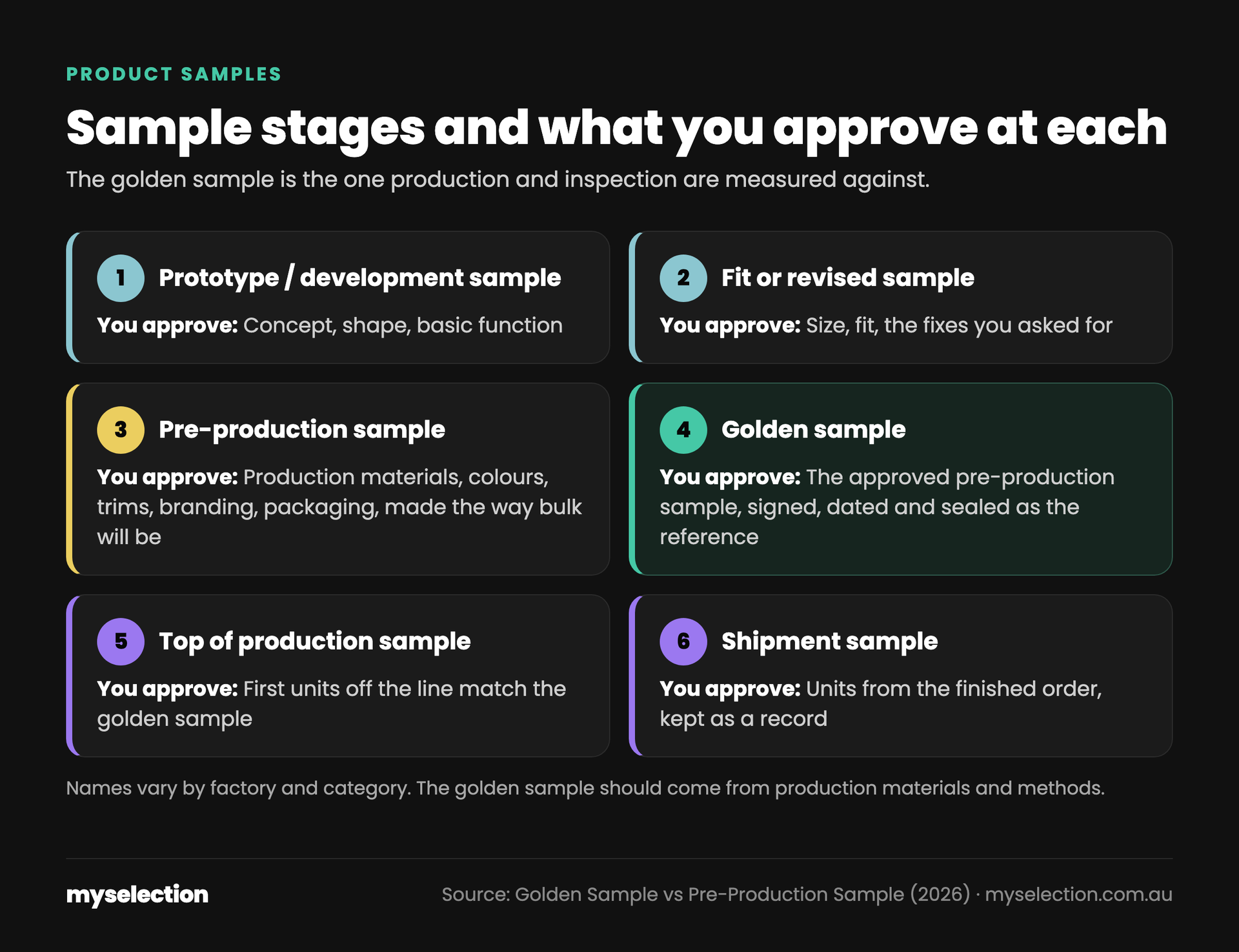
Sample stages and what you approve at each. Free to share with a link back to this guide.
| Stage | When | What you approve |
|---|---|---|
| Prototype / development sample | Early | Concept, shape, basic function |
| Fit or revised sample | After each round of changes | Size, fit, the fixes you asked for |
| Pre-production sample (PPS) | Just before bulk | Production materials, colours, trims, branding, packaging, made the way bulk will be made |
| Golden sample | When the PPS is approved | The approved PPS, signed, dated and sealed as the reference |
| Top of production (TOP) sample | First units off the line | That bulk matches the golden sample |
| Shipment sample | From the finished order | Kept as a record of what shipped |
Early prototypes are covered in detail in our guide to prototype manufacturing. The stages after that are where the golden sample comes in.
Golden sample vs pre-production sample
The two terms overlap, and some factories use them interchangeably. The useful difference:
- A pre-production sample is a stage: the last sample before bulk, made with the actual production materials and methods.
- A golden sample is a status: the sample you've approved and sealed as the standard. Usually that's the approved pre-production sample.
So the question isn't "do I need a golden sample or a PPS?". It's "has my approved PPS been made into a sealed reference, and does everyone have a copy?".
One trap: approving an early sample that was hand-made by the sample room, then letting it become the reference. Hand-made samples can look better than bulk will. The golden sample should come from production materials and methods, so production can actually match it.
How to seal and sign off a golden sample
When you approve the pre-production sample:
- Ask for at least two identical approved units. One stays at the factory as the production reference, one comes to you. If a third-party inspector will check the order, ask for a third, or make sure they can see the factory's copy.
- Tag and sign each one. A tag with product name, style or item number, colour or variant, version, approval date, and signatures from you (or your representative) and the factory.
- Seal it. Use a tamper-evident sticker or sealed bag, so nobody can quietly swap a part.
- Photograph it. All sides, close-ups of logo, stitching, closures and packaging, next to a ruler and a colour reference.
- Write down anything the sample can't show. Tolerances, material specs, test results, and any changes you approved that aren't on the sample yet ("final version uses the black zip pull").
- Reference it in your purchase order. For example: "Production to match sealed golden sample GS-01, approved on [date], and spec sheet v3."
- Store it properly. Away from sunlight and heat, which can fade colours or warp plastics, so it still represents the approved version months later.
If there's more than one colour or variant, each one needs its own approved reference. Colour is the most common dispute, so approve it against a physical colour standard, such as a Pantone colour reference, as well as the sample.
Golden sample sign-off sheet
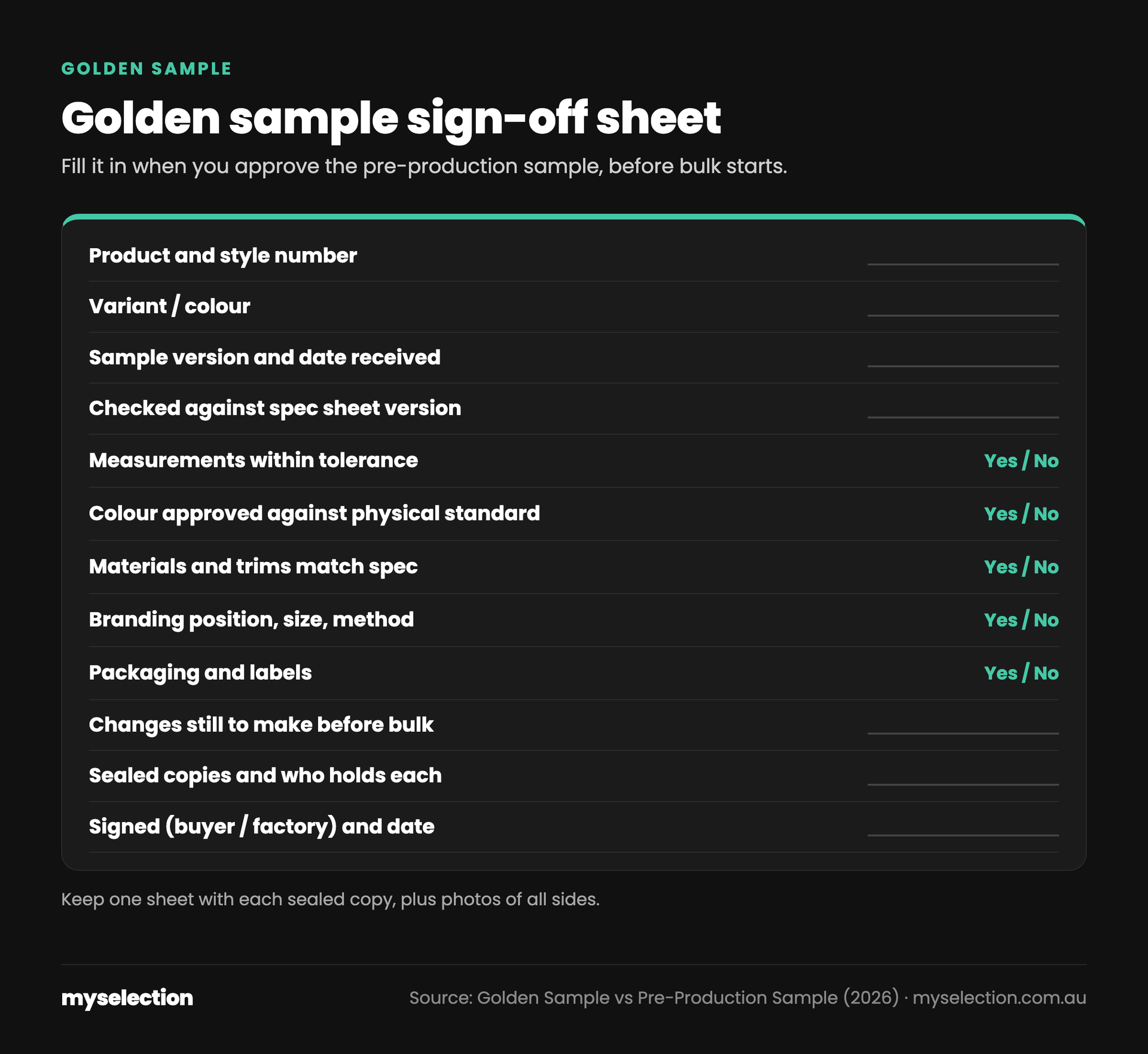
A sign-off sheet to keep with each golden sample.
| Field | Fill in |
|---|---|
| Product and style number | |
| Variant / colour | |
| Sample version and date received | |
| Checked against spec sheet version | |
| Measurements within tolerance | Yes / No |
| Colour approved against physical standard | Yes / No |
| Materials and trims match spec | Yes / No |
| Branding position, size, method | Yes / No |
| Packaging and labels | Yes / No |
| Changes still to make before bulk | |
| Sealed copies and who holds each | |
| Signed (buyer / factory) and date |
Vague vs usable approval comments
| Vague | Usable |
|---|---|
| "Looks good!" | "Approved as golden sample GS-01, navy, version 4, with the zip pull change below" |
| "Colour a bit darker" | "Match colour to the approved physical standard; current sample is too light" |
| "Logo smaller" | "Logo 6 cm wide (was 8 cm), centred, 7 cm below the neck seam" |
| "Same as before but better" | "Keep everything from version 3 except: stronger stitching on the handle, as marked in photo 2" |
Numbers here are illustrative. Yours come from your spec.
Where the golden sample goes next
Once production is running, the golden sample does its real job. Check the top-of-production units against it as soon as the first units come off the line, while changes are still easy. At the end, the inspector uses it during the pre-shipment inspection, comparing random units to the sealed reference using AQL sampling from ISO 2859-1.
The golden sample is one checkpoint in the wider journey of creating a physical product, from idea and brief to production and launch.
Conclusion
A golden sample is your approved pre-production sample turned into a sealed, signed reference that production and inspection are measured against. Make it from production materials, seal at least two copies, write down what the sample can't show, and name it in your purchase order. It's a small amount of admin, and it's what turns "that's not what I approved" from an argument into a check.
FAQ
Who keeps the golden sample? Usually both sides. The factory keeps one sealed copy at the production line as the reference, and the buyer keeps another. If a third-party inspector checks the order, they need access to one too, either their own sealed copy or the factory's.
What if bulk production doesn't match the golden sample? Compare the differences against the sealed sample and the spec, with photos. If bulk is outside what you approved, ask the factory to correct it before you accept the goods. This is exactly why a sealed, dated sample and a written spec matter: they turn a disagreement into a check.
Is a golden sample the same as a pre-production sample? Often they're the same physical unit. The pre-production sample is the last sample stage before bulk; once you approve it and seal it as the reference, it becomes the golden sample. Some factories use the two terms interchangeably.
Discuss your product idea
In sample rounds and not sure what to approve? Discuss your product idea with us. My Selection helps creators develop products under their own brand, working with long-term partner factories in Jiangsu, Zhejiang and the Pearl River Delta and our own development team in China. Our supplier network covers 867 suppliers across 34 countries, with 10+ designers on the team. Which products fit and what's included are confirmed per project. Lead times, MOQs and unit costs depend on the product, so we confirm those too.