A pre-shipment inspection (PSI) is a check of your finished goods at the factory, before they ship and usually before you pay the balance. An inspector picks a random sample from the packed order and checks it against your spec and approved sample: quantity, appearance, measurements, function, packing and labelling. You get a report and a pass or fail.
POV: production finished, the factory sends three nice photos and "all good, ready to ship". Plot twist: those three photos are the three best units in the building. Once the goods are on a ship and the money has gone, fixing a problem gets much harder.
This guide covers when to book a pre-shipment inspection, what gets checked, how AQL sampling works (with one worked example), and what to do if the order fails.
This is what we do at My Selection: we help creators develop products and coordinate with factories through samples and production, including planning which checks to book before shipping. If your first run is coming up, tell us what you're making.
In this guide:
- Where pre-shipment inspection fits
- When to book it
- What a pre-shipment inspection checks
- AQL in plain English
- Vague vs usable inspection instructions
- What to do if the order fails
Where pre-shipment inspection fits
A pre-shipment inspection is the most common product inspection, but it's one of four points where you can check an order:
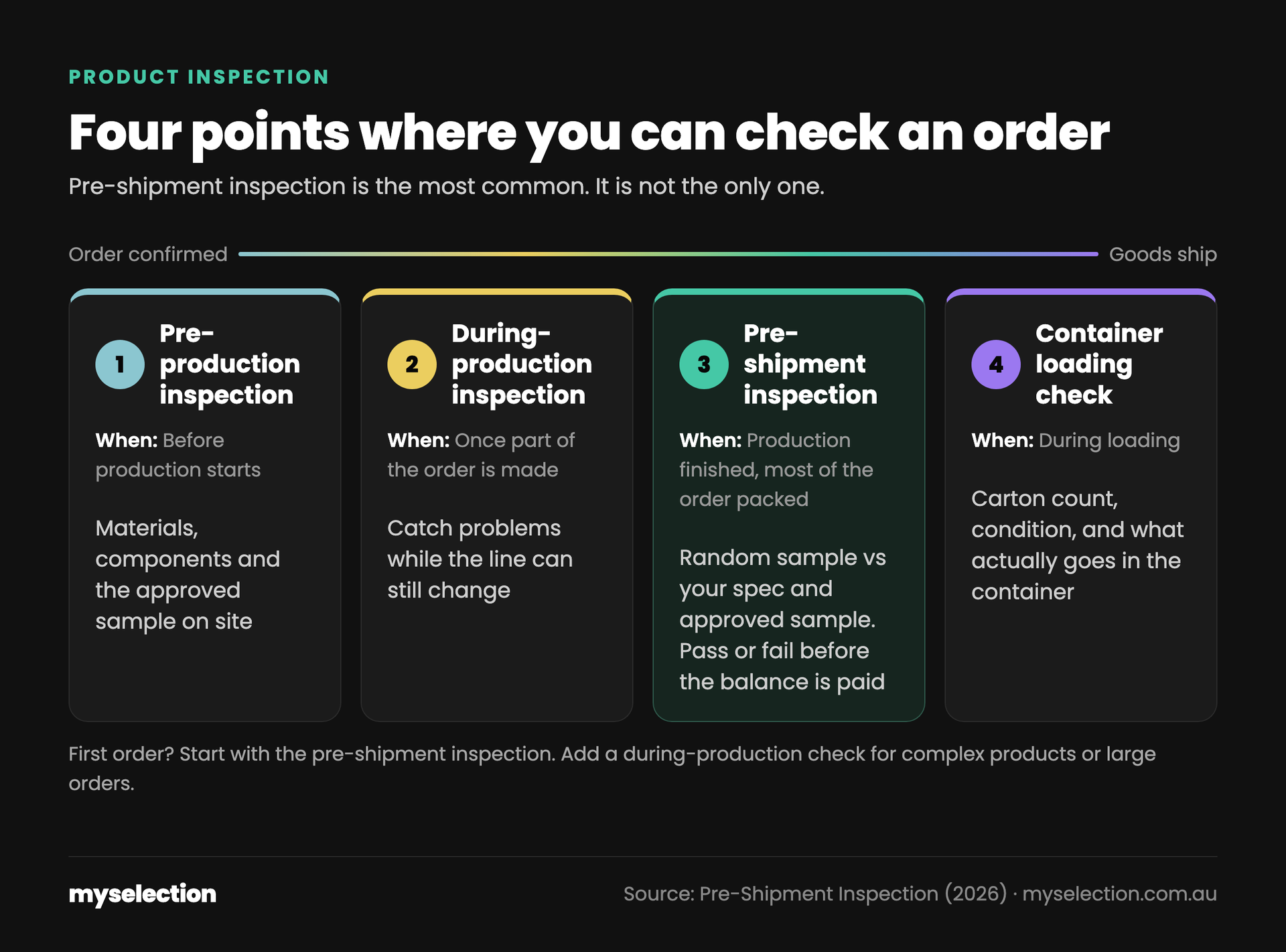
Four points where you can check an order. Free to share with a link back to this guide.
| Inspection | When | What it catches |
|---|---|---|
| Pre-production inspection | Before production starts | Wrong materials or components; no approved sample on site |
| During-production inspection | Once part of the order is made | Problems early, while the line can still change |
| Pre-shipment inspection | Production finished, most of the order packed | Defects, wrong measurements, packing and labelling errors across the order |
| Container loading check | During loading | Short shipments, damaged cartons, wrong goods loaded |
For a first order, a pre-shipment inspection is the one most brands start with. Add a during-production check when the product is complex or the order is large, so problems surface while they're still cheap to fix.
If you're still choosing your supplier, the inspection plan belongs in the conversation from the start; our guide to the product sourcing process shows where it fits.
When to book it
Inspection companies commonly schedule a pre-shipment inspection when production is complete and most of the order (often 80% or more) is packed in its export cartons. That way the inspector sees the real packing and can pull cartons at random.
Practical rules:
- Book before the balance is due. If your payment terms ask for the balance before shipping, the inspection report is your evidence to pay or hold.
- Agree it in writing early. Put "pre-shipment inspection by the buyer or its nominee, results to be accepted before shipment" in the order confirmation, and agree who pays for a re-inspection if the first one fails.
- Give the factory a heads-up, not a script. They need to know the date; they don't need to choose the cartons.
Some importing countries make pre-shipment inspection a legal requirement for certain goods, carried out by government-appointed agencies. That's a different thing from the quality inspection in this guide; the WTO has an agreement on preshipment inspection covering those government schemes. Check with your forwarder whether it applies to your shipment.
What a pre-shipment inspection checks
A typical product inspection covers:
- Quantity: units and cartons ready, against the order.
- Packing and labelling: carton marks, barcodes that scan, retail packaging, inserts, labels in the right place.
- Appearance and workmanship: stains, scratches, loose threads, uneven print, colour against the approved sample.
- Measurements: key dimensions against your spec and tolerances.
- Function: zips, lids, buttons, switches, closures, anything that moves or seals.
- Product-specific tests: for example a carton drop test, a seal or leak check, a print rub test, or a barcode scan.
- Comparison with the approved sample: the inspector should have your golden sample or a sealed reference, plus your spec sheet.
Defects are sorted into three classes (an industry convention; you define them in your spec):
- Critical: unsafe, or breaks a legal requirement (sharp edge on a kids' product, wrong voltage label).
- Major: the customer would likely return it or complain (seam opening, wrong size, print missing).
- Minor: off-standard but usable (small mark, loose thread).
AQL in plain English
You can't check every unit, so inspectors check a statistical sample. AQL (acceptance quality limit) is the worst average defect rate you're willing to tolerate, expressed as a percentage (or defects per 100 units). Together with the lot size and inspection level, it sets the sampling plan: how many units are checked and how many defects the sample can contain before the lot fails. The sampling tables come from ISO 2859-1, which inspection companies widely use.
Three steps:
- Lot size → code letter. How many units are in the order, read against the inspection level. General inspection level II is the usual default.
- Code letter → sample size. How many units the inspector checks.
- AQL → accept and reject numbers. For each defect class, the maximum defects allowed in the sample.
Common buyer settings for consumer goods are 0 critical defects allowed, AQL 2.5 for major and AQL 4.0 for minor. Those are conventions buyers choose, not legal requirements; stricter products get stricter numbers.
Worked example (illustrative)
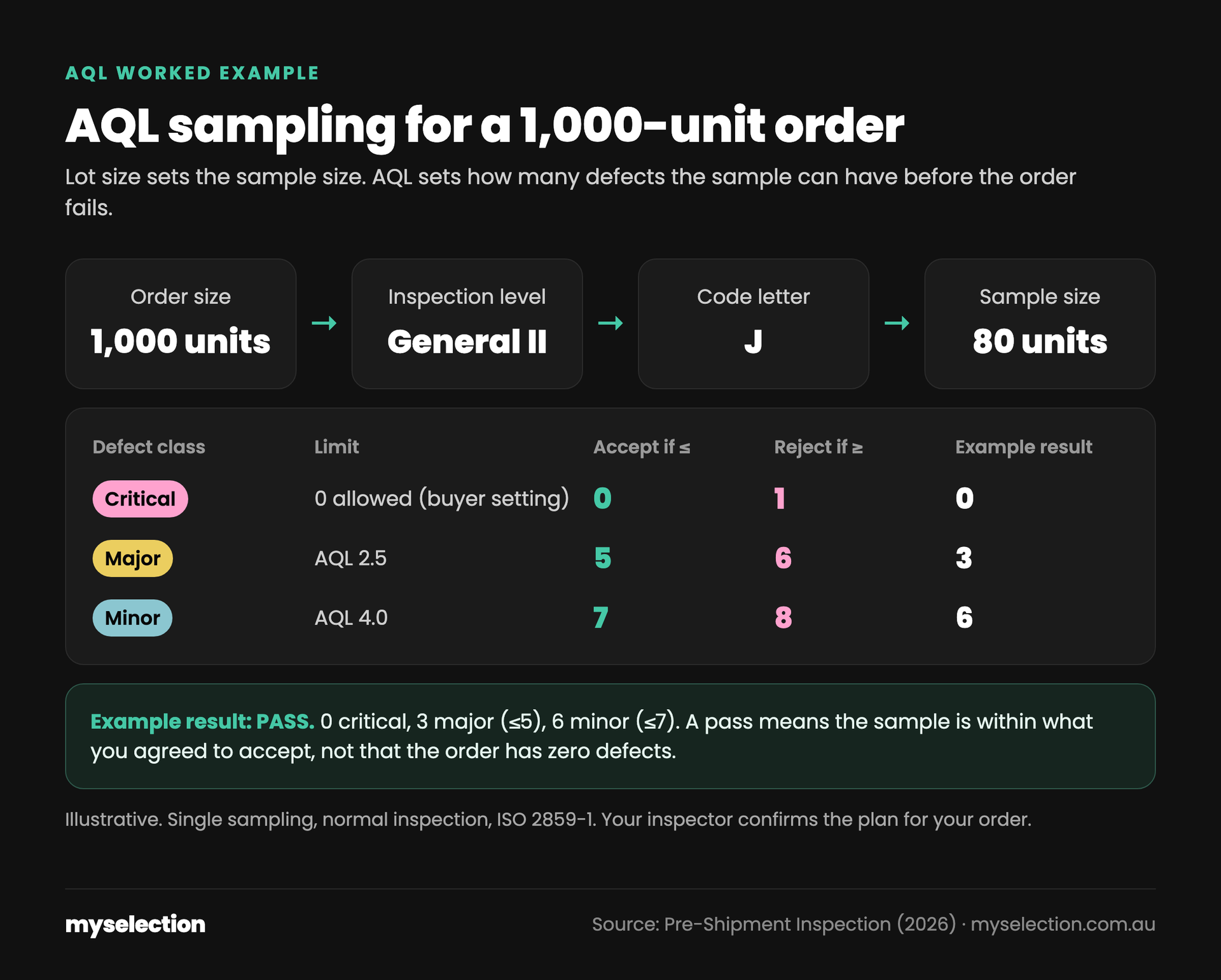
Illustrative example. Your inspector confirms the exact plan for your order.
| Step | Value |
|---|---|
| Order size | 1,000 units of one product |
| Inspection level | General level II |
| Code letter | J |
| Sample size | 80 units |
| Critical (buyer setting: 0 allowed) | Any critical defect fails the lot |
| Major, AQL 2.5 | Accept with 5 or fewer, reject at 6 |
| Minor, AQL 4.0 | Accept with 7 or fewer, reject at 8 |
| Example result | 0 critical, 3 major, 6 minor → pass |
These numbers are for single sampling under normal inspection. A pass doesn't mean the order has zero defects; it means the defect rate in the sample is within what you agreed to accept. That's why the AQL you choose should match how much a defect would hurt your brand.
Vague vs usable inspection instructions
| Vague | Usable |
|---|---|
| "Check quality" | "Check against the sealed approved sample and spec sheet v3; AQL 0 / 2.5 / 4.0, level II" |
| "Make sure the size is right" | "Measure chest width and length on every sampled unit, tolerance ±1 cm" |
| "Logo should look good" | "Logo centred, 8 cm wide, no cracking after a rub test" |
| "Packing OK" | "One unit per polybag, barcode scans, carton marks match the shipping label template" |
| "Test it works" | "Open and close each zip 10 times; lid sealed and turned upside down for 30 seconds, no leak" |
Every number in the right-hand column is illustrative. Yours should come from your spec or tech pack.
What to do if the order fails
A fail is information, not the end of the world. Your options, roughly in order:
- Ask for the defect breakdown and photos. Is it one repeating problem or lots of different ones?
- Sort and rework at the factory, then re-inspect. Most common. The factory checks every unit, fixes or replaces defective ones, and you book a re-inspection. Agree upfront who pays for it.
- Accept with conditions. For minor issues only, and only if you're comfortable: for example the factory replaces the defective units in the next order, or you agree a price adjustment. This is your commercial decision, not the inspector's.
- Hold the shipment. For critical or widespread major defects, don't ship and don't pay the balance until it's fixed.
Whatever you choose, put it in writing, and note what went wrong for the next order. Repeat problems with the same factory are worth a closer look at the factory itself; that's where a factory audit comes in.
Conclusion
A pre-shipment inspection is the last cheap moment to catch problems: production is done, the goods are still at the factory and the balance hasn't been paid. Book it for when production is complete and most of the order is packed, give the inspector your approved sample and a clear spec, agree the AQL before production starts, and decide in advance what happens if it fails.
FAQ
Who pays for a pre-shipment inspection? Usually the buyer books and pays the inspection company, because the inspector is working for the buyer. If the order fails and needs a re-inspection, many buyers agree in the order that the factory covers that cost. Settle it in writing before production.
What does AQL 2.5 mean? AQL 2.5 means the sampling plan is built around a tolerable defect level of 2.5% (2.5 defects per 100 units). With the lot size and inspection level, it gives the accept and reject numbers. For a sample of 80 units under single sampling, normal inspection, AQL 2.5 accepts up to 5 defects of that class and rejects at 6.
Is a pre-shipment inspection the same as a factory audit? No. A pre-shipment inspection checks your goods from one order. A factory audit checks the supplier itself: capability, quality system and working conditions. Brands usually audit a factory before the first order and inspect every order.
Discuss your product idea
Planning your first production run and not sure which checks to book? Discuss your product idea with us. My Selection helps creators turn their audience into a product brand, working with long-term partner factories in Jiangsu, Zhejiang and the Pearl River Delta and our own development team in China. Our supplier network covers 867 suppliers across 34 countries, with 10+ designers on the team. Which products fit and what's included are confirmed per project. Lead times, MOQs and unit costs depend on the product, so we confirm those too.