POV: a supplier quotes a unit price, you do the maths on your phone, and it looks amazing. Then samples, printing, labels, freight and fees show up, and your margin quietly ghosts you.
So, how much does it cost to make merch? The honest answer is that it depends on the product, the quantity and the production model, and any single number on the internet is a guess. What you can know is every line that goes into the total. This guide gives you that list, a simple formula, an illustrative budget and a way to get quotes you can trust.
Costs are one step in the bigger plan; our guide on how to start a clothing brand covers the whole path from first idea to first production run.
This is what we do at My Selection: we help creators develop products and work with factories, including getting real quotes. If you want help pricing your idea, tell us what you're planning.
How much does it cost to make merch? Every line that goes in
The cost depends first on how you make it. With print-on-demand, you pay a per-item price when each order comes in, plus shipping, and there's no stock to buy. With a bulk run or your own product, you pay for the whole batch upfront, and these lines add up:
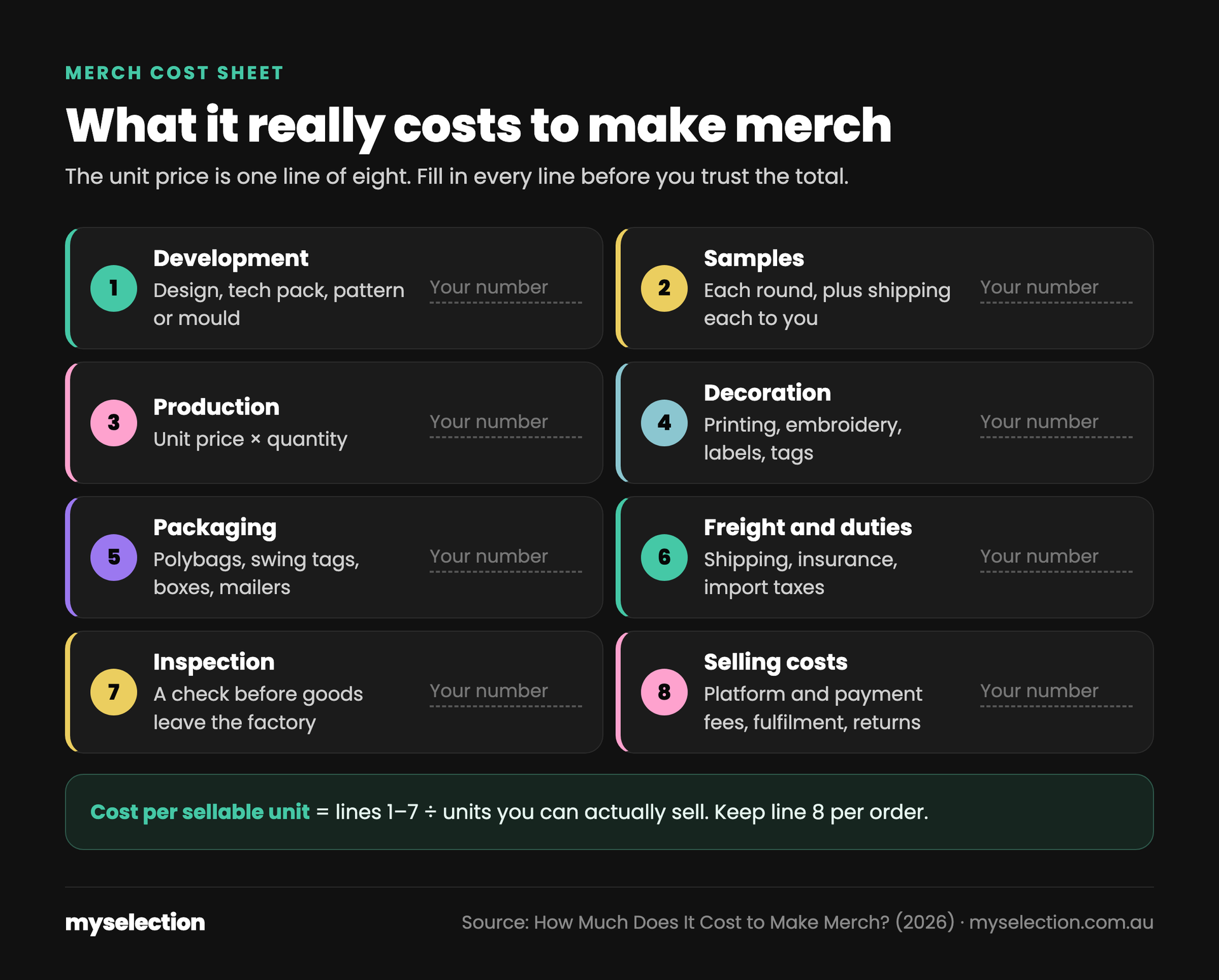
Eight lines to fill in before you trust a unit price. Free to share with a link back to this guide.
| Cost line | What's in it | Paid when |
|---|---|---|
| Development | Design work, tech pack, pattern or mould | Before samples |
| Samples | Each sample round, plus shipping each one to you | Before production |
| Production | Unit price × quantity | Usually a deposit, then the balance |
| Decoration | Printing, embroidery, custom labels, tags | With production |
| Packaging | Polybags, swing tags, boxes, mailers | With production |
| Freight and duties | Shipping, insurance, import duties and taxes | When goods move |
| Inspection | A check before goods leave the factory | Before shipping |
| Selling costs | Platform and payment fees, fulfilment, returns | Every order |
Two things change the production line more than anything else. Quantity: per-unit prices usually drop as quantities rise, which is why the minimum order matters; our MOQ guide explains how minimums change your real cost per unit. Complexity: more colours, more print positions, custom fabric or a new shape all add cost.
The formula: cost per sellable unit
Here's the number that matters:
Cost per sellable unit = (development + samples + production + decoration + packaging + freight and duties + inspection) ÷ units you can actually sell
Two details people miss:
- Divide by sellable units, not ordered units. If a few pieces arrive damaged or misprinted, the cost of the batch is spread over fewer shirts.
- Selling costs come per order. Keep platform fees, payment fees, fulfilment and returns as a separate per-order line, then check the price still leaves margin after them.
Who pays for freight, insurance and duties depends on the shipping terms you agree with the supplier. Those terms are called Incoterms; the ICC's Incoterms rules define what each one covers, so check which one your quote uses before comparing two suppliers.
An illustrative merch budget
Here's an illustrative example for a first bulk run of 200 hoodies. Every number is made up to show the maths; it isn't a quote, a typical price or a promise.
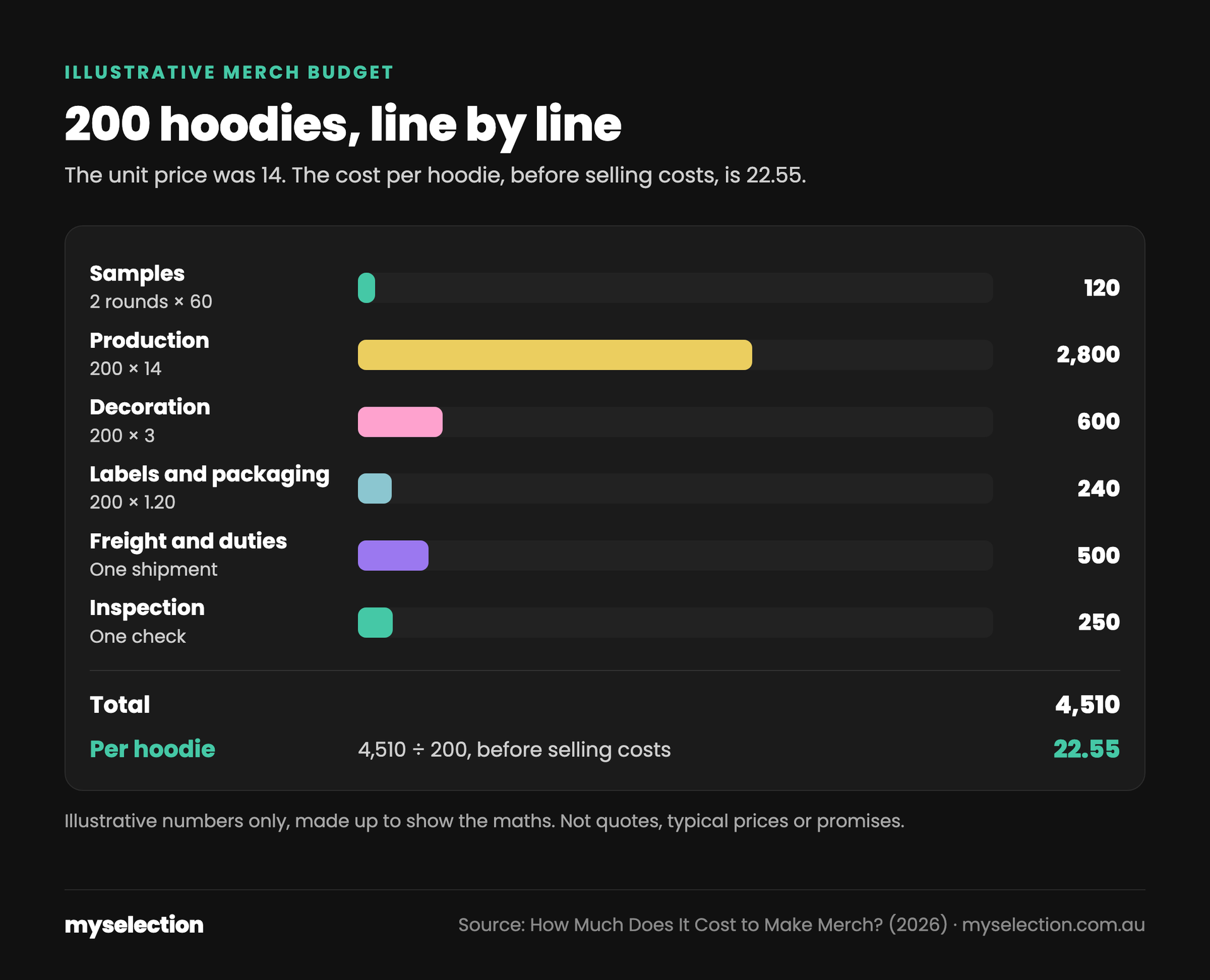
Illustrative numbers only. Real costs depend on your product, quantity and supplier.
| Line (illustrative) | Maths | Amount |
|---|---|---|
| Samples | 2 rounds × 60 | 120 |
| Production | 200 × 14 | 2,800 |
| Decoration | 200 × 3 | 600 |
| Labels and packaging | 200 × 1.20 | 240 |
| Freight and duties | One shipment | 500 |
| Inspection | One check | 250 |
| Total | 4,510 | |
| Per hoodie | 4,510 ÷ 200 | 22.55 |
That assumes all 200 arrive sellable. If 10 are misprinted, it's 4,510 ÷ 190 = 23.74 per hoodie (still illustrative). It also assumes the design already exists, so there's no development line.
That 22.55 is before selling costs. If the hoodie sells for, say, 55 (also illustrative), the gap has to cover platform and payment fees, fulfilment, returns, marketing and your profit.
Real spend = unit price × number of attempts
The quote assumes everything works first time. It rarely does. A third sample round, a print colour that's off, a reprint or a re-shipped carton all cost money again, and time. In the example above, one extra sample round adds another 60 and pushes everything back by however long a round takes.
| How people budget | How to budget |
|---|---|
| "The unit price is 14, so each hoodie costs 14" | "Each hoodie costs 22.55 once every line is in, before selling costs" |
| "One sample should do it" | "Budget two or three rounds and be pleasantly surprised" |
| "Shipping is the supplier's problem" | "The quote says which Incoterm, so I know what I pay" |
| "We'll sell all 200" | "I'll divide by the units I can actually sell" |
Keep a buffer for attempts. It's the cheapest insurance you'll buy.
Print-on-demand vs bulk: how the costs compare
With print-on-demand, there's no batch to pay for. You pay a per-item price each time someone orders, so the risk is low but your margin per item is usually lower. Providers publish their product prices; Printful's product catalogue is one example you can use to fill in your own sheet.
With a bulk run, you pay upfront and hold the stock, and the per-item cost usually falls as quantity rises. Our guide on how to make merch compares print-on-demand, bulk runs and your own product line side by side, including who each one fits.
How to get merch quotes you can trust
- Send the same brief to every supplier. Same product, materials, decoration, quantity and packaging, so the quotes compare like for like.
- Ask what's included. Samples, setup or screens, labels, packaging, inspection and the shipping terms.
- Ask for prices at two or three quantities. That shows you how much the unit price moves with volume.
- Get it in writing, including what happens if a sample or batch isn't to spec.
- Fill in the cost sheet. Then check the price still works after selling costs.
Conclusion
The cost of making merch isn't the unit price; it's every line on the sheet divided by the units you can sell, plus a buffer for attempts. Fill in the sheet before you commit, use print-on-demand while demand is unknown, and move to bulk once the numbers and the designs are proven.
FAQ
Is print-on-demand cheaper than bulk? It's cheaper to start, because there's no stock to buy. Per item it's usually more expensive than a bulk run at a decent quantity. Many creators use POD to find their best designs, then switch those to bulk.
Why do small merch orders cost more per unit? Setup work, like screens, machine set-up and sampling, costs about the same whether you make 50 pieces or 500. Spread over fewer units, each one carries more of that cost.
What costs do people forget when budgeting merch? Sample rounds, shipping samples to you, labels and packaging, freight and duties, inspection, fulfilment, returns and platform fees. Reprints and extra sample rounds are the ones that hurt most.
Discuss your product idea
Want real numbers for your merch idea? Discuss your product idea with us. My Selection helps creators turn their audience into a product brand, working with long-term partner factories in Jiangsu, Zhejiang and the Pearl River Delta and our own development team in China. Our supplier network covers 867 suppliers across 34 countries, with 10+ designers on the team. Which products fit and what's included are confirmed per project. Lead times, MOQs and unit costs depend on the product, so we confirm those too.