POV: your audience has been asking for merch for months, and you keep saying "soon" while quietly googling "how do I make merch". Here's how to make merch without guessing, from picking the product to the launch post.
How to make merch, in one line: choose something your audience will actually use, prepare print-ready artwork, pick a production model (print-on-demand, a bulk run or your own custom product), order a sample, price it with every cost in, then launch it like content. The production model is the decision that changes everything else, so most of this guide is about choosing it.
If merch is the first step towards a bigger brand, our guide on how to start a clothing brand covers the full path from audience to first production run.
This is what we do at My Selection: we help creators develop their own products with factories. If you're past print-on-demand and want something custom, talk to us about your merch idea.
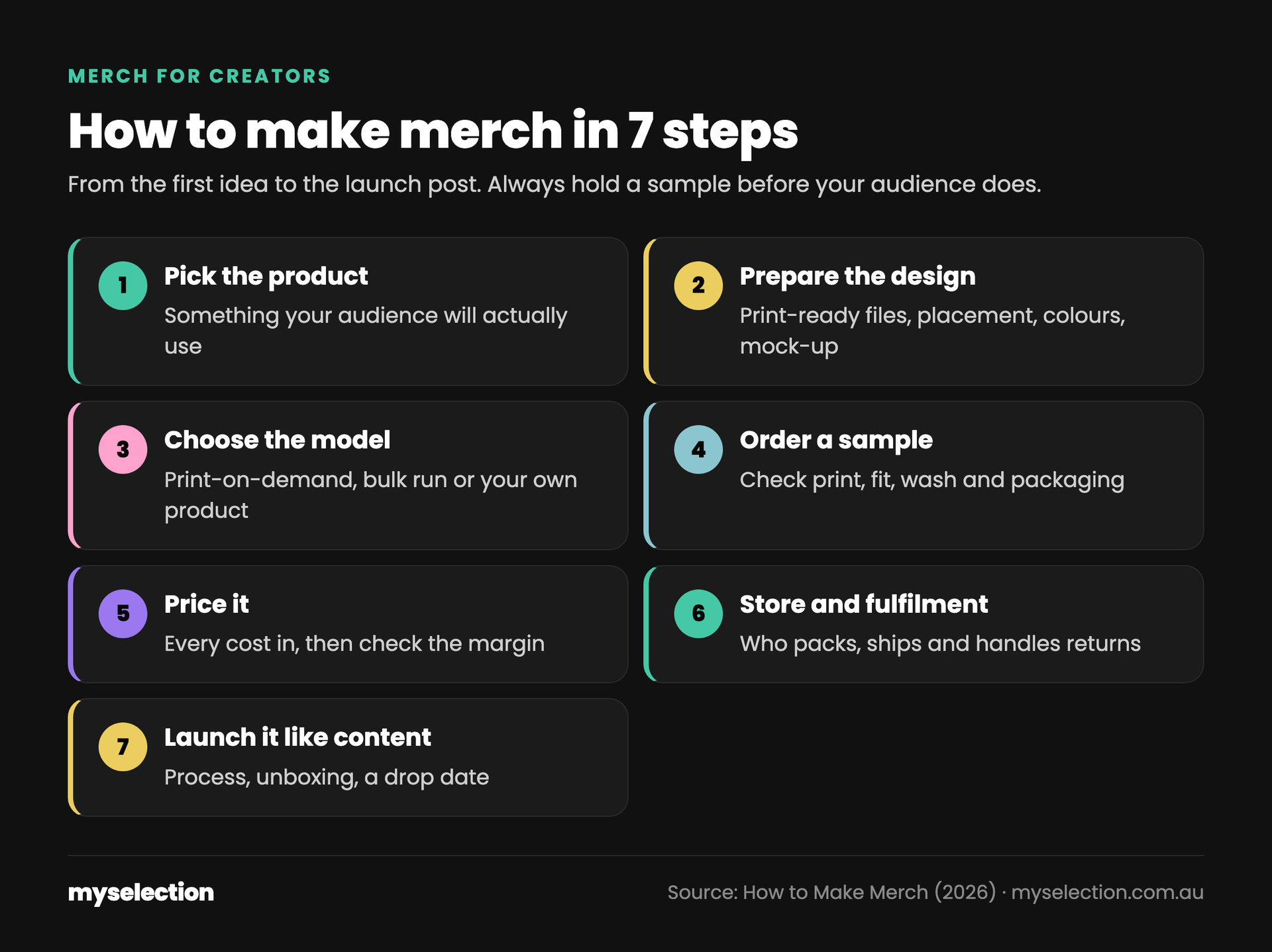
Seven steps from first idea to launch post. Free to share with a link back to this guide.
Step 1: Pick merch your audience will actually use
Good influencer merch feels like it belongs to your community, not like a logo stuck on a shirt. Start from what your audience already does with you: what they wear while watching, what's on your desk, the phrase they spam in chat.
| Weak merch idea | Strong merch idea |
|---|---|
| A t-shirt with my logo | A heavyweight tee with the inside joke from your most-quoted video |
| Some kind of hoodie | The exact hoodie colour fans already associate with your set |
| Stickers, I guess | A sticker pack of the reactions your community uses as emotes |
| Merch for everyone | Merch for the people who show up every week |
Then pick one or two products to start. Every extra product means more designs, more sizes and more decisions to get wrong.
Deliverable: one or two products and the idea behind each, in a sentence.
Step 2: Prepare the design
You don't need to be a designer, but the files need to be right. Ask your provider or printer for their file requirements before you start; most want:
- Print-ready files: vector artwork, or a high-resolution PNG with a transparent background, at the actual print size
- Placement and size: where the design goes and how big, for each product and size
- Colours: the number of colours matters for screen printing; embroidery has limits on fine detail and small text
- A mock-up: so you and your audience can see it before anything is printed
If your design is fan art or uses someone else's characters, music or logos, check you have the rights first. Merch is a product, and the same rules apply.
Deliverable: print-ready files, placement notes and a mock-up for each product.
Step 3: Choose a merch production model
This is the big one. There are three common ways to make merch for YouTubers, streamers and other creators.
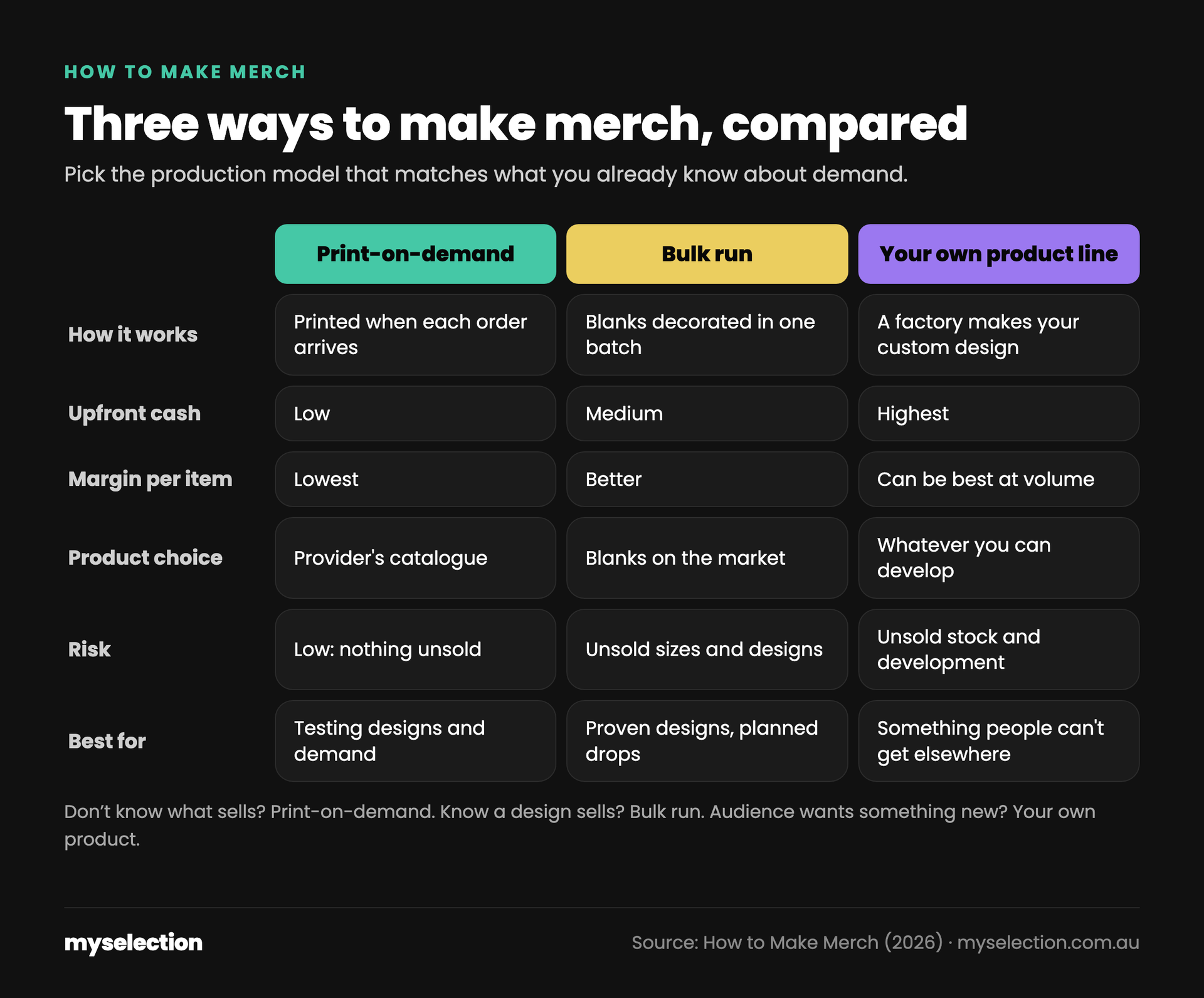
Three ways to make merch. Pick the one that matches what you know about demand.
| Print-on-demand | Bulk run (blanks + decoration) | Your own product line | |
|---|---|---|---|
| How it works | A provider prints and ships each item when an order comes in | You order a batch of printed or embroidered stock and ship it yourself or through a fulfilment partner | A factory develops and makes a custom product to your spec |
| Upfront cash | Low: samples and setup | Medium: you pay for the batch | Highest: development, samples, production |
| Margin per item | Lowest | Better | Can be best at volume |
| Product choice | Provider's catalogue | Blanks on the market | Whatever you can develop |
| Risk | Low: nothing unsold | Unsold sizes and designs | Unsold stock and development |
| Best for | Testing designs and demand | Proven designs, planned drops | Something people can't get elsewhere |
Who fits which, in one line: if you don't know what will sell, use print-on-demand; if you know a design sells, do a bulk run; if your audience wants something that doesn't exist yet, develop your own product.
Print-on-demand
POD providers such as Printful and Printify connect to your store, and when an order comes in, the item is printed (by Printful itself, or by one of the print providers in Printify's network) and shipped to the buyer. Some creator platforms, such as Fourthwall, bundle a store with merch production. It's the fastest way to launch and the safest way to test. The trade-offs: you choose from their products and print methods, and your margin per item is usually thinner than buying in bulk.
Bulk run
You buy blank garments or products and have them decorated in one batch by a local printer or a factory. Per-item cost usually drops as quantity rises, but you now own stock, so the risk moves to you. It works best for a design you've already tested, or a limited drop with pre-orders.
Your own product line
This is creator merch that isn't merch any more: your own fit, fabric, shape or product, made by a factory to your spec. It takes a prototype, samples and more upfront cash, but it's the only route that gives people something they can't buy elsewhere. It usually makes sense to get here after proving demand with POD or a bulk run.
Deliverable: the production model you're starting with and the provider or supplier you'll use.
Step 4: Order a sample before you sell
Always hold the product before your audience does. Order a sample of each product, in the size and colour you'll promote, and check:
- Print or embroidery quality, colour and placement
- How it fits and feels on real people, not just a hanger
- How it looks after a wash or two
- Packaging and how it arrives
If something's off, fix it now. One bad batch shows up in your comments forever.
Deliverable: an approved sample of each product, photographed for launch.
Step 5: Price it with every cost in
Price from cost, not from vibes. Add the product, decoration, packaging, shipping to you (for bulk runs), platform and payment fees, fulfilment and a buffer for returns and reprints. Then compare that with what your audience will realistically pay. Our guide on how much it costs to make merch has a line-by-line cost sheet you can fill in.
Deliverable: a price per product that still leaves margin after every cost.
Step 6: Set up the store and fulfilment
With POD, the provider usually handles printing and shipping once your store is connected. With a bulk run or your own product, decide who packs and ships orders: you, or a fulfilment partner. Either way, write down your shipping times, returns policy and size guide before launch so your inbox doesn't fill up with the same three questions.
Deliverable: a connected store, a shipping and returns policy, and a size guide.
Step 7: Launch it like content
Your audience already watches what you make, so make the merch part of the content: the design process, the sample unboxing, the "plot twist, I changed the colour" moment. Give the drop a date, and for bulk runs consider a pre-order window to set quantities. Then ask buyers for photos; that's your next round of content.
Deliverable: a drop date, launch content planned and, for bulk runs, a pre-order window.
How to make merch: choosing your production model (quick checklist)
- Do you have proof people will buy? No → print-on-demand.
- Do you know which designs and sizes sell? Yes → a bulk run can improve margin.
- Is your audience asking for something that doesn't exist? Yes → your own product line.
- Can you afford to hold unsold stock for a few months? No → stay on POD or use pre-orders.
Conclusion
Making merch is mostly about matching the production model to what you know. Start where the risk is low, learn what your audience actually buys, then move your best sellers to bulk or custom. Simple products done well beat a big range done in a hurry.
FAQ
How do I make merch for free? Print-on-demand lets you start without buying stock, so the upfront cost can be very low. You'll still want to pay for samples to check quality, and you give up some margin per item in exchange for no inventory risk.
What's the best merch for YouTubers? There's no universal best. The best merch is what your audience uses and connects to you: often apparel, but sometimes a desk item, a sticker pack or a product tied to your niche. Test a few designs on POD before committing to stock.
How many units should I order for a first bulk run? Start smaller than you think. Use POD sales, a pre-order or a waitlist to estimate demand, then split quantities by size based on that data rather than ordering the same amount of every size.
Can I turn merch into my own brand? Yes. Many creator brands start as merch and then develop their own products once demand is clear. That step usually means working with a factory on custom designs, samples and production.
Discuss your product idea
Ready to go beyond print-on-demand? Discuss your product idea with us. My Selection helps creators build a product brand from their audience, working with long-term partner factories in Jiangsu, Zhejiang and the Pearl River Delta and our own development team in China. Our supplier network covers 867 suppliers across 34 countries, with 10+ designers on the team. Which products fit and what's included are confirmed per project. Lead times, MOQs and unit costs depend on the product, so we confirm those too.