Knowing how to validate a product idea means getting evidence that people will pay for it before you pay a factory to make it. For a creator, that means moving your audience up a ladder: from comments and likes, to answering a specific question, to leaving an email, to putting money down. Each step costs your audience a bit more, so each step tells you more.
POV: you posted a mock-up, the comments went wild, and you're ready to order 1,000 units. Plot twist: "omg need" is free to type. Likes are based on vibes; a pre-order is based on a bank card. This guide walks through the validation ladder step by step, what to set up at each rung, what counts as a pass, and when to stop.
This is what we do at My Selection: we help creators turn a validated idea into a physical product, from development and samples to production. If your audience is already asking for something, tell us what you're making.
In this guide:
- How to validate a product idea: the ladder
- Step 1 to step 6
- Weak vs strong signals
- Validation vs product market fit
- FAQ
How to validate a product idea: the ladder
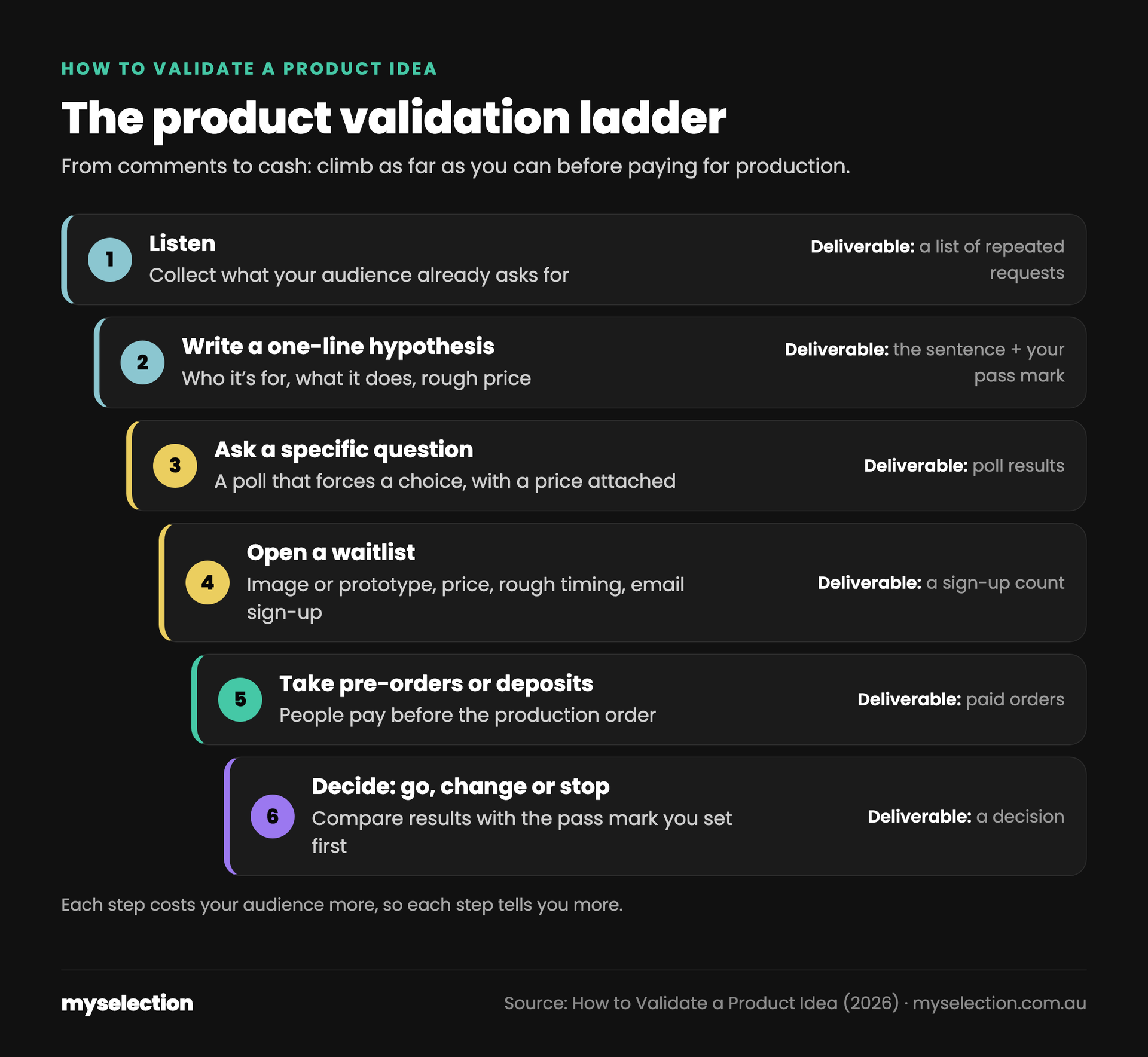
Each rung costs your audience more, so it tells you more. Free to share with a link back to this guide.
You don't have to climb every rung for every idea. But the higher you get before production, the less you're guessing. Validation sits at the very start of the full process of creating a physical product: it decides whether the rest of the process is worth paying for.
Step 1: Listen before you ask
What to do: Go through comments, DMs, replies and Q&A stickers from the last few months. Note every time someone asks where to buy something, asks you to make something, or complains about a product they already use.
Deliverable: a list of repeated requests, with rough counts.
Common trap: counting one enthusiastic superfan ten times. Count people, not messages.
You can also check whether the wider world searches for the thing your audience is asking about. Google Trends shows whether interest in a product type is rising, falling or seasonal. It won't validate your version, but it can warn you off a fading trend.
Step 2: Write a one-line product hypothesis
What to do: Turn the idea into one sentence: who it's for, what it does, and roughly what it costs. For example (illustrative): "A leak-proof 750 ml bottle for my gym followers, around $35."
Deliverable: the sentence, plus your pass mark for the next steps, written down before you test.
Common trap: testing a vague idea ("merch?") and getting a vague answer. If you don't know your price range yet, get a rough cost estimate first; even a ballpark changes which version you test.
Step 3: Ask a specific question
What to do: Run a poll or question box that forces a choice, ideally with a price. "Would you buy this?" invites polite yeses. "Which one would you buy at $35: black or sand?" gets closer to a real decision.
Deliverable: poll results and the comments around them.
Common trap: treating a poll vote as a sale. Votes are cheap. Use the poll to choose between versions (colour, size, feature), not to decide whether to manufacture.
Step 4: Open a waitlist
What to do: Put up a simple page with a product image or a working prototype, the target price, a rough timing, and an email sign-up. Link it from your bio and stories.
Deliverable: a sign-up count, and how many people open your follow-up email.
Common trap: a waitlist with no price on it. People sign up for a free surprise much more readily than for a $35 bottle. Show the price.
Step 5: Take pre-orders or deposits
What to do: Let people pay, in full or as a deposit, before you place the production order. Most store platforms support this; for example, Shopify explains how to set up pre-orders and collect full, partial or no payment upfront. Say clearly what people are buying, when you expect to ship, and what happens if it's delayed or cancelled.
Deliverable: paid orders.
Common trap: promising a ship date before the factory has confirmed a schedule. Pre-order rules and consumer protections vary by where you sell, so check what applies to you and be generous with refunds if plans change.
Pre-orders also help with a practical problem: factories set a minimum order. If your pre-orders get you close to the minimum order quantity for your product, the first run is far less of a gamble.
Step 6: Decide: go, change or stop
What to do: Compare your results with the pass mark you wrote in step 2.
- Go: you hit the mark at the pre-order or waitlist step. Move to samples and production planning, then work through your product launch checklist.
- Change: interest is real but split (for example, people love the idea but not the price). Adjust one thing and test again.
- Stop: you couldn't get past likes. That's a win too: you just saved the cost of a production run nobody asked for.
Weak vs strong signals
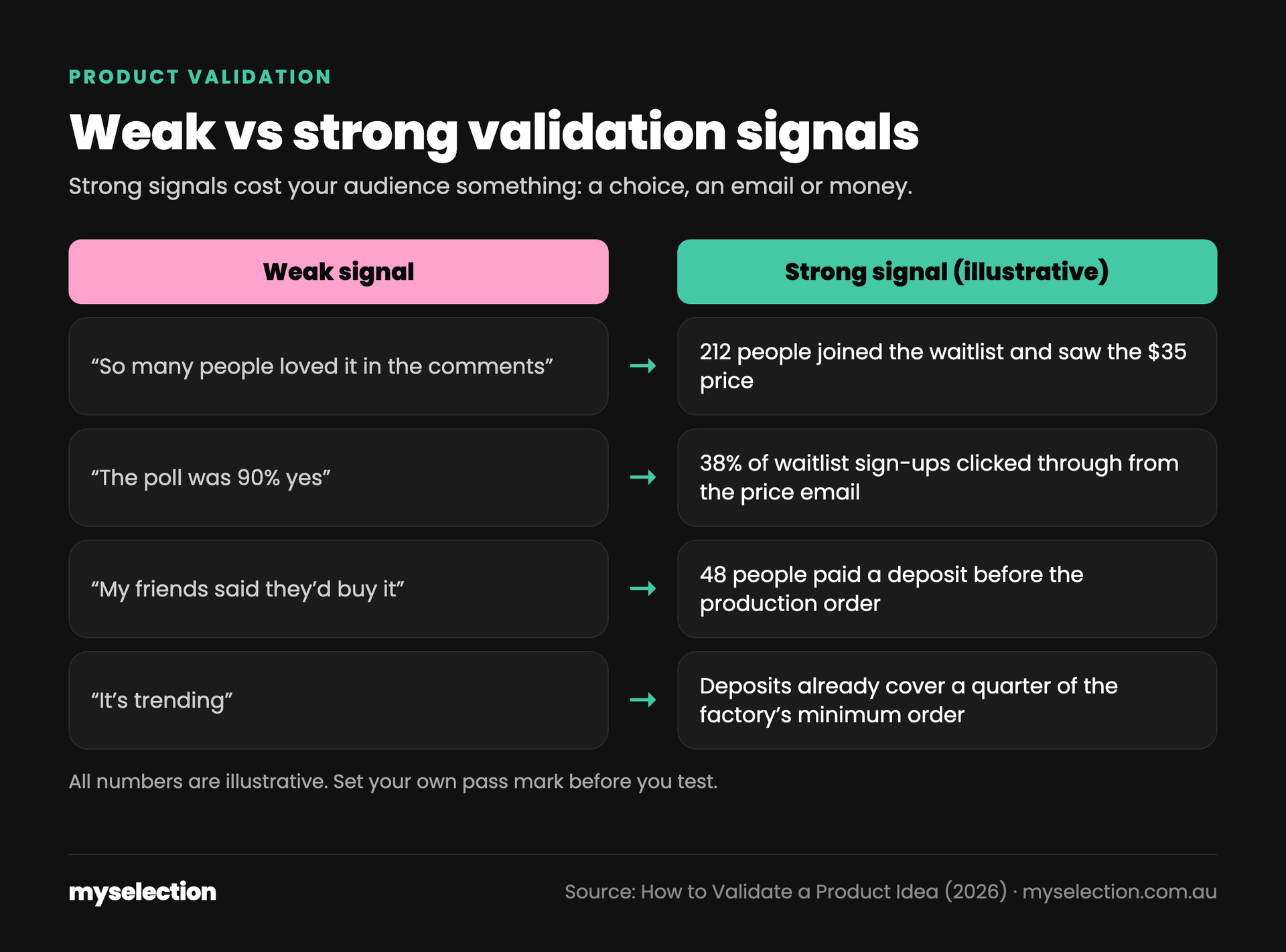
Illustrative numbers. Set your own pass mark before you test.
| Weak signal | Strong signal (illustrative numbers) |
|---|---|
| "So many people loved it in the comments" | "212 people joined the waitlist and saw the $35 price" |
| "The poll was 90% yes" | "38% of waitlist sign-ups clicked through from the price email" |
| "My friends said they'd buy it" | "48 people paid a deposit before the production order" |
| "It's trending" | "Deposits already cover a quarter of the factory's minimum order" |
Polls and repeated requests are still useful for choosing a version; demand is proven by emails and money. Every number here is illustrative. What counts as enough depends on your audience size, your price and the factory's minimum order, which is why you set the pass mark before you test, not after.
Validation vs product market fit
Product validation answers one question: will enough of your audience pay for this specific product, at this price, to justify a first run? Product market fit is a bigger, later question: does the product keep selling, including to people who don't already follow you, and do buyers come back?
You validate before you manufacture. You find out about product market fit after you've sold through the first run and seen reorders, reviews and sales from outside your audience. Don't wait for product market fit before making anything; just don't skip validation either.
Conclusion
Validating a product idea is about collecting evidence that costs your audience something: an answer to a specific question, an email, and ideally a payment. Write your pass mark down before you test, climb the ladder as far as you can before paying for production, and treat a "stop" as money saved, not a failure.
FAQ
How do you validate a product idea for free? Most of the ladder costs little or nothing: reading your comments and DMs, running polls, checking Google Trends, and putting up a simple waitlist page. Pre-orders cost little upfront beyond any app or payment fees, but they create an obligation to deliver or refund, so only open them when you have a realistic plan to produce.
How many pre-orders do you need before manufacturing? There's no universal number. Compare pre-orders with the factory's minimum order and your costs: the closer pre-orders get you to covering the first run, the lower your risk. Decide your number before you open pre-orders.
How do you do pre-orders for a product that doesn't exist yet? Show a prototype or realistic render, state the price, an expected ship window and your refund policy, and take payment or a deposit through your store's pre-order feature. Only promise dates the factory has confirmed.
Discuss your product idea
Got an idea your audience keeps asking for, and rather not run every step alone? Discuss your product idea with us. My Selection helps creators turn their audience into a product brand, working with long-term partner factories in Jiangsu, Zhejiang and the Pearl River Delta and our own development team in China. Our supplier network covers 867 suppliers across 34 countries, with 10+ designers on the team. Which products fit and what's included are confirmed per project. Lead times, MOQs and unit costs depend on the product, so we confirm those too.