A factory audit is an on-site check of a manufacturer, done before or during a business relationship, to confirm the factory can actually make your product the way you need it: the equipment, the people, the quality controls and, depending on the audit, the working conditions. It looks at the factory, not at your finished goods.
POV: a supplier replies in two hours, sends glossy photos and says "strict quality control". Very good vibes. Plot twist: none of that tells you whether the photos are their factory, whether they make your category in-house, or whether anyone checks the work before it's packed.
This guide covers what a factory audit checks, the three main types, when a new brand needs one (and when a lighter check is enough), and what to do with the report.
This is what we do at My Selection: we help creators develop products and work with factories from the first brief to approved samples and production. If you're about to commit to a new factory, tell us what you're making.
In this guide:
- What a factory audit actually checks
- The three main types of factory audit
- When does a new brand need a factory audit?
- Factory audit checklist: what to check and what "good" looks like
- Vague claims vs evidence to ask for
- Who does the audit, and how to brief them
- What to do with the audit report
What a factory audit actually checks
Think of a factory audit as due diligence on the supplier. A product inspection asks "are these units right?". A factory audit asks "can this place keep making them right?".
Most audits combine some of these areas:
- Identity and legitimacy: the business is registered, the address on the paperwork is the site you're looking at, and it's a factory rather than a trading office.
- Capability and capacity: the machines, processes and people for your product, and enough room in the schedule for your order.
- Quality system: how incoming materials are checked, how production is checked along the way, how defects are recorded and fixed.
- Social compliance: working hours, wages, age checks, health and safety, fire exits.
- Environment (sometimes): waste, chemicals and emissions handling.
The audit ends with a report: findings, photos, a score or pass/fail by section, and a list of issues for the factory to fix.
The three main types of factory audit
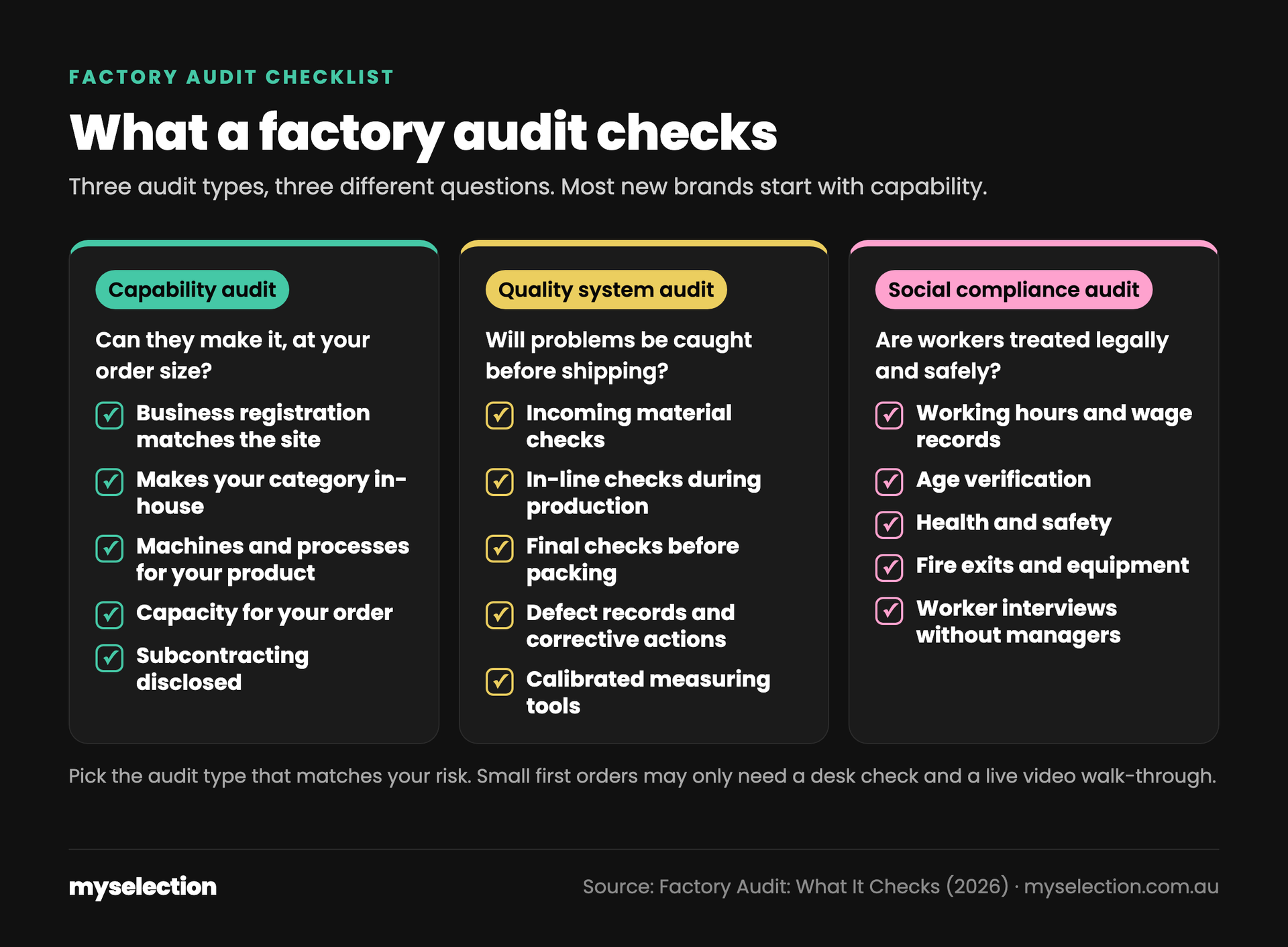
A factory audit scope checklist. Free to share with a link back to this guide.
| Type | Main question | Who usually asks for it |
|---|---|---|
| Capability (technical) audit | Can this factory make my product, at my order size? | Brands choosing a new supplier |
| Quality system audit | Does the factory have working controls that catch problems before shipping? | Brands placing repeat or larger orders |
| Social compliance audit | Are workers treated legally and safely? | Retailers, marketplaces and brands with ethical-sourcing commitments |
A few names you'll see on quotes and certificates:
- ISO 9001 is the international standard for quality management systems, part of the ISO 9000 family. A certificate shows the factory's quality system was certified by an outside body. It's a good sign, but it doesn't prove your specific product will be made to your spec.
- SA8000 is a social certification standard from Social Accountability International.
- SMETA is Sedex's ethical trade audit methodology, widely used for social compliance audits. A SMETA audit produces a report, not a certificate.
If a retailer you want to sell through asks for a specific social audit, ask them which one they accept before you book anything. They're not interchangeable.
When does a new brand need a factory audit?
Not every first order needs a full third-party audit. Here's a practical way to decide:
| Situation | Suggested check |
|---|---|
| Small test order, simple product, supplier with a long track record you can verify | Desk check + video walk-through + a good sample |
| First order with a factory nobody on your side has visited | Capability audit before you pay the deposit |
| Product with safety risk (kids' products, electrical, anything worn on skin or in contact with food) | Capability audit + quality system audit |
| Larger order, or a big share of your launch cash riding on one factory | Capability + quality system audit |
| A retailer or partner requires a social audit | The specific social audit they name |
A desk check is the lightweight version: business registration, export history, references from other buyers, certificates checked with the body that issued them, and a live video call walking the production floor (not a pre-recorded video).
If you're still choosing between suppliers, the steps in our guide to how product sourcing works for creator brands show where an audit fits: after the shortlist and quotes, before you commit to production.
Factory audit checklist: what to check and what "good" looks like
Copy this into your audit brief, or use it to read a report you've been sent.
Capability
- Business registration matches the site. Good: the name and address on the licence match the gate you're standing at. Red flag: "Our factory is at another address, this is our office."
- They make your category in-house. Good: you see your type of product, or very similar, on the line. Red flag: the floor makes something unrelated.
- Machines and processes for your product. Good: the key steps (sewing, moulding, printing, assembly) happen on site, or the subcontractor is named. Red flag: key steps are "done by a partner" with no name.
- Capacity for your order. Good: they can show how your order fits around current orders. Red flag: "No problem, any quantity."
Quality system
- Incoming material checks. Good: records showing fabric, resin or components are checked on arrival. Red flag: materials go straight to the line.
- In-line checks. Good: someone checks work during production, with a record. Red flag: quality is only checked at the end, or never.
- Final checks before packing. Good: a defined check with a sampling method. Red flag: "Workers check their own work."
- Defect records and fixes. Good: they can show a recent problem and what they changed. Red flag: "We never have defects."
- Measuring tools. Good: gauges, scales and testers are calibrated, with dates. Red flag: tools with no record.
Social compliance
- Working hours and wage records that look consistent, not suspiciously perfect.
- Age checks on hiring.
- Health and safety: protective equipment in use, machines guarded.
- Fire safety: exits clear and marked, extinguishers in date.
- Worker interviews held without managers in the room.
Vague claims vs evidence to ask for
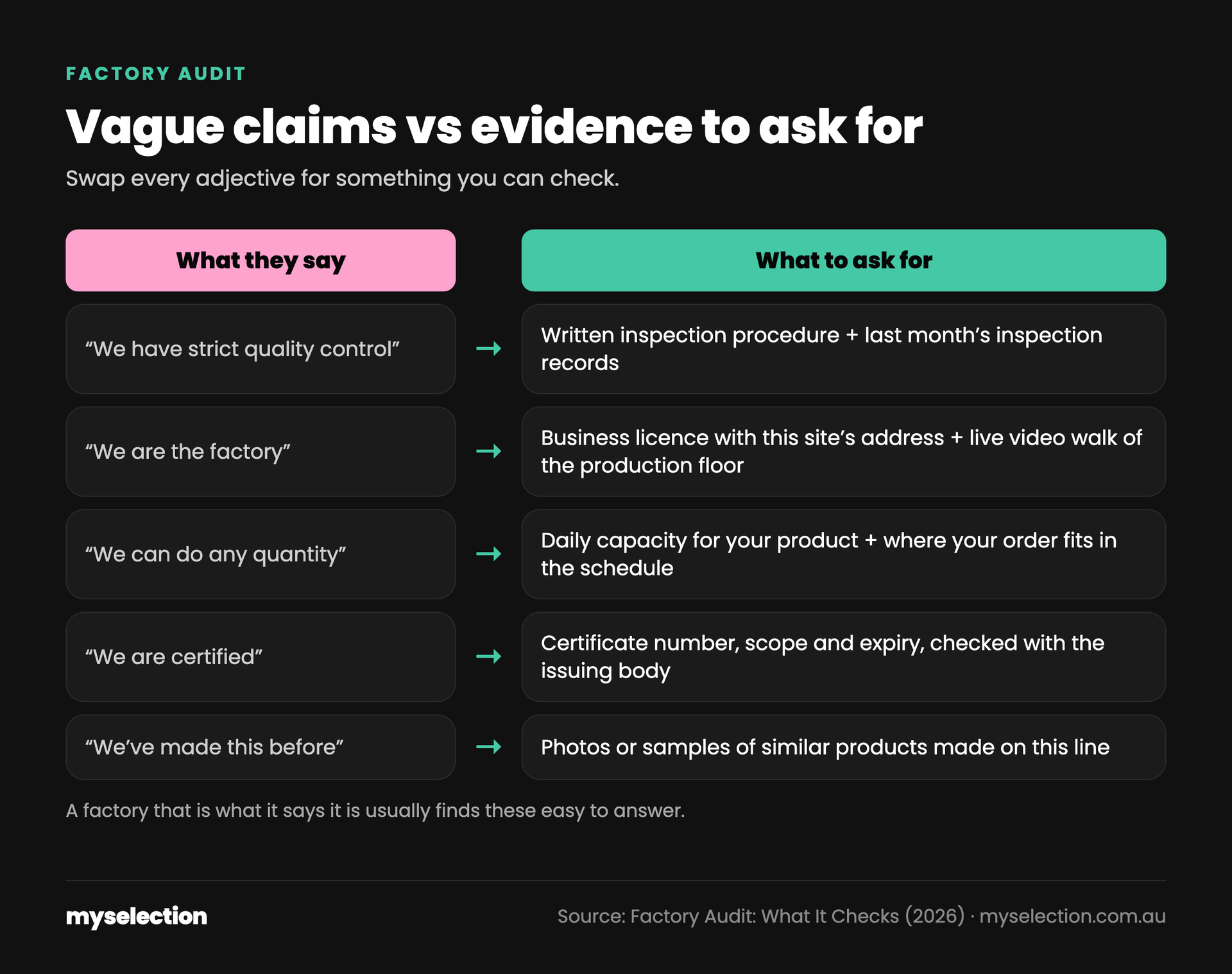
Swap every vague claim for something you can check.
| What the supplier says | What to ask for instead |
|---|---|
| "We have strict quality control" | Their written inspection procedure and last month's inspection records |
| "We are the factory" | A business licence with the site address, plus a live video walk of the production floor |
| "We can do any quantity" | Daily capacity for your product, and where your order fits in the schedule |
| "We are certified" | Certificate number, scope and expiry date, checked with the body that issued it |
| "We've made this before" | Photos or samples of similar products made on this line |
A factory that is what it says it is usually finds these easy to answer.
Who does the audit, and how to brief them
You have three options:
- Visit yourself. Best for relationships, hardest if you're far away or don't know what to look for.
- A third-party audit company. Independent, uses a standard checklist and gives you a report. Audits are usually priced per auditor-day, so ask for a quote for your scope.
- A sourcing agent or product partner who already visits factories in the region. Our guide on what a sourcing agent does covers how to judge whether one is independent.
Whoever goes, brief them with:
- your product, a photo or sample, and your tech pack if you have one;
- which audit type you want (from the table above);
- the three or four things that worry you most about this supplier;
- whether you want photos of specific machines, areas or documents.
What to do with the audit report
Read the report as a to-do list, not a verdict:
- Critical findings (fake address, child labour, no ability to make your product): walk away.
- Major findings (no final inspection, no material checks): ask for a written fix plan with dates before you pay a deposit, and plan a closer check of the goods.
- Minor findings (records incomplete, labels missing on a shelf): note them and check again next time.
Then carry what you learned into the next steps. An audit says the factory can do the job; you still need an approved reference to measure production against, which is the golden sample, and a check of the finished goods before you pay the balance, which is a pre-shipment inspection.
Conclusion
A factory audit is a check on the supplier, not the product. For a small first order with a supplier you can verify, a desk check and a strong sample may be enough; for a new factory, a product with safety risk, or an order that carries a big share of your launch budget, book a capability audit before the deposit and add a quality system audit when the stakes rise. Ask for evidence, not adjectives.
FAQ
What is the difference between a factory audit and an inspection? A factory audit checks the supplier: its capability, quality system and working conditions. An inspection checks your goods: a sample of finished or in-production units is measured against your spec and approved sample. You usually audit once before working with a factory (and again periodically), and inspect every order.
Is an ISO 9001 certificate enough instead of an audit? It helps, but it isn't the same thing. ISO 9001 certification shows an outside certification body found the factory's quality management system met the standard at its last audit. It doesn't confirm that the factory makes your type of product well or has capacity for your order. Check the certificate's scope and expiry, and still check capability.
Can I audit a factory remotely? Partly. A live video walk-through plus document checks can confirm a lot for a small first order. It can't easily confirm records are genuine or interview workers privately, so for higher-risk products or larger orders an on-site audit is still the safer option.
Discuss your product idea
Not sure whether your first factory needs an audit, or what to ask for? Discuss your product idea with us. My Selection helps creators build a physical product brand from their audience, working with long-term partner factories in Jiangsu, Zhejiang and the Pearl River Delta and our own development team in China. Our supplier network covers 867 suppliers across 34 countries, with 10+ designers on the team. Which products fit and what's included are confirmed per project. Lead times, MOQs and unit costs depend on the product, so we confirm those too.