Private label clothing is apparel made by a manufacturer and sold under your brand, with your labels and your agreed changes to an existing style. Instead of printing on a blank tee, you start from a garment the factory already makes, adjust the fabric, colour, fit details and trims, and add your own neck label, care label and packaging. It's the middle route between decorated blanks and full cut-and-sew.
POV: your merch drop sold out and the comments are asking for "the real version". Plot twist: the real version isn't a better print, it's a better garment. This guide explains how private label clothing compares with the other routes, then walks through the steps, the labels you need, and the request to send a factory.
This is what we do at My Selection: we help creators develop products, including apparel, and coordinate production with partner factories. If you're planning a clothing line, tell us what you're making.
In this guide:
- Private label clothing vs blanks vs cut-and-sew
- Step 1 to step 7
- Labels to plan
- Vague vs factory-ready requests
- FAQ
Private label clothing vs blanks vs cut-and-sew
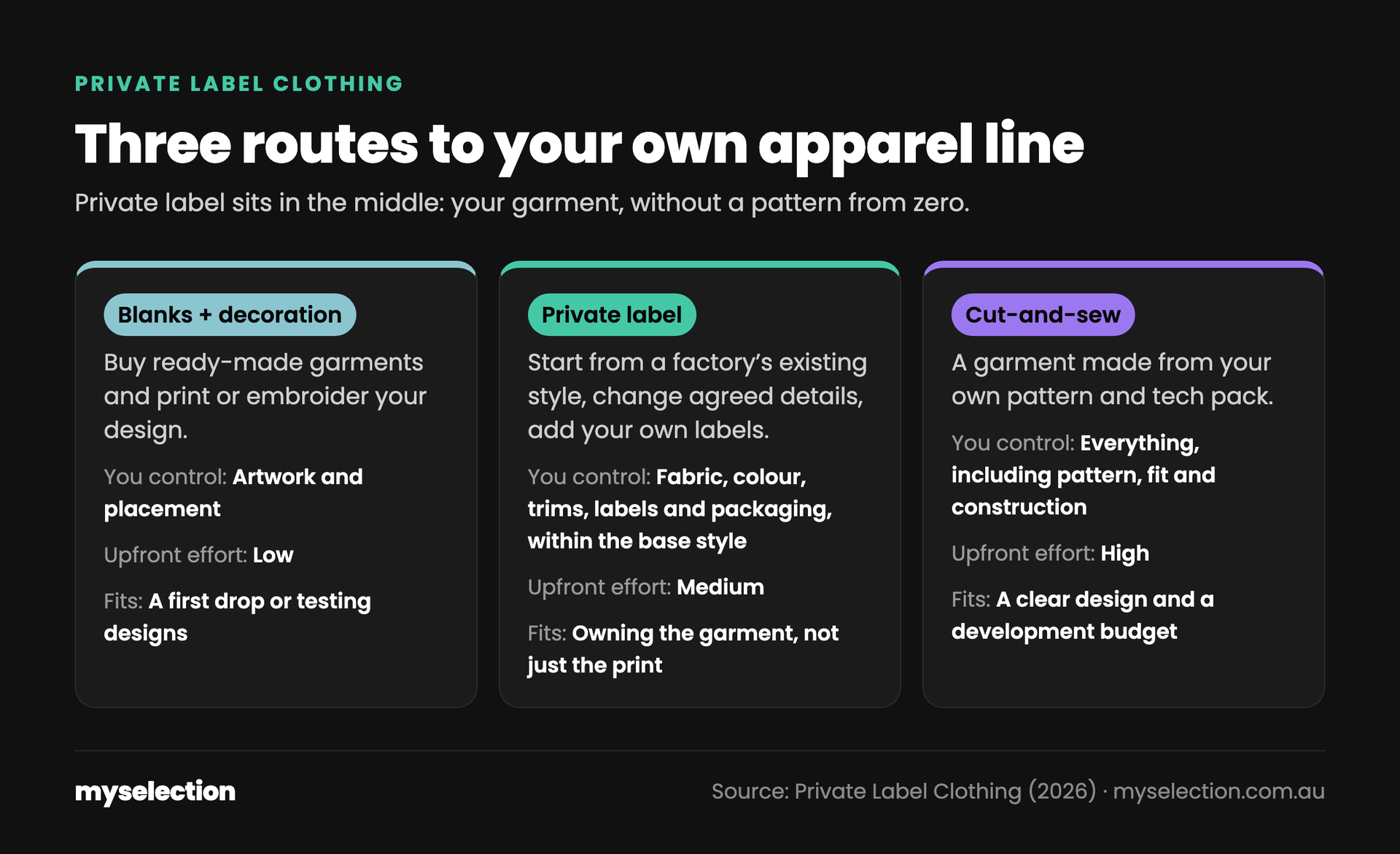
Three routes, three levels of control. Free to share with a link back to this guide.
| Route | What you control | Upfront effort | Fits when |
|---|---|---|---|
| Blanks + decoration | Artwork and placement | Low | First drop, testing designs |
| Private label clothing | Fabric, colour, trims, labels and packaging, within the factory's base style | Medium | You want your own garment without designing a pattern from zero |
| Cut-and-sew | Everything, including pattern, fit and construction | High | You have a clear design and budget for development |
Private label sits where most creators land once merch becomes a brand. If you're still choosing between print-on-demand and a bulk run, start with how to make merch. If you're planning the full brand, from audience to first production run, read how to start a clothing brand.
Step 1: Choose the garment and the base style
What to do: pick one garment type your audience already wears in your content: a hoodie, a tee, a pair of shorts. Ask factories for their existing styles in that type and request photos, measurements and fabric options.
Deliverable: one or two shortlisted base styles with their size charts.
Common trap: launching five garment types at once. Each one has its own sizes, samples and fit issues.
Step 2: Decide what changes
What to do: list exactly what you'll change from the base style: fabric weight and composition, colour, trims (zips, drawcords, buttons), small fit adjustments, and decoration (print, embroidery, patch).
Deliverable: a one-page change list, with photos or references for each change.
Common trap: asking for "a better fit". Name the measurement and the target, for example (illustrative): "body length +3 cm on all sizes".
Step 3: Plan your labels
What to do: decide your neck label (woven, printed or heat transfer), size label, fibre content label and care label. Care symbols are set out internationally in ISO 3758, the textile care labelling code, but which care, fibre-content and origin rules apply depends on where you sell, so check the rules for your markets.
Deliverable: label artwork and the wording for content and care.
Common trap: leaving labels to the last minute. Labels are sewn in or heat-applied during production, so they need approval before the run.
Step 4: Request samples
What to do: send the base style, change list and label artwork, and ask for a sample in your sample size. Try it on more than one body if you can.
Deliverable: a sample, with your fit and quality comments written against each measurement.
Common trap: approving from photos. Fabric hand-feel, colour and stitching only show up in person.
Step 5: Approve the sample and size range
What to do: once the sample is right, confirm the size range and the measurements for every size, then sign off the approved sample. That sample becomes the standard the run is checked against.
Deliverable: an approved sample and a size chart for every size.
Common trap: approving one size and assuming the rest will follow. Ask for a size set if the factory offers one.
Checkpoint: don't request a quote for the run until the sample and every size are approved.
Step 6: Budget and order quantity
What to do: get a quote per size and colour, including labels, packaging and any decoration. Factories often set minimums per style, colour or fabric, so ask how they apply. Add freight and duties; the full number is your cost per garment, not the factory price. Our merch budget breakdown shows each line to include.
Deliverable: a budget per garment and a size and colour split for the first order.
Common trap: spreading a small order across too many colours and sizes. Fewer colours means more units per option.
Step 7: Production, inspection and launch
What to do: place the order, check the goods against the approved sample before they ship, and plan your launch content around the arrival date the factory confirms.
Deliverable: inspected stock and a launch plan.
Common trap: announcing a date before the factory has confirmed a schedule.
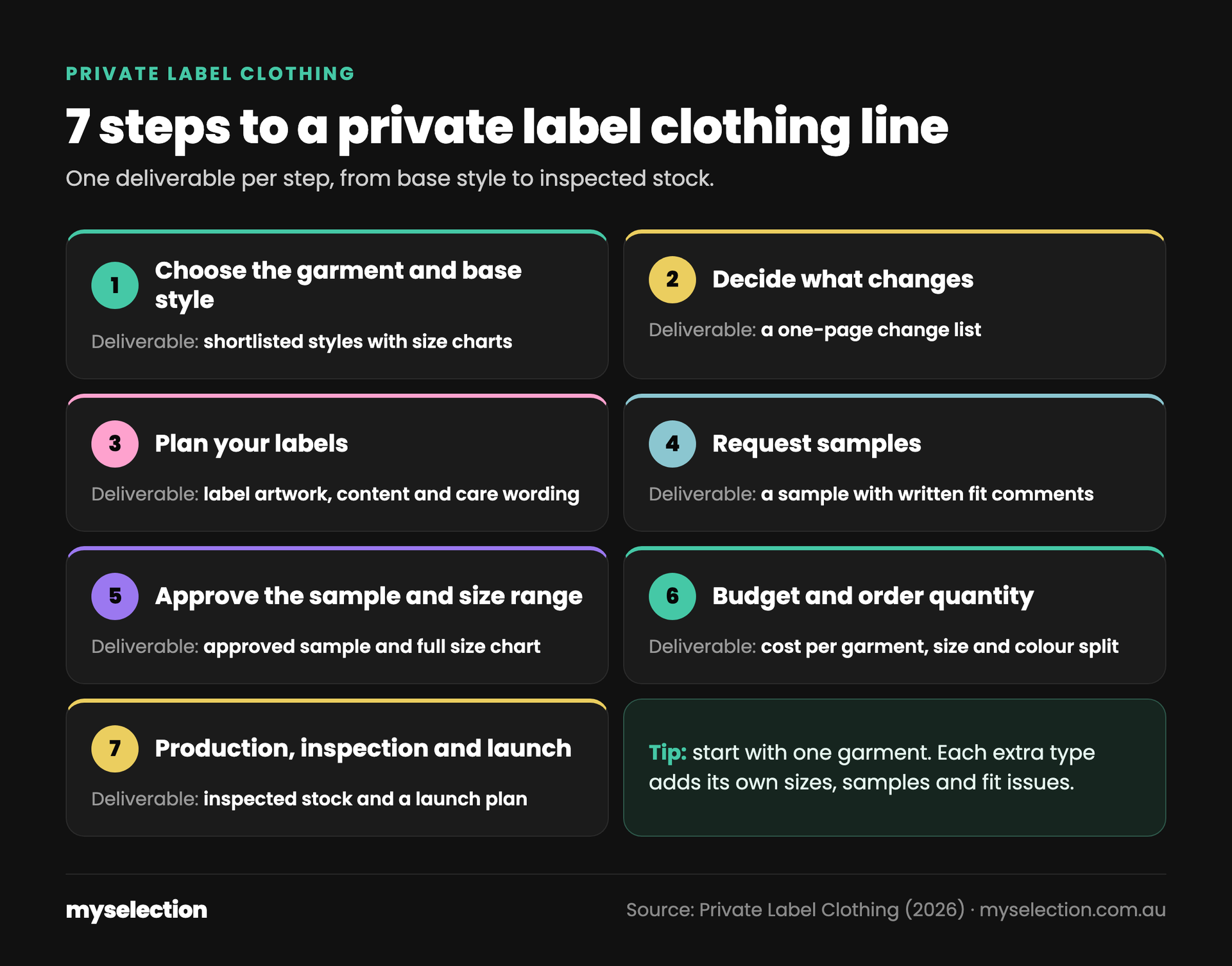
One deliverable per step. Free to share with a link back to this guide.
Vague vs factory-ready requests
| Vague | Factory-ready |
|---|---|
| "A heavyweight hoodie." | "Base style #H-12 in 100% cotton fleece, fabric weight as per the swatch we approved." |
| "Make it oversized." | "Chest +4 cm and sleeve +2 cm on every size vs your base chart (illustrative)." |
| "Our logo inside." | "Woven neck label, artwork attached, centred 1 cm below the collar seam." |
| "Usual care label." | "Care label with the symbols and fibre content on the attached sheet." |
| "Nice packaging." | "Each garment folded, in a recyclable mailer with our insert card." |
Every number above is illustrative. The point is to give a factory something it can measure.
Conclusion
Private label clothing lets a creator sell a garment that's genuinely theirs, without designing a pattern from scratch or owning a factory. Start with one garment, list your changes precisely, sort labels early, approve a physical sample, and budget the full cost per garment before you order.
FAQ
Is private label clothing the same as white label? No. White label is a ready-made product many brands sell with their own logo and little or no change. Private label clothing is made for your brand with agreed changes and your labels, so it's harder for another store to sell the identical item.
How do I find private label clothing manufacturers? Look for factories that already make your garment type, ask for photos and measurements of their base styles, and request a sample before committing. Compare quotes on the same specification, including labels and packaging.
Do I need a tech pack for private label clothing? Not always a full one, because you start from the factory's base style. You still need a clear change list, measurements and label artwork. For cut-and-sew, a full tech pack is essential.
Discuss your product idea
Want a clothing line that's more than a print on a blank? Discuss your product idea with us. My Selection helps creators turn a loyal audience into a product brand, working with long-term partner factories in Jiangsu, Zhejiang and the Pearl River Delta and our own development team in China. Our supplier network covers 867 suppliers across 34 countries, with 10+ designers on the team. Which products fit and what's included are confirmed per project. Lead times, MOQs and unit costs depend on the product, so we confirm those too.