Contract manufacturing is when your brand hires an outside factory to make your product to your specifications, and you sell it under your own name. You own the brand and the customer relationship; the contract manufacturer owns the machines, the staff and the production line. For a creator, it's the normal way to get a physical product made without buying a factory.
POV: you've got the audience, the idea and maybe a sketch. Plot twist: nobody expects you to own a sewing floor or an injection-moulding machine. What you do need is clarity on who designs, who pays for moulds, who checks quality and who owns what at the end. That split is where most first-time brands get ghosted by their own assumptions. This guide covers what contract manufacturing is, how it works, the main types, a who-owns-what matrix, and the wording to get in writing.
This is what we do at My Selection: we help creators develop a product and coordinate manufacturing with partner factories. If you're weighing up a first run, tell us what you're making.
What contract manufacturing means
A contract manufacturer (sometimes called a CM) produces goods for another company under an agreement. The brand decides what the product is; the manufacturer turns that into units. The arrangement is usually set out in a supply or manufacturing agreement plus a purchase order for each run.
You'll see contract manufacturing in almost every category: cosmetics, supplements, electronics, apparel, drinkware, fitness gear. Large brands use it, and so do small ones. It sits inside the wider job of product sourcing for a creator brand, which also covers finding, comparing and approving suppliers before anything is made.
Why it matters for a new brand
- No factory to buy. You pay per unit and per project, not for buildings and machines.
- Access to skills. A factory that already makes your product type knows the materials, tolerances and common defects.
- Focus. You spend your time on the product idea, content and customers, which is the part only you can do.
The trade-off: you control the result through documents and checks, not by standing on the line. Clear specifications and written responsibilities replace physical control.
How contract manufacturing works, step by step
- Brief and specification. You describe the product: dimensions, materials, colours, finish, packaging, and the standard it must meet.
- Quotation. The manufacturer prices the job. Quotes normally depend on quantity, materials and any tooling. Factories also set a minimum order quantity, which is often the first number that changes your plan.
- Samples. You approve a sample (or several rounds of them) before production.
- Agreement and purchase order. You sign terms covering price, quality, ownership, confidentiality and delivery, then place the order.
- Production and quality control. The factory produces; you or a third party inspect against the approved sample.
- Shipping. Goods leave the factory on the agreed shipping term and go to your warehouse or fulfilment partner.
The main types of contract manufacturing
| Type | What the manufacturer does | Fits when |
|---|---|---|
| Full-service (turnkey) | Sources materials, makes the whole product, often packs it | You want one supplier responsible for the finished unit |
| Component or sub-assembly | Makes one part that goes into your product | You're combining parts from several suppliers |
| Labour-only (cut, make, trim in apparel) | Assembles using materials you supply | You already source your own fabric or components |
| Private label | Puts your brand on a product it already makes, with limited changes | Speed matters more than a unique design |
Private label is the lightest form of contract manufacturing: the factory's existing product with your brand and limited changes. OEM and ODM describe something else again: whose design it is. If you're comparing those routes, start with the specification and work out who will produce the design.
Who owns what in contract manufacturing
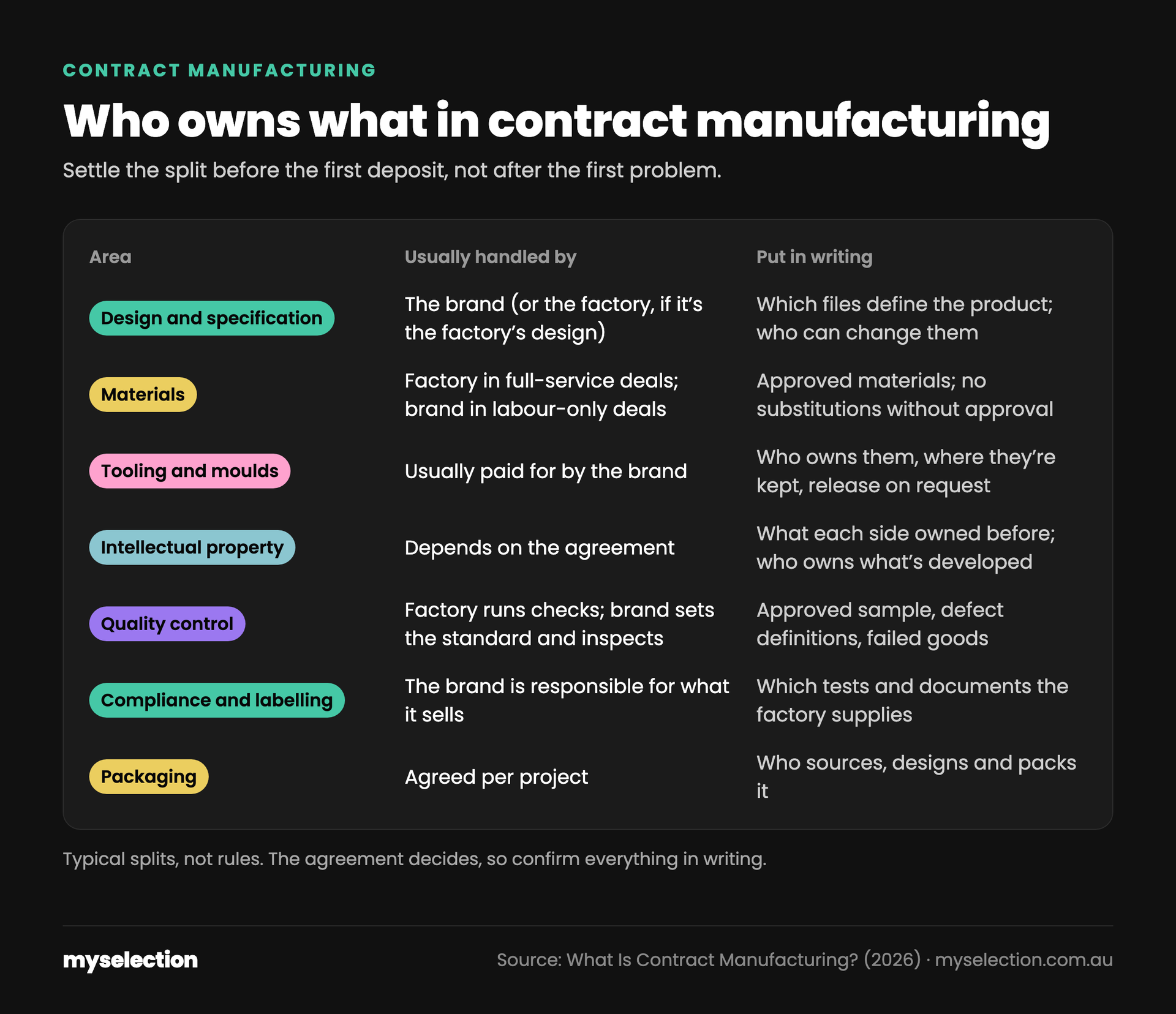
Typical splits, not rules. The agreement decides. Free to share with a link back to this guide.
This is the part to settle before money moves. Typical splits:
| Area | Usually handled by | What to put in writing |
|---|---|---|
| Design and specification | The brand (or the factory, if you're using its design) | Which files and specs define the product; who can change them |
| Materials | Factory in full-service deals; brand in labour-only deals | Approved materials, suppliers and substitutions |
| Tooling and moulds | Usually paid for by the brand | Who owns them, where they're kept, release on request |
| Intellectual property | Depends on the agreement | What each side owned before; who owns what is developed during the project |
| Quality control | Factory runs checks; brand sets the standard and inspects | The approved sample, defect definitions and what happens to failed goods |
| Compliance and labelling | The brand is responsible for what it sells | Which tests and documents the factory must supply |
| Packaging | Agreed per project | Who sources it, who designs it, who packs it |
On IP: a confidentiality agreement and careful sharing of files protect information that isn't public. The World Intellectual Property Organization explains that information can qualify as a trade secret only if its holder takes reasonable steps to keep it secret, such as confidentiality agreements with business partners. For anything that matters, get qualified legal advice for the places where you make and sell.
On quality: a factory with an ISO 9001 certificate has had its quality management system certified by an independent certification body. That's a good sign about process, but it doesn't certify your specific product. You still need your own approved sample and inspection.
Vague vs contract-ready wording
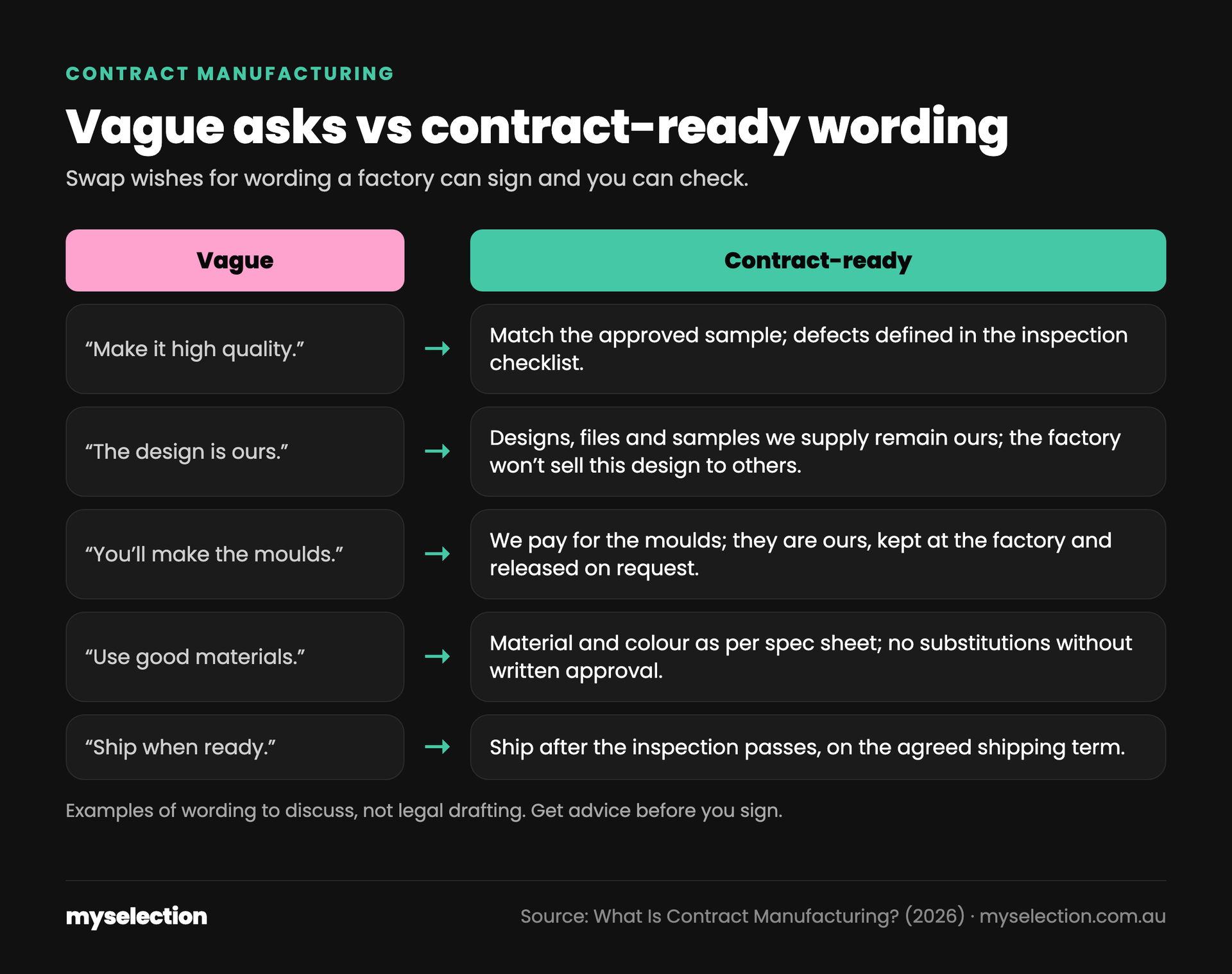
Swap vague asks for wording a factory can sign. Free to share with a link back to this guide.
| Vague | Contract-ready |
|---|---|
| "Make it high quality." | "Match the approved sample; defects defined in the inspection checklist." |
| "The design is ours." | "Designs, files and samples we supply remain ours; the factory won't sell this design to others." |
| "You'll make the moulds." | "We pay for the moulds; they are ours, kept at the factory and released on request." |
| "Use good materials." | "Material and colour as per spec sheet; no substitutions without written approval." |
| "Ship when ready." | "Ship after the inspection passes, on the agreed shipping term." |
These are examples of the kind of wording to discuss, not legal drafting. The exact terms depend on your product, the factory and the law that applies to your agreement.
Common misconceptions
- "Contract manufacturing means I lose control." You keep control through the spec, the approved sample and inspection. You lose control when those are missing.
- "The factory owns the design if they make it." Not automatically. It depends on who created the design and what the agreement says. Write it down.
- "Certified factory means my product is fine." A management-system certificate covers how the factory runs, not whether your batch meets your spec.
- "I need an agent to do this." Some brands go direct; some use a sourcing agent to manage suppliers; some use a development partner. It depends on how much time and experience you have.
How to choose a contract manufacturer
Look for a factory that already makes your product type, can show relevant samples, answers technical questions clearly, and is willing to put responsibilities in writing. Compare quotes on the same specification, ask what's included (tooling, packaging, testing), and treat a refusal to sign a confidentiality agreement as information.
Conclusion
Contract manufacturing lets a creator brand make a real product without owning a factory. It works when the split of responsibilities is explicit: who designs, who pays for tooling, who owns what, and how quality is judged. Get the spec, the sample and the ownership terms in writing before the first deposit.
FAQ
What is an example of contract manufacturing? A creator designs a branded water bottle, approves a sample, and pays a drinkware factory to produce 1,000 units (illustrative) under the creator's brand. The factory makes and packs the bottles; the creator sells them. The creator owns the brand, and the agreement decides who owns the moulds and design files.
Is contract manufacturing the same as private label? Not quite. Private label is one form of it: the factory makes something close to an existing product and puts your brand on it. Contract manufacturing more broadly includes making a product from your own design and specification.
What should a contract manufacturing agreement cover? At minimum: the specification and approved sample, price and payment terms, quality standards and inspection, ownership of designs, files and tooling, confidentiality, delivery terms, and what happens if goods fail inspection. Get legal advice before signing.
Discuss your product idea
Rather not work out the spec, the sample rounds and the who-owns-what on your own? Discuss your product idea with us. My Selection helps creators build a product brand from their audience, working with long-term partner factories in Jiangsu, Zhejiang and the Pearl River Delta and our own development team in China. Our supplier network covers 867 suppliers across 34 countries, with 10+ designers on the team. Which products fit and what's included are confirmed per project. Lead times, MOQs and unit costs depend on the product, so we confirm those too.